
Microsoft Patents a Private Countdown Timer for Secret Subgroups in Video Calls
Imagine a negotiating team that can see a countdown ticking down while the other side of the call has no idea the clock is running. Microsoft has patented exactly that.
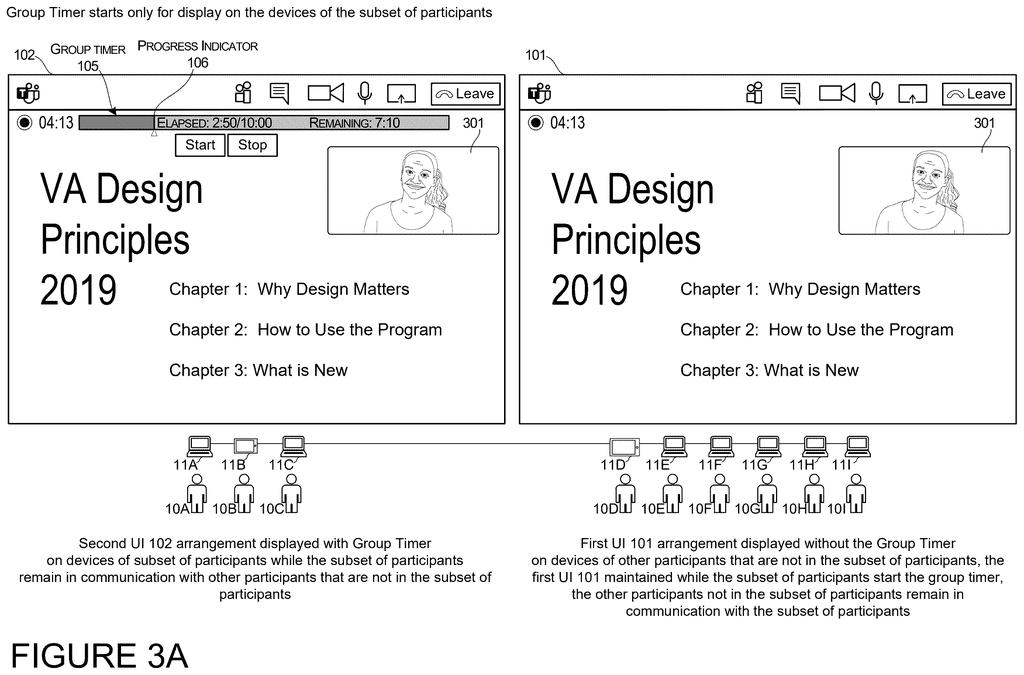
What Microsoft's private meeting timer actually does
Imagine you're in a video call negotiating a deal. Your team needs to know you have ten minutes left before you have to walk away, but you don't want the other side to see that pressure. Right now, you'd have to mute, leave the room, or use a separate device just to keep time privately.
Microsoft's patent describes a system that lets you create a small group inside a larger meeting and share a countdown timer with only that group. Everyone stays on the same call, and everyone can still see and hear each other. The timer just never appears on the screens of people outside your circle.
It's designed for situations like negotiating, presenting, or any meeting where one subgroup needs to coordinate timing without tipping off the rest of the room. The timer is essentially invisible to outsiders, while the subgroup stays fully connected to the larger call.
… the permissions allowing the group timer to be displayed on the devices of the subset of participants, the permissions restricting the group timer from being displayed on the other devices of other participants that are not part of the subset of participants …
Translation: The system ensures the countdown is only visible to the chosen subgroup and hidden from everyone else.
How the meeting object hides the timer from outsiders
The patent describes a "meeting object", essentially a rulebook stored on Microsoft's servers that governs who can see and do what inside a given video call. When a host or participant wants to create a private timer, they select a subset of attendees, and the meeting object is updated with a new layer of permissions specifically for that timer.
Those permissions do two things at once:
- They allow the timer to appear on the screens of the chosen subgroup.
- They block any notification, display, or hint of the timer from reaching participants outside that subgroup.
Critically, the patent specifies that while the timer is running and visible to the subgroup, the video and audio connections between all participants remain intact. The subgroup doesn't get siloed into a breakout room; they stay in the main call while holding a piece of information the others can't see.
The system is also designed so the outside participants receive no indication that a group timer even exists. There's no badge, no notification, no visible UI element that could tip them off.
The group timer is displayed to the subset without providing notifications showing the other users outside the subgroup that the group timer exists, while the subgroup is still sharing content with the others outside the subgroup.
Translation: People outside the secret group get no alerts that a private timer is running while the call continues normally.
What this means for Teams and video negotiation tools
For anyone who uses video calls in high-stakes situations (legal negotiations, sales calls, live presentations, panel Q&As), this solves a genuinely awkward problem. Right now, coordinating a private countdown inside a meeting requires hacks: text messages on a second phone, a hidden stopwatch, a muted side channel. A built-in, permission-controlled timer would make that coordination invisible and reliable.
Microsoft's claim 1 is written broadly enough to cover any online meeting platform using this permission-layer approach, not just Teams. If granted, it could give Microsoft a strong position over competitors building similar coordination tools. The latest Big Tech patents in the video conferencing and workplace software space show companies racing to patent exactly this kind of fine-grained meeting-room control, and this filing lands squarely in that contest.
That makes this Microsoft's 332nd filing in our Microsoft coverage since May, adding to work like building AI training data and naming objects by context.
Claim 1 protects a method, meaning it covers the act of doing something rather than a specific product. That act is creating a permissions object that decides who sees a shared timer during an online meeting, showing it to a chosen subgroup while hiding it from everyone else on the same call. That scope is deliberately wide. Any software that lets a smaller group inside a larger meeting privately share a timed display falls within reach, regardless of whether the product calls it a timer, a countdown, or something else entirely.
The claim requires no particular button, screen layout, or app. If granted, this gives Microsoft legal standing over a broad category of private in-meeting display features built by anyone, including developers who build tools on top of standard video platforms.
The protected act is simple: showing one piece of information to some participants but not others while keeping everyone on the same call.
Get our take in your Top Stories
Liked this breakdown? Add Patentlyze as a preferred source on Google, and our plain-English take shows up more often in your Top Stories the next time Microsoft patent news breaks.
There are more where this came from
We read every patent application Big Tech publishes and send you the ones worth knowing. Plain English, free, every week.
The drawings
27 drawing sheets from US 2026/0252301 A1 · click any drawing to enlarge


Want this weekly breakdown for a company we don't cover? Patentlyze Pro →
Be the first to weigh in