
Microsoft
Microsoft · AI / ML · Filed May 28, 2025 · USPTO published Aug 27, 2026 · Aug 27 release
Microsoft Patents a System That Uses AI to Build Training Data for Other AIs
Training an AI model requires enormous amounts of carefully labeled data, which is expensive and slow to produce by hand. Microsoft has patented a system that lets one AI model generate that labeled data automatically, tailored to whatever task the student model needs to learn.
- Publication number
- US 2026/0252819 A1(US20260252819A1)
- Applicant
- Microsoft Technology Licensing, LLC
- Filed · Published
- May 28, 2025 · Aug 27, 2026
- Inventors
- Jean-François LAVALLÉE
- Status when we published
- Waiting for an examiner
- Document
- 20 claims
- US classification
- 704/9
- Parent application
- Claims priority from a provisional application 63764339 (filed Feb 27, 2025)
How Microsoft's AI trains itself on data it made up
Every time a company wants to build an AI assistant for, say, medical billing or legal document review, someone has to collect thousands of real examples and label each one by hand. That labeling work can take months and cost a fortune before a single line of code is trained.
Microsoft's patent describes a way to skip much of that grind. A "synthesizing" AI model reads a plain-language description of the job the new AI needs to do, then writes its own practice examples from scratch, complete with the correct answers already attached. You describe the task; the system invents the homework.
The clever part is that not everything is left to the AI's imagination. Some labels, the ones that need to be exactly right, are chosen from a fixed, pre-approved list before the AI ever starts writing. The AI then builds realistic examples around those locked-in facts, so the finished dataset is both varied and trustworthy.
… generating a first synthesizing instruction for input to a synthesizing language model based on the one or more first deterministic annotations, a synthesizing instruction template, and a scenario description specifying a task of a specified domain for which the machine learning model is to be trained or evaluated; …
Translation: The system creates custom instructions for an AI model using predefined labels, templates, and specific task details.
How the system mixes fixed rules with AI-written examples
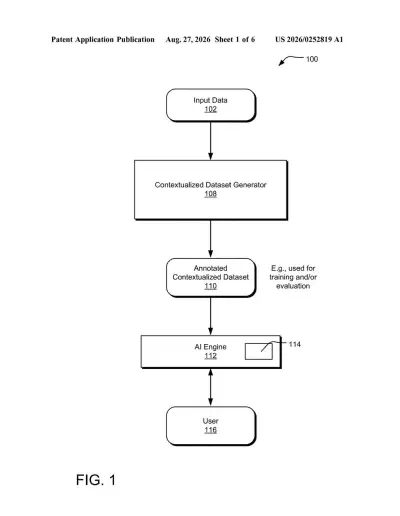
The patent describes a pipeline Microsoft calls a "contextualized dataset generator." It works in four steps:
- Pick the fixed labels first. Some data points have answers that must be exact, like a category code or a numeric score. The system pulls these "deterministic annotations" from a pre-approved candidate pool, filtered by rules that match the data type needed.
- Write the instruction. Those locked-in labels get combined with a template and a plain-language "scenario description" (basically: "train a model to do X in domain Y") to produce a detailed prompt for a second AI.
- Generate the example and the soft labels. The synthesizing language model reads that instruction and writes two things: a realistic input prompt (the kind of text the future model will actually see) and one or more "probabilistic annotations" (softer judgments, like sentiment scores or confidence levels, that the AI estimates rather than calculates exactly).
- Package the datapoint. The fixed labels, the AI-written prompt, and the soft labels are bundled into a single training example and added to the growing dataset.
The loop repeats until the dataset is large enough, with each pass potentially selecting different fixed labels to keep the examples diverse. The result is an annotated dataset built almost entirely by machine, scoped precisely to the task described in the scenario.
The contextualized dataset generator synthesizes a first input prompt and one or more first probabilistic annotations by the synthesizing language model based on the first synthesizing instruction.
Translation: The tool uses an AI model to automatically generate training prompts and predicted answers.
What this means for companies building specialized AI tools
For companies trying to build specialized AI tools, the biggest practical barrier is almost never the model architecture; it's getting enough good training examples in the right domain. A hospital system, a law firm, or a logistics company rarely has tens of thousands of pre-labeled examples sitting around. This patent describes infrastructure that could let a team describe what they want in plain English and receive a ready-to-use training set in return, dramatically cutting the time between "we have an idea" and "we have a working model."
The broader pattern here is that AI companies are increasingly using existing large language models to bootstrap the next generation of smaller, task-focused ones, and Microsoft is filing heavily in this space. You can trace this filing alongside other newest Big Tech patents covering AI training infrastructure, where the race to automate the data pipeline is now just as competitive as the race to improve the models themselves.
This is the 16th Microsoft filing we've tracked in AI training & infrastructure since May, adding to work like one that shrinks and expands models and one using hybrid loss training.
Source: US 2026/0252819 A1 at the USPTO (PDF). Full patent text and figures are in the official publication.
Get our take in your Top Stories
Liked this breakdown? Add Patentlyze as a preferred source on Google, and our plain-English take shows up more often in your Top Stories the next time Microsoft patent news breaks.
Add Patentlyze on Google
One click.
There are more where this came from
We read the new patents from Big Tech, carmakers and more and send you the ones worth knowing. Plain English, free, every week.
The drawings · 6 sheets
6 drawing sheets from US 2026/0252819 A1 · click any drawing to enlarge


More from Microsoft
All 681 Microsoft patents →
More in AI training & infrastructure
All 324 AI training & infrastructure patents →
Adobe
Adobe Patents a Way to Send Human Reviewers Only the Data That Will Trip Them Up
Nvidia
Nvidia Patent Reveals AI Models That Reshape Themselves Mid-Task Based on Chip Power
Google
Google Patents Technology That Sends Each Learning Task to Its Most Qualified AI Specialist
IBM