
Microsoft Patents Seasonal-Aware Cloud Usage Anomaly Detection System
Most cloud anomaly detectors treat a Black Friday traffic spike the same as a suspicious breach. Microsoft's new patent tries to fix that by teaching the system what 'normal' looks like for each time of year — for each individual customer.
How Microsoft's seasonal cloud alerts avoid false alarms
Imagine your cloud bill suddenly doubles in December. Is that a security incident, or just the holiday rush? A dumb alert system can't tell the difference — it just sees a big number and fires off a warning. That's the problem Microsoft is trying to solve.
This patent describes a system that watches how each cloud customer uses resources over time — not just day-to-day, but across repeating seasonal cycles like weeks, months, or quarters. Instead of comparing today's usage to some flat average, it asks: what does this customer's usage normally look like at this specific point in the year?
If your company always spikes in Q4, the system learns that. When Q4 rolls around again and usage climbs, no alarm. But if usage spikes at an unexpected time — say, March — that's when you get the alert. It's the difference between a smoke detector that screams every time you cook bacon versus one smart enough to know you make breakfast every morning.
How the temporal relevance filter builds seasonal baselines
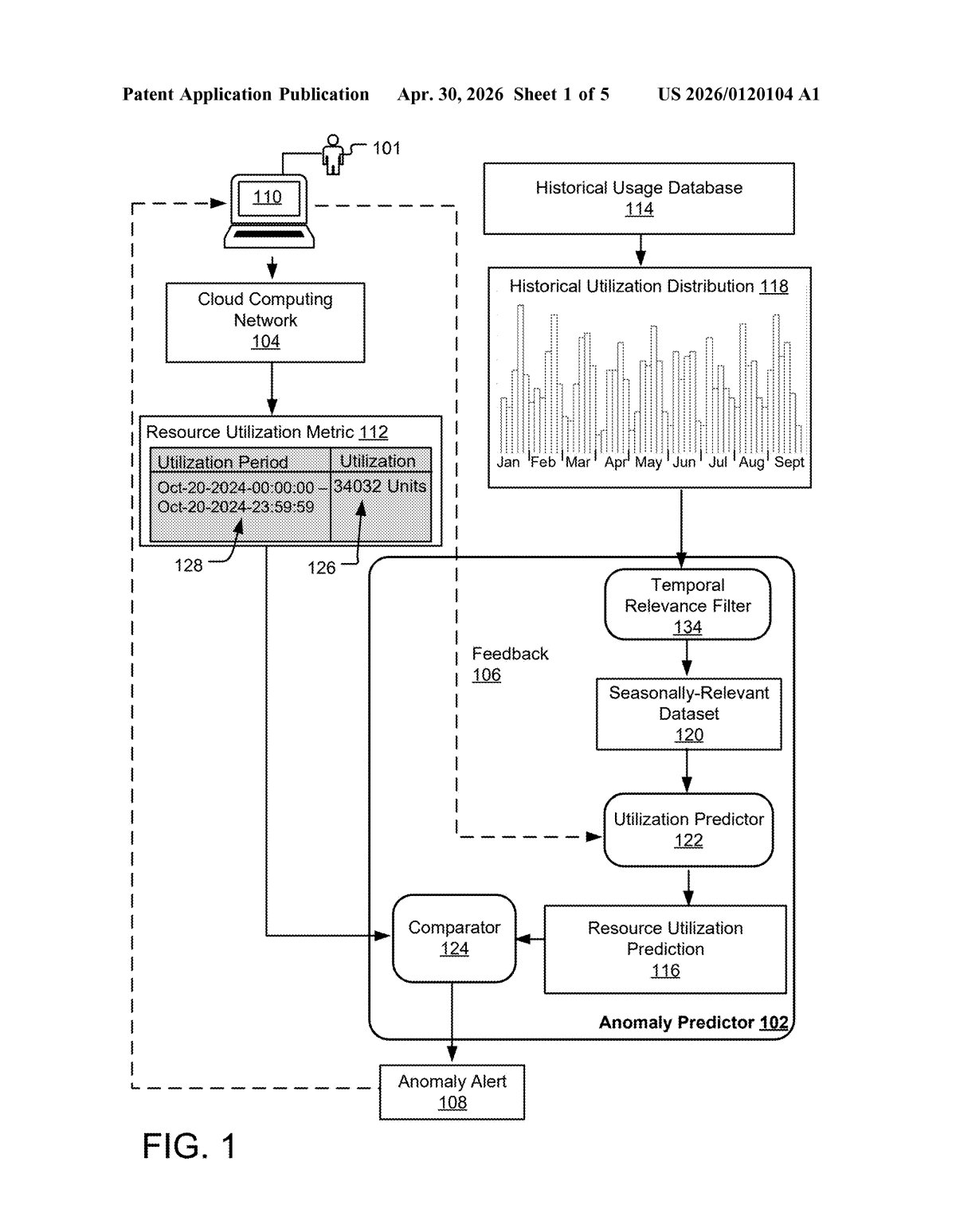
The system builds a historical utilization distribution for each cloud customer — essentially a rich statistical picture of how much compute, storage, or network they've consumed across many past instances of a recurring cycle (weekly, monthly, quarterly, etc.).
When a new monitoring window opens (the anomaly detection period), the system identifies where that window falls within the seasonal cycle — think of it as pinpointing "week 3 of Q4" or "Tuesday of a business week." It then applies a temporal relevance filter to carve out only the historical data points that correspond to that same position in past cycles. You get a tight, seasonally-scoped dataset rather than a noisy blob of all-time history.
From that filtered dataset, a utilization predictor computes an expected usage range for the current period. The actual observed usage is then compared against this prediction. If actual usage satisfies a "predefined relationship" with the prediction — meaning it blows past a threshold or falls unusually short — an anomaly alert is automatically generated.
Key components in the pipeline:
- Seasonal cycle identification — maps each moment to its recurring position in time
- Temporal relevance filter — isolates historically comparable data points
- Utilization predictor — generates a statistically grounded expected value
- Anomaly predictor — compares actuals to predictions and triggers alerts
What this means for Azure cost and security monitoring
For Azure customers, this kind of seasonally-aware detection is the difference between an alert system you trust and one you've learned to ignore. Alert fatigue is a real operational problem — if your monitoring fires every time a predictable pattern plays out, on-call engineers start tuning it out, and real incidents get buried in noise.
From a Microsoft Azure strategy standpoint, this feeds directly into cost management and security tooling. Unexpected usage spikes can mean runaway workloads burning budget, or they can mean a compromised account spinning up crypto miners. A system that understands seasonal context gets better at telling those two scenarios apart — which makes Azure's monitoring tier more competitive against AWS and GCP equivalents.
This is solidly useful infrastructure work, not a flashy AI story. The core idea — filter historical data by seasonal position before computing a baseline — is intuitive and addresses a genuine pain point in cloud ops. It's not a conceptual leap, but it's the kind of quiet improvement that makes enterprise monitoring tools actually worth using.
There are more where this came from
We read every patent application Big Tech publishes and send you the ones worth knowing. Plain English, free, every week.
Want this weekly breakdown for a company we don't cover? Patentlyze Pro →