
Samsung Patents a Display That Shifts Between Mirror and Screen on Demand
Imagine a bathroom mirror that turns into a TV, then goes back to looking like a plain mirror when you walk away. Samsung's new patent describes exactly that kind of display, built from three programmable layers stacked on top of each other.
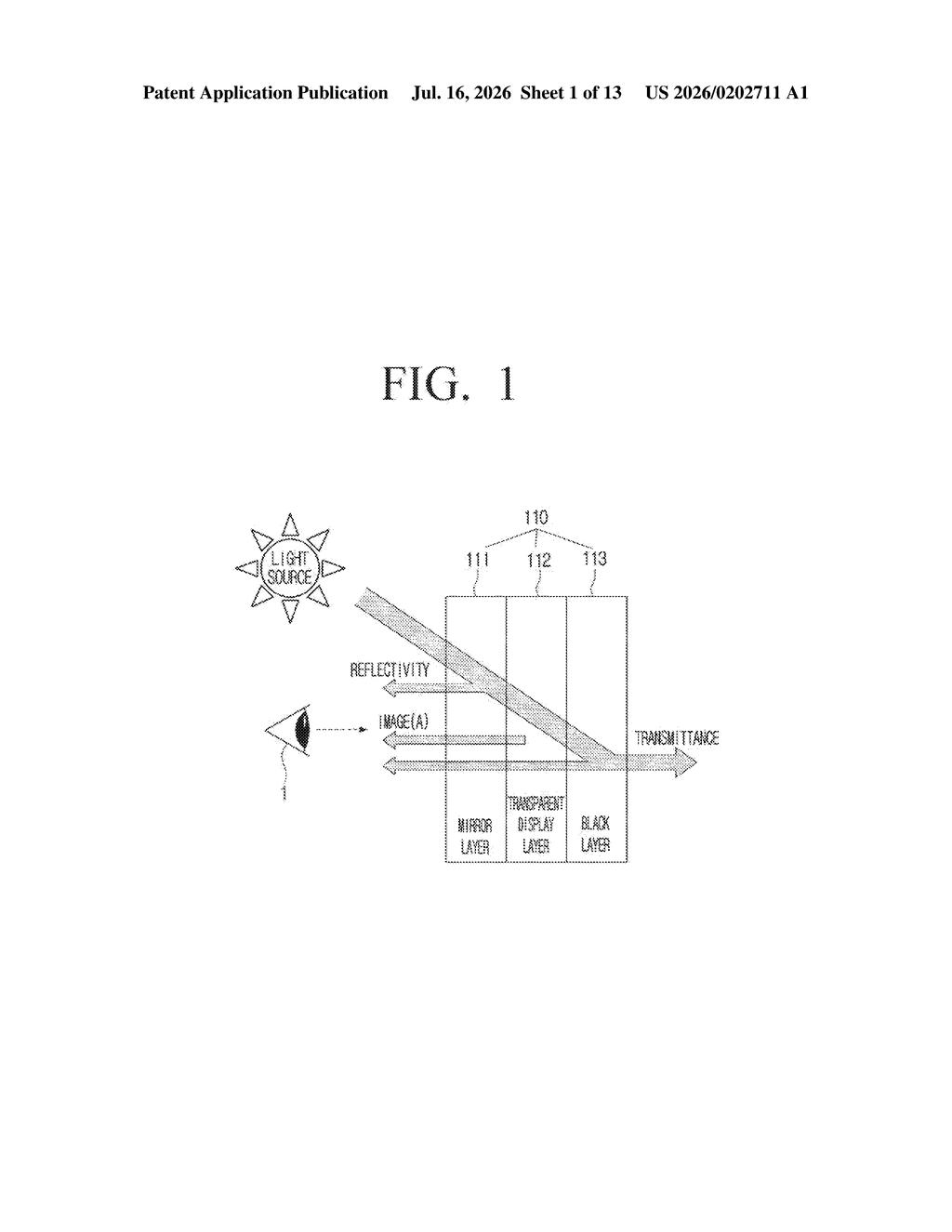
What Samsung's switchable mirror display actually does
Picture a mirror on your wall. Now imagine it can show you the weather, your calendar, or a movie, and then go back to being a perfectly normal mirror when you're done. That's the core idea behind this Samsung patent.
The display is made of three layers working together. A black backing layer can be made more or less see-through. A transparent screen in the middle shows actual images when needed. And a mirror layer on the front can dial its reflectiveness up or down. By adjusting all three at once, the device shifts between different modes.
Depending on what you're doing, the device's processor picks the right combination. Full mirror mode, full screen mode, or something in between, where you can see both a reflection and an image at the same time. Samsung isn't reinventing the display so much as giving one display the ability to behave like several different objects.
How the three stacked layers control light and reflection
The patent describes a mirror display built from three distinct layers, each with a tunable property:
- Black layer (rear): Its transmittance (how much light passes through it) can be adjusted electronically. When it's opaque, it blocks light from behind, making the display look like a solid surface. When it's transparent, light from behind can pass through.
- Transparent display layer (middle): A screen that can render images but is otherwise see-through. This sits in front of the black layer.
- Mirror layer (front): Its reflectivity can be tuned. High reflectivity makes it act like a real mirror; low reflectivity lets you see through to the display beneath.
A processor monitors the device's current operation state (think: idle, active, ambient display, full mirror) and sets each layer's properties accordingly. For a pure mirror state, the mirror layer is fully reflective and the screen is off. For a full display state, the mirror layer becomes less reflective and the screen turns on. Intermediate states let images appear to float in a reflection.
The claim is broad enough to cover many hardware implementations, as long as all three layers are present and software-controlled together.
What this means for smart mirrors and Samsung displays
Smart mirrors have been a concept for years, but most commercial versions are awkward: either a screen with a reflective film glued on top, or a two-way mirror with a display behind it, neither of which looks great in every mode. Samsung's layered approach, where each property is tuned independently by software, is a more flexible architecture that could produce much cleaner transitions between states.
For consumers, this is most relevant if Samsung is planning a mirror-display product for bathrooms, retail spaces, or living rooms. The patent doesn't name a specific product, but Samsung already sells "The Frame" and "The Mirror" display products. A version with this kind of per-layer software control could let one device serve as a full-quality mirror and a full-quality screen, rather than a compromise between the two.
This is a solid engineering patent for a specific display architecture, not a moonshot idea. Samsung has the manufacturing capability to build layered displays like this, and the commercial use case (smart mirrors for home and retail) is real and growing. The interesting question is whether the layer-tuning can be done fast and cleanly enough that switching modes doesn't look jarring in person.
There are more where this came from
We read every patent application Big Tech publishes and send you the ones worth knowing. Plain English, free, every week.
Want this weekly breakdown for a company we don't cover? Patentlyze Pro →
Be the first to weigh in