
Nvidia Patents an AI Method for Turning 3D Scans Into Usable Digital Models
Turning a raw 3D scan of a real object into a clean, usable digital model is one of the messiest problems in computer graphics. Nvidia's new patent describes a machine-learning approach that may make that process significantly more automatic.
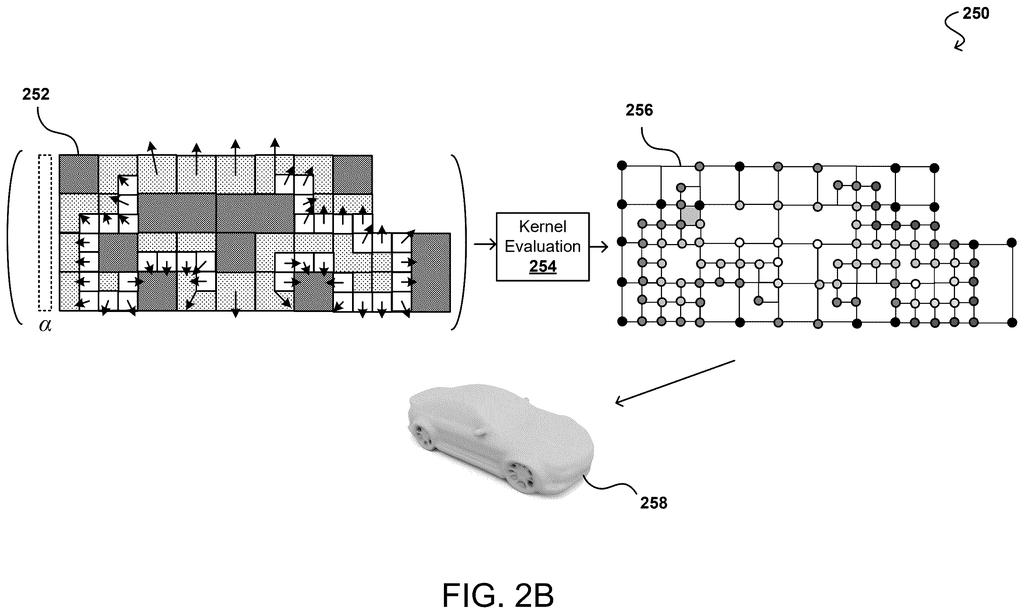
How Nvidia's scan-to-model pipeline actually works
Ever tried to assemble a puzzle with pieces that don't have clear edges? That's roughly what happens when a scanner captures a real-world object: you get thousands of floating dots in space, but no instructions on how to connect them into a solid surface. Software has to guess where the actual surface is.
Nvidia's patent describes a system that feeds those dots into a trained AI model. The model doesn't just connect the dots blindly. It estimates a kind of "density" at every point in space, where high density means you're deep inside the object and zero density means you're right on the surface. By finding all the zero-density locations, the system can trace out the object's skin automatically.
The result is a clean geometric mesh, the kind of 3D model you'd use in a game, a film, or a product simulation, built directly from the scan data with far less manual cleanup. For anyone who works with 3D content, that's a meaningful reduction in tedious repair work.
… mapping individual points of the point cloud representation to voxels of a voxel hierarchy; providing the individual points of the point cloud as input to a density model; receiving, as output of the density model, density functions inferred for the individual points …
Translation: The system organizes raw 3D scan data into a grid and uses AI to calculate the density of the object at every specific point.
How the density model builds a surface from scattered points
The patent describes a pipeline for converting point cloud data (a raw collection of 3D coordinates captured by a physical scanner) into a watertight geometric mesh ready for use in graphics applications.
Here's how the steps chain together:
- Point cloud input: The scan captures the object as a cloud of oriented points, each with a position and a surface-normal direction (a vector showing which way the surface faces at that spot).
- Voxel hierarchy mapping: Those points are organized into a sparse voxel hierarchy, a nested grid structure that zooms in on areas where points actually exist and ignores empty space, keeping computation efficient.
- Density model inference: A trained neural network takes each point as input and outputs a density function for it. Think of a density function as a mathematical description of how "solid" space feels near that point.
- Weighted combination: The individual density functions are blended using learned contribution weights to produce a single smooth 3D density field covering the whole object.
- Mesh extraction: The system finds the locations where the density field equals zero (or near-zero). Those zero-crossings define the object's surface, and a mesh is generated from them.
The zero-level-set approach (finding where a field crosses zero to define a boundary) is a classical technique in geometry processing. What this patent adds is the ML-driven density estimation, which lets the model generalize across different object shapes rather than relying on hand-crafted rules.
The density field can be evaluated to generate a geometric mesh where points having a zero, or near-zero, value are determined to contribute to the surface of the object.
Translation: The software creates a 3D model by identifying the specific points in space that represent the outer skin of the object.
What this means for 3D content creation pipelines
3D scanning is increasingly common in film production, game development, product design, and digital twin creation, but the gap between a raw scan and a production-ready model has always required skilled human intervention. A system that automates the surface-reconstruction step could reduce that bottleneck, letting pipelines ingest real-world geometry faster and at higher volume.
Nvidia sits at the intersection of the hardware (GPUs that run both scanners and renderers) and software (Omniverse, its platform for 3D collaboration) sides of this problem, so a patent in this area fits a clear strategic pattern. Readers who follow how AI is changing creative and industrial workflows will find plain-English patent summaries of 3D reconstruction and simulation filings a useful window into where that toolchain is heading.
Nvidia's 19th filing we've tracked in our text-to-3D characters watchlist since May builds on earlier applications like the sign language avatar one and the motion prediction one.
For anyone who works with large numbers of 3D scans, fixing broken digital shapes by hand before they are ready to use is a slow, expensive routine. A system that learns to read raw scan data and fill in missing surfaces on its own could deliver cleaner results with no human repair step in between.
Studios and engineering teams doing this work at scale would notice fast: jobs finished sooner, fewer files stuck waiting in a backlog.
There are more where this came from
We read every patent application Big Tech publishes and send you the ones worth knowing. Plain English, free, every week.
The drawings
18 drawing sheets from US 2026/0245306 A1 · click any drawing to enlarge


Want this weekly breakdown for a company we don't cover? Patentlyze Pro →
Be the first to weigh in