Nvidia
Nvidia · AI / ML · Filed Feb 18, 2025 · USPTO published Aug 20, 2026 · Aug 20 release
Nvidia Patents an AI That Breaks 3D Objects Into Labeled Parts
Teaching a computer to look at a 3D model of a chair and immediately know which bits are legs, which is the seat, and which is the back turns out to be surprisingly hard. Nvidia's latest patent describes an AI approach that does exactly that, breaking any 3D shape into a tree of labeled pieces.
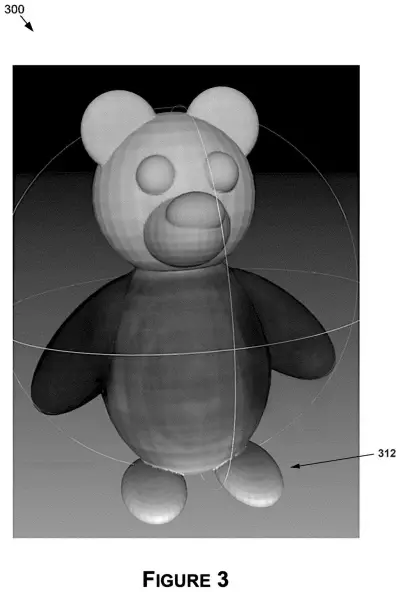
- Publication number
- US 2026/0245300 A1(US20260245300A1)
- Applicant
- NVIDIA Corporation
- Filed · Published
- Feb 18, 2025 · Aug 20, 2026
- Inventors
- Minghua LIU, Tianchang SHEN, Mikaela Angelina UY, Nicholas Mark Worth SHARP, Jun GAO, Sanja FIDLER
- Status when we published
- Waiting for an examiner
- Document
- 20 claims
- US classification
- 345/419
- Examiner
- GUO, XILIN (Art Unit 2616)
What Nvidia's 3D part-labeling system actually does
Imagine you hand someone a 3D scan of a bicycle and ask them to label every part: wheels, frame, handlebars, brakes. A human does it in seconds, but software has historically struggled because 3D shapes are just clouds of points with no built-in labels telling the computer where one part ends and another begins.
Nvidia's patent describes an AI model that reads a 3D object and produces a hierarchy of parts, meaning it doesn't just say "this chunk is a wheel" but also organizes pieces into a logical tree: the wheel contains a rim, spokes, and a tire. Each group is ranked by a score that controls how confident the system is about that grouping.
Once the object is broken into labeled pieces, the system can generate new 3D representations from those individual parts. That opens the door to editing, reassembling, or analyzing objects piece by piece rather than treating the whole shape as one undivided blob.
segment, using at least one machine learning model, a first representation of an object into a plurality of parts according to a hierarchy, wherein the hierarchy indicates groups of datapoints for at least one part of the plurality of parts based on a value …
Translation: The AI breaks a 3D model into smaller, organized pieces by grouping data points based on specific characteristics.
How the hierarchy ranks and groups 3D object parts
The patent describes a pipeline with two main outputs. First, a machine learning model takes a first representation of a 3D object (think a point cloud or a mesh, the raw mathematical description of a shape's surface) and segments it into distinct parts. Second, the system uses those parts to generate a second representation, a new or refined version of the object built from its labeled components.
The key concept is the hierarchy. Rather than a flat list of parts, the system organizes them into a tree structure where some parts are sub-parts of others. A "value" score is attached to each grouping, letting the model express degrees of confidence or granularity (for example, "arm" contains "forearm" contains "hand"). This mirrors how humans naturally think about objects.
This approach is sometimes called part field segmentation, meaning the model learns a continuous field over the object's surface where each point in space gets a score indicating how strongly it belongs to a given part.
Practical uses described or implied include:
- Generating editable 3D assets where each component can be swapped or resized independently
- Training robots to recognize and manipulate specific parts of real-world objects
- Automating the labeling work that 3D artists and dataset builders currently do by hand
The one or more processors generate at least one second representation of the object based on the at least one of the part of the plurality of parts.
Translation: After breaking the object down, the system uses those individual pieces to build a new version of the 3D model.
What this means for robotics and 3D content tools
For anyone building 3D content pipelines, from game studios to robotics labs, the bottleneck is often labeling: a human has to sit down and manually tag which polygon belongs to which part before any downstream AI can use the data. A system that automates that hierarchical labeling at scale could cut weeks of work from a production cycle and make large labeled 3D datasets far cheaper to create.
On the robotics side, a robot that understands an object's part structure can make much more targeted decisions, grasping a door handle rather than the whole door, or tightening one bolt without disturbing the rest of the assembly. Nvidia sits at the intersection of GPU hardware, simulation software, and robotics tooling, so a filing in 3D perception fits naturally into that broader strategy. Readers who follow new Big Tech patents in 3D AI and robotics perception will recognize this as part of a wider push to give machines finer-grained spatial understanding of the physical world.
Nvidia's 27th filing we've tracked since May in our robot grasping and movement watchlist follows an AI grading system and object orientation detection.
Source: US 2026/0245300 A1 at the USPTO (PDF). Full patent text and figures are in the official publication.
Get our take in your Top Stories
Liked this breakdown? Add Patentlyze as a preferred source on Google, and our plain-English take shows up more often in your Top Stories the next time Nvidia patent news breaks.
Add Patentlyze on Google
One click.
There are more where this came from
We read the new patents from Big Tech, carmakers and more and send you the ones worth knowing. Plain English, free, every week.
The drawings · 14 sheets
14 drawing sheets from US 2026/0245300 A1 · click any drawing to enlarge


Show the other 6 sheets


More from Nvidia
All 665 Nvidia patents →
More in AI simulation
All 193 AI simulation patents →
Adobe
Adobe Patents a Text-to-3D System That Lets You Edit Objects by Describing Changes
Adobe
Adobe Patents an AI System That Compresses 3D Scenes for Faster Editing
Microsoft
Microsoft Patents a System That Runs Robot Missions in Simulation Before the Real Thing
Adobe