
Nvidia Patents a Cloud System That Puts AI-Generated Likenesses Under Lock and Key
Nvidia has filed a patent for a cloud-based gatekeeper that decides who can instruct an AI to generate images or video using a real person's likeness, and then does the generating inside a locked, tamper-resistant environment.
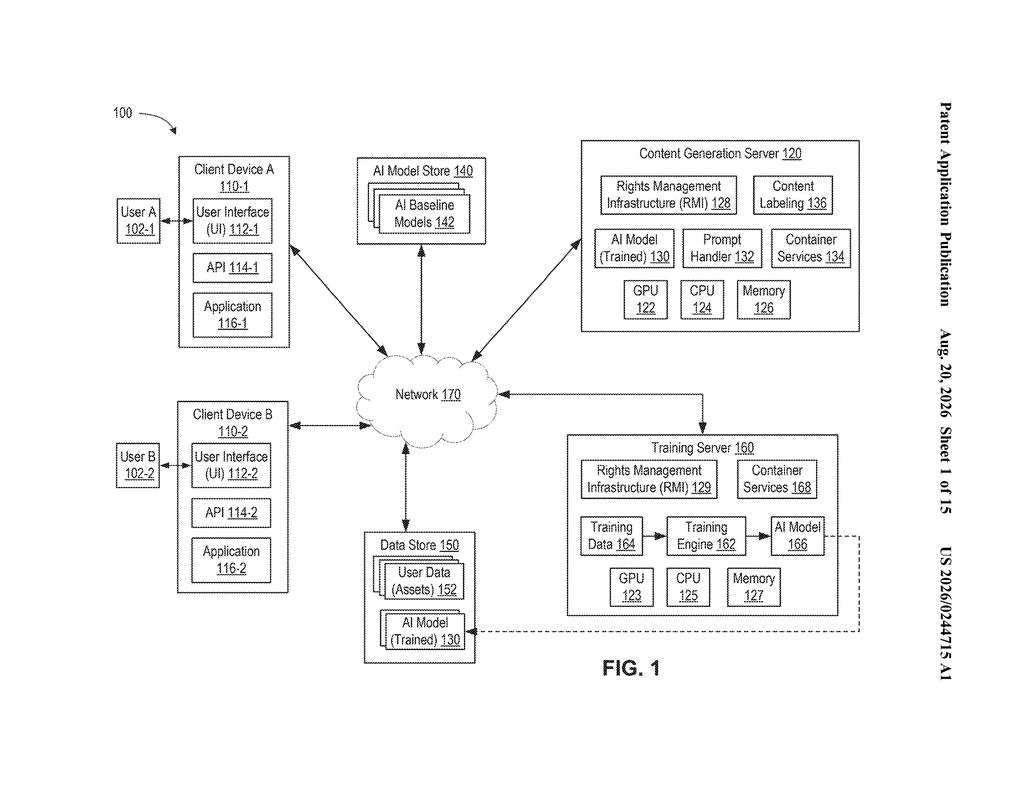
How Nvidia's likeness protection system actually works
Every time an AI image tool creates a realistic face, it's drawing on data that looks a lot like a person's appearance. Right now, there's little stopping someone from feeding in a celebrity's name or a private individual's description and getting back a convincing fake photo or video of that person.
Nvidia's patent describes a system that would change that. Before any AI can generate content using a protected likeness (think: a real person's face, voice, or appearance), a cloud server first checks whether the person making the request actually has permission to use that likeness. If they don't, the request is refused before the AI even starts.
If the check passes, the actual generation happens inside a secure container, a walled-off computing environment where the likeness data can be used but can't easily be extracted or misused. The finished image or video is then delivered or stored according to whoever owns those permissions. It's essentially a rights-management layer built directly into the AI pipeline.
… loading, into a secure execution container, one or more generative media content models and a representation of the likeness data; processing, in the secure execution container and using the representation of the likeness data and the one or more generative media content models, the prompt to generate the media content …
Translation: The system creates AI content inside a protected digital vault that keeps the sensitive likeness data hidden from outsiders.
Inside Nvidia's secure container for AI likeness data
The patent describes a cloud-server architecture with three main stages.
First, authentication: When a user sends a prompt asking for media featuring a protected person or object, the cloud server checks whether that user (or the app they're using) has been granted rights to use the associated likeness data. Likeness data here means a mathematical representation of someone's appearance, voice, or other identifying traits, the kind of data modern generative AI uses to reproduce a specific person.
Second, secure execution: If access is approved, the generative AI model and a representation of the likeness data are loaded into a secure execution container (think of it as a locked room inside the server, isolated from the rest of the machine). The actual image, video, or audio generation happens entirely inside that container, so the raw likeness data is never exposed to outside software or users.
- The model and likeness data are loaded together into the isolated environment.
- The prompt is processed only inside that environment.
- The output is released or stored only according to predefined instructions tied to the original permission grant.
Third, delivery: The finished media is sent back to the requester or stored somewhere specified by the rights holder, with the secure container closed after each session. The patent covers both training AI models on protected likenesses and deploying those models to answer real-time requests.
Disclosed are apparatuses, systems, and techniques for trusted training and deployment of artificial intelligence (AI) for generating media content that uses likeness to natural persons and other protected objects.
Translation: Nvidia is patenting a secure way to use AI to create digital versions of real people and other restricted subjects.
What this means for AI-generated images of real people
Deepfakes and unauthorized AI likenesses are already a legal and reputational problem, and the tools to create them keep getting cheaper and faster. A system like this would give rights holders (celebrities, athletes, companies, ordinary people who opt in) a technical mechanism to enforce consent, not just a legal one. That matters because lawsuits happen after the damage; this approach tries to prevent the unauthorized output from existing in the first place.
For Nvidia, whose GPUs power most of the AI generation industry, building this kind of access-control layer into a cloud service would position the company as infrastructure for a rights-respecting AI ecosystem. It's a way to address regulatory and PR pressure around generative AI without waiting for legislation to catch up. This patent sits inside a broader wave of Big Tech patent news around AI content governance, where companies are racing to show they have technical guardrails, not just policy promises.
Nvidia's fourth filing in AI safety guardrails since July follows its work on filtering prompts before models see them and weighted panels of AI judges, the three we've tracked so far.
The system described runs almost entirely on existing software and standard server hardware already sitting in data centers. No new chips or laboratory breakthroughs are needed.
The real work is connecting identity checks, AI model loading, and private data processing into one smooth pipeline. That is a big job, but it is an engineering job, not a waiting-for-invention job.
The document itself points to the same conclusion: a real service built this way could launch soon.
There are more where this came from
We read every patent application Big Tech publishes and send you the ones worth knowing. Plain English, free, every week.
The drawings
15 drawing sheets from US 2026/0244715 A1 · click any drawing to enlarge


Want this weekly breakdown for a company we don't cover? Patentlyze Pro →
Be the first to weigh in