
Adobe Patents a Second-Pass AI That Cleans Up Messy Edges in Photo Edits
Every AI photo editor has a dirty secret: the spot where a removed object used to be often looks slightly wrong at the edges. Adobe's new patent describes a dedicated cleanup layer that runs after the main edit, trained specifically to spot and fix those telltale seams.
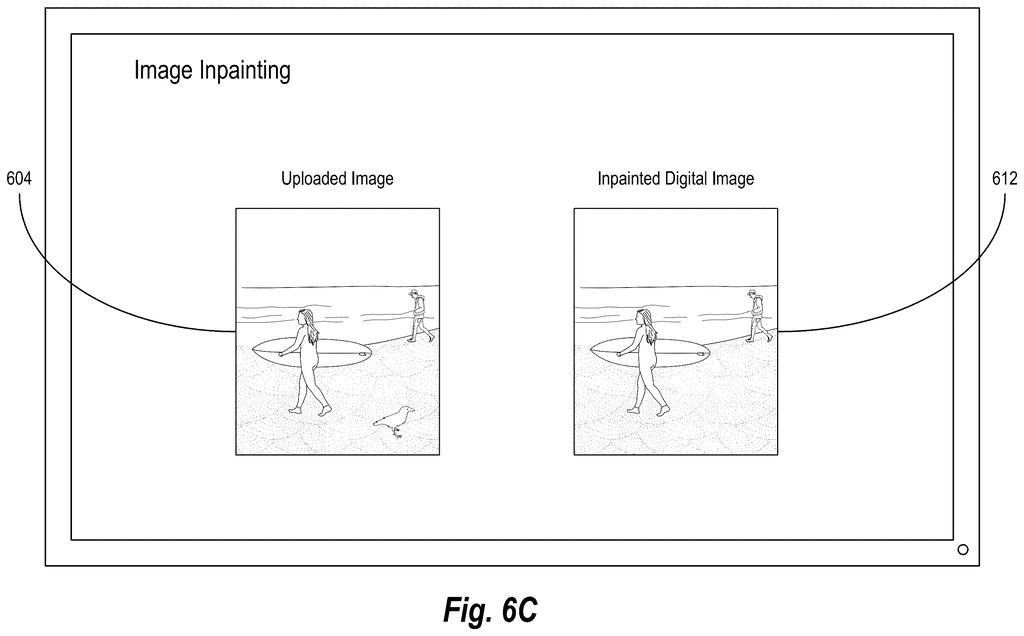
What Adobe's inpainting edge-fix actually does
You're editing a photo in Photoshop, you paint over a person you want removed, and the AI fills the gap beautifully. But right at the border where the new pixels meet the old ones, something looks slightly off. Maybe there's a faint halo, a color shift, or a texture that doesn't quite match. That edge problem is so common it has a name: an inpainting artifact.
Adobe's patent describes a two-step fix. First, a standard AI fills in the selected area (this part already exists in tools like Generative Fill). Then a second AI model, which Adobe calls a refiner, takes the whole image and focuses specifically on those border zones, correcting whatever the first model got wrong.
Think of it like a painter doing a rough coat first, then a careful second pass just along the trim. The refiner is trained to know what a convincing edge should look like, so it can spot the subtle problems a human might not notice until they zoom in.
… generating, utilizing a neural network-based refiner model, a refined digital image that corrects artifacts around borders of the one or more inpainted portions in the modified digital image.
Translation: The software uses a second AI model to smooth out the rough edges where the new content meets the original photo.
How the refiner model hunts and fixes border artifacts
The system works in two distinct stages, each handled by a different AI model.
Stage one is standard generative inpainting: you select a region of the image (using a mask, basically a digital stencil), and a generative model fills it in with plausible pixels. This is the AI content generation step that tools like Adobe Firefly already perform.
Stage two is where this patent's contribution lives. A separate neural network-based refiner model receives the completed image and targets the areas around the borders of the newly filled region. The refiner is trained to recognize artifact patterns (subtle color banding, texture mismatches, sharpness discontinuities) that tend to appear where AI-generated pixels meet original pixels. It then generates a refined digital image that corrects those problems.
The key architectural decision is keeping these two models separate. The refiner doesn't try to redo the fill, it only corrects the edges. That specialization matters because the failure modes at borders are different from the failure modes in the middle of a fill, and training one model to handle both well is harder than training two focused models.
- Input: original image plus user-drawn mask
- Step 1: generative model fills the masked region
- Step 2: refiner model corrects border artifacts in the full image
- Output: a refined image with cleaner transitions
The present disclosure relates to systems, methods, and non-transitory computer-readable media that generates a refined digital image that corrects inpainting artifacts in a modified digital image with inpainted pixels.
Translation: This technology describes a way to automatically fix the messy pixels that often appear after using AI to fill in an image.
What this means for AI photo editing in Photoshop
For anyone who uses AI photo editing tools regularly, edge artifacts are the most common reason an edit looks fake rather than natural. You can remove a car from a street scene and the sky fills in perfectly, but a slight shimmer along where the car's roof used to be gives the whole thing away. A dedicated cleanup model that runs automatically after every fill would remove one of the most visible weaknesses in modern generative editing tools.
Adobe's Photoshop and Firefly are already the dominant platforms for this kind of work, so a patent in this area fits directly into their product roadmap. The approach described here, a specialized second model rather than a bigger single model, is also an architecture worth watching because it suggests Adobe is thinking about quality control as a modular problem. For anyone following how AI image tools are maturing, this filing sits alongside a broader wave of Big Tech patent news around AI image quality and post-generation refinement that shows companies moving from "can it generate?" to "can it generate cleanly?"
This is the 28th Adobe filing we've tracked in the photo editing AI race since May, building on earlier ideas like 3D scene compression and two-level material selection.
Edge artifacts in AI image fills cost professional designers real time. When a tool removes an object from a photo and leaves a visible seam along the border of the replacement area, that flaw travels into every downstream step: client reviews, print production, large-format output. The problem scales with ambition.
The more a designer relies on AI fills for complex work, the more often those border flaws compound, and the more invisible labor gets spent on corrections that should not be necessary. Adobe's answer is a dedicated second model trained specifically to clean up what the fill model leaves behind.
Whether a model trained on manufactured examples of edge problems holds up against the full variety of real images is the honest open question, but the problem it addresses is real, recurring, and expensive enough that even a partial solution earns its place.
Get our take in your Top Stories
Liked this breakdown? Add Patentlyze as a preferred source on Google, and our plain-English take shows up more often in your Top Stories the next time Adobe patent news breaks.
There are more where this came from
We read every patent application Big Tech publishes and send you the ones worth knowing. Plain English, free, every week.
The drawings
18 drawing sheets from US 2026/0253186 A1 · click any drawing to enlarge


Want this weekly breakdown for a company we don't cover? Patentlyze Pro →
Be the first to weigh in