
Nvidia Files Patent to Shrink Large AI Language Models Without Breaking Them
Giant AI language models are expensive to run, and Nvidia's new patent application describes a way to cut them down without scrambling the layers that read text in order.
What Nvidia's model-trimming patent actually does
Imagine you've packed a suitcase for a week away, and the airline says it will only take half the weight. You can't toss things at random, because if you leave behind your charger, the whole trip gets harder.
Nvidia's patent application tackles that problem for AI language models, the software behind chatbots. Many newer ones mix two designs: one that connects far-apart ideas in a long text, and one, called a state space model, that reads text in order using a small, fixed amount of memory. They are still enormous, and the filing says trimming this mix is largely unexplored.
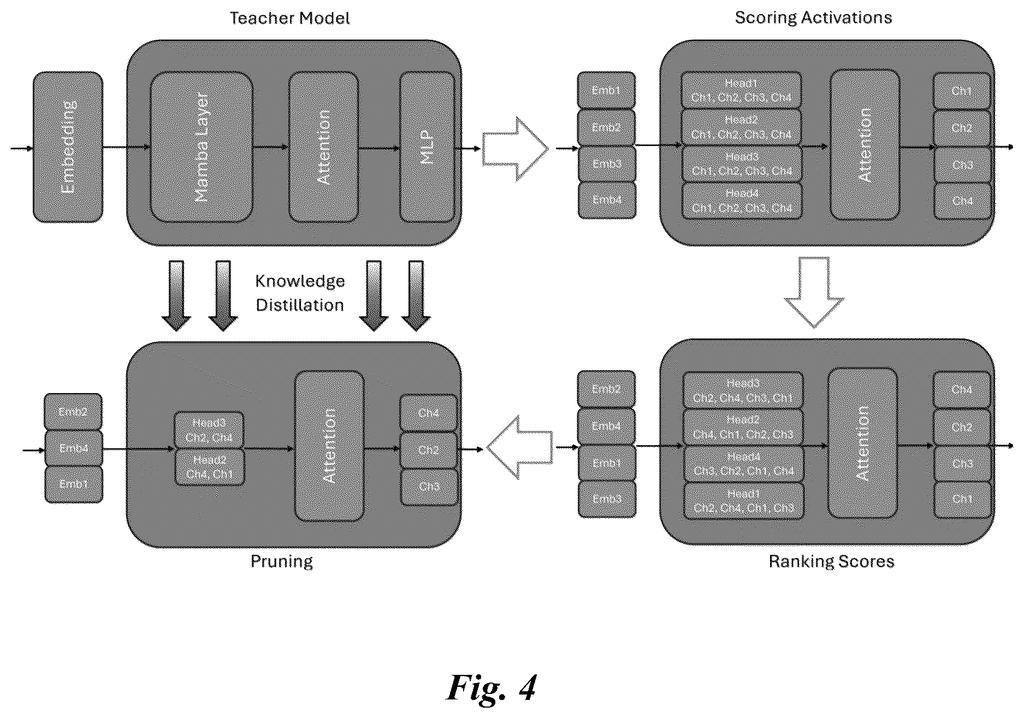
The catch is that parts of the memory-style design work in teams, so cutting one member carelessly can break the group. Nvidia's method scores each piece, removes the weakest ones team by team, then retrains the smaller model with the original acting as its tutor.
performing group-aware pruning of a non-permutation equivariant layer of a pretrained neural network to generate a compressed neural network …
Translation: Trimming specific parts of a pre-trained AI network to make it smaller while keeping it functional.
How Nvidia decides which pieces to cut and keep
The filing covers a way to shrink a pretrained neural network by applying group-aware pruning to a layer that is non-permutation equivariant (a mouthful meaning that shuffling the order of its parts changes what it computes). The main example is a state space model layer such as Mamba, inside a hybrid language model.
In the described pipeline, the system first scores parts of the model using only forward passes (feeding data through and measuring how strongly each part activates, with no retraining needed). Then it:
- Ranks channels with one shared ranking, so a channel is kept or cut across every head at once;
- Ranks heads (the layer's parallel working units) only within their own group, keeping a target number per group;
- Trims the matching rows and columns out of the layer's weight matrices.
Other layers, such as feed-forward neurons and embedding channels, are pruned in the same pass without the group rule. Afterward, knowledge distillation (the original model acts as teacher for the smaller one) recovers lost accuracy, using a forward Kullback-Leibler divergence loss, a score for how far the student's word predictions drift from the teacher's.
The filing also describes a variant that ranks parts by how much their activity varies, weighted by the size of their weights.
This motivates the need for efficiently creating smaller (i.e. compressing) hybrid language models suitable for deployment in various resource-constrained environments.
Translation: This creates a need to shrink massive AI models so they can run smoothly on ordinary devices.
Why smaller hybrid models matter for your devices
If this works as described, you could end up with language models that fit in less memory and answer faster. That matters most where computers are limited: phones, laptops, and servers that charge by the hour. The filing says the group-aware approach delivers better accuracy and speed than pruning that ignores group structure.
For Nvidia, which sells the chips most of these models run on, smaller models are a way to serve customers who can't afford giant ones. The application is general, too: the description says the idea can apply to other pretrained networks with this kind of layer, not just chatbots.
Nvidia's 54th filing we've tracked since July in our AI chip wars watchlist follows one stacking chip on memory and one merging AI steps, each pushing toward faster, leaner AI processing.
Every cut costs something. The filing admits that trimming loses accuracy, so the smaller model needs extra training with the original as its tutor, which takes time and computing power.
The group rule adds a second cost: heads can only be ranked within their own group, so each group must keep its target count even if one of its members is weaker than a member elsewhere. That rigidity protects the layer's wiring, and since scrambling that wiring changes what the layer computes, the trade looks worth it.
The claims are broad and the description gives no accuracy or speed numbers, so the benefit is a promise on paper for now. Protecting the groups still looks like a cheap price for keeping a trimmed model working.
Get our take in your Top Stories
Liked this breakdown? Add Patentlyze as a preferred source on Google, and our plain-English take shows up more often in your Top Stories the next time Nvidia patent news breaks.
There are more where this came from
We read every patent application Big Tech publishes and send you the ones worth knowing. Plain English, free, every week.
The drawings
10 drawing sheets from US 2026/0330225 A1 · click any drawing to enlarge


Show the other 2 sheets


Want this weekly breakdown for a company we don't cover? Patentlyze Pro →
Be the first to weigh in