
Nvidia Patents a Compiler That Skips Unnecessary AI Math at Runtime
Every time a modern AI model processes text or images, it runs a massive grid of calculations called an attention matrix. Nvidia's new patent is about teaching a compiler to figure out, before those calculations even run, which parts of that grid can be skipped entirely.
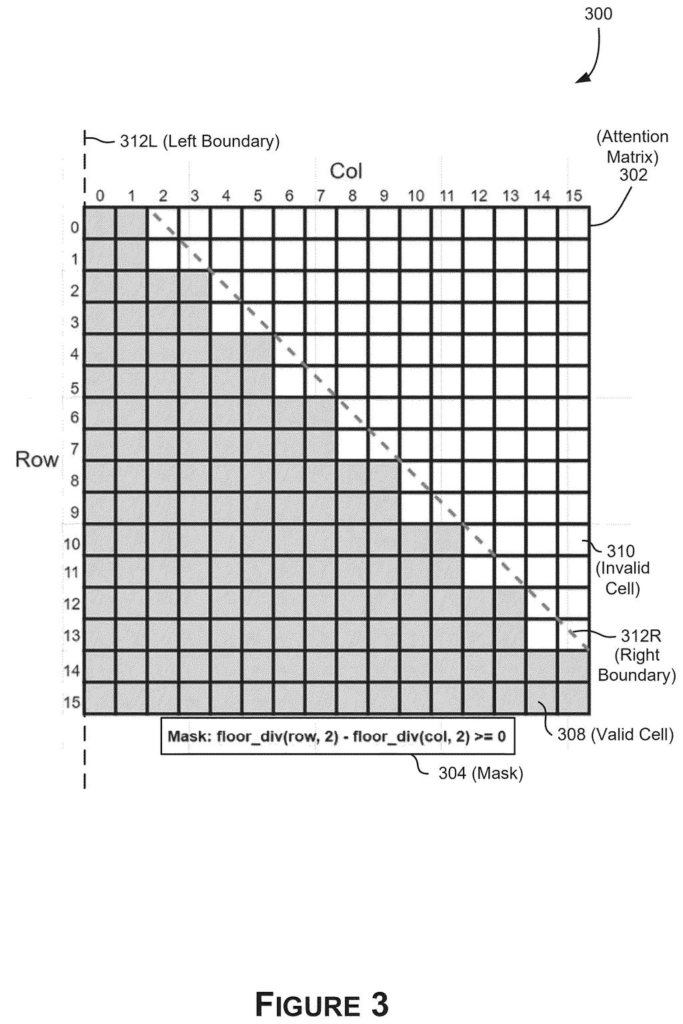
What Nvidia's attention-skipping compiler actually does
Running an AI model is expensive. A big chunk of that cost comes from something called the attention mechanism, which is how models like the ones behind chatbots figure out which words or pixels relate to each other. That process builds a huge grid of numbers, but many of those grid cells are intentionally blocked out by a "mask" (a rule that says "ignore this part"). The problem: most systems still do the math for those cells and then throw the answer away.
What Nvidia's patent proposes is a compiler (a program that translates code before it runs) that reads the masking rules, works out the exact boundaries of the blocked-out regions, and then writes the final program so those regions are simply never calculated. No wasted math, no wasted time.
The practical result is that the chip does less work for the same output. That can mean faster AI responses or the ability to run larger models without buying more hardware.
… skip computation of one or more masked values in one or more masked portions of at least one data structure representing one or more attention matrices that are masked by a mask predicate …
Translation: The system avoids calculating parts of AI attention matrices that are hidden by a mask.
How the compiler derives bounds and skips masked tiles
The attention mechanism inside AI models operates on a large 2D grid called an attention matrix. Developers apply masks (rules that mark certain cells as irrelevant, for example blocking out future words in a language model) to this grid. Normally, even masked cells go through the full computation pipeline before being discarded.
Nvidia's patent describes a compiler-level solution that analyzes the mask rules before the program ever runs. The compiler:
- Reads the mask predicate (the mathematical rule defining which cells are blocked)
- Derives a set of boundary expressions that describe where the masked region starts and ends
- Generates left and right bounding functions (formulas that return the first and last unmasked column for any given row)
- Rewrites the final executable instructions so the GPU loops only over unmasked regions, skipping entire tiles (rectangular sub-blocks of the matrix) when they fall entirely inside the masked zone
The system is designed to handle arbitrary and user-defined masks, not just the simple triangular masks common in standard language models. That flexibility means the optimization can apply to a wide range of model architectures and attention patterns without requiring the developer to hand-code the skipping logic themselves.
… analyze arbitrary and/or user-defined masks, and to generate bounding functions that may be used by an executing kernel to identify which tiles of an attention matrix can be skipped at runtime …
Translation: The compiler evaluates custom masks so the processor knows which data blocks to ignore while running.
What faster AI attention math means for GPU workloads
For anyone using an AI product, the payoff from work like this is shorter wait times and lower costs. Attention matrices are at the core of almost every large AI model in use today, so an optimization that cuts redundant math at that level can compound across every single request a model handles. You might not notice it as a sudden leap in quality, but it's the kind of efficiency gain that lets a company serve more users on the same hardware or run a bigger model for the same price.
Nvidia's ongoing push into AI compiler tooling reflects the company's awareness that raw chip speed matters less if the software layer is wasting cycles. For AI teams running large workloads, a compiler that automatically eliminates dead computation is a meaningful reduction in operational cost, even if it never ships as a feature with a marketing name.
That makes this Nvidia's 36th filing we've tracked since July in our AI chip wars watch, joining one on watching dozens of processors and one on a power-saving math shortcut.
The practical difference lands in moments most people already notice: a chatbot that responds before you've finished reading your own question, or an image generator that stops failing halfway through a request. This filing is about making the math behind AI faster by teaching the software to skip calculations that don't affect the final answer.
What makes it useful beyond the obvious speed gain is that it works regardless of how a developer has structured their AI model. A developer building something unusual doesn't have to write special shortcuts by hand; the compiler figures out what can be skipped automatically.
Faster responses and fewer timeouts are the whole story for anyone using a product built on this. The optimization stays invisible, which is exactly how it should work.
Get our take in your Top Stories
Liked this breakdown? Add Patentlyze as a preferred source on Google, and our plain-English take shows up more often in your Top Stories the next time Nvidia patent news breaks.
There are more where this came from
We read every patent application Big Tech publishes and send you the ones worth knowing. Plain English, free, every week.
The drawings
13 drawing sheets from US 2026/0259730 A1 · click any drawing to enlarge


Show the other 5 sheets


Want this weekly breakdown for a company we don't cover? Patentlyze Pro →
Be the first to weigh in