
Qualcomm Patents an Image Upscaling Method That Keeps Edges from Going Blurry
When a graphics chip blows up a low-resolution image to fill a bigger screen, fine details tend to smear. Qualcomm's new patent describes a way to keep those edges crisp by being smarter about which nearby pixels to trust.
What Qualcomm's sharpness-aware upscaling actually does
Imagine taking a small photo and dragging one corner to make it twice as big. The computer has to invent pixels that weren't there, and if it guesses wrong, text looks fuzzy and sharp lines go soft. That's the everyday problem with image upscaling.
Qualcomm's patent describes a method that gives each invented pixel a more careful recipe. Instead of just asking "how far away is each neighboring pixel?" (the traditional approach), it also asks "how similar is that neighbor's brightness to the average brightness nearby?" Pixels that are both close in distance and close in brightness get more say in what the new pixel looks like.
The result is that thin lines, text, and texture details survive the enlargement process instead of blurring together. This kind of work is most valuable in mobile chips and embedded graphics, where you often render at a lower resolution to save battery and then scale up before the image hits the screen.
How the algorithm weighs distance and brightness together
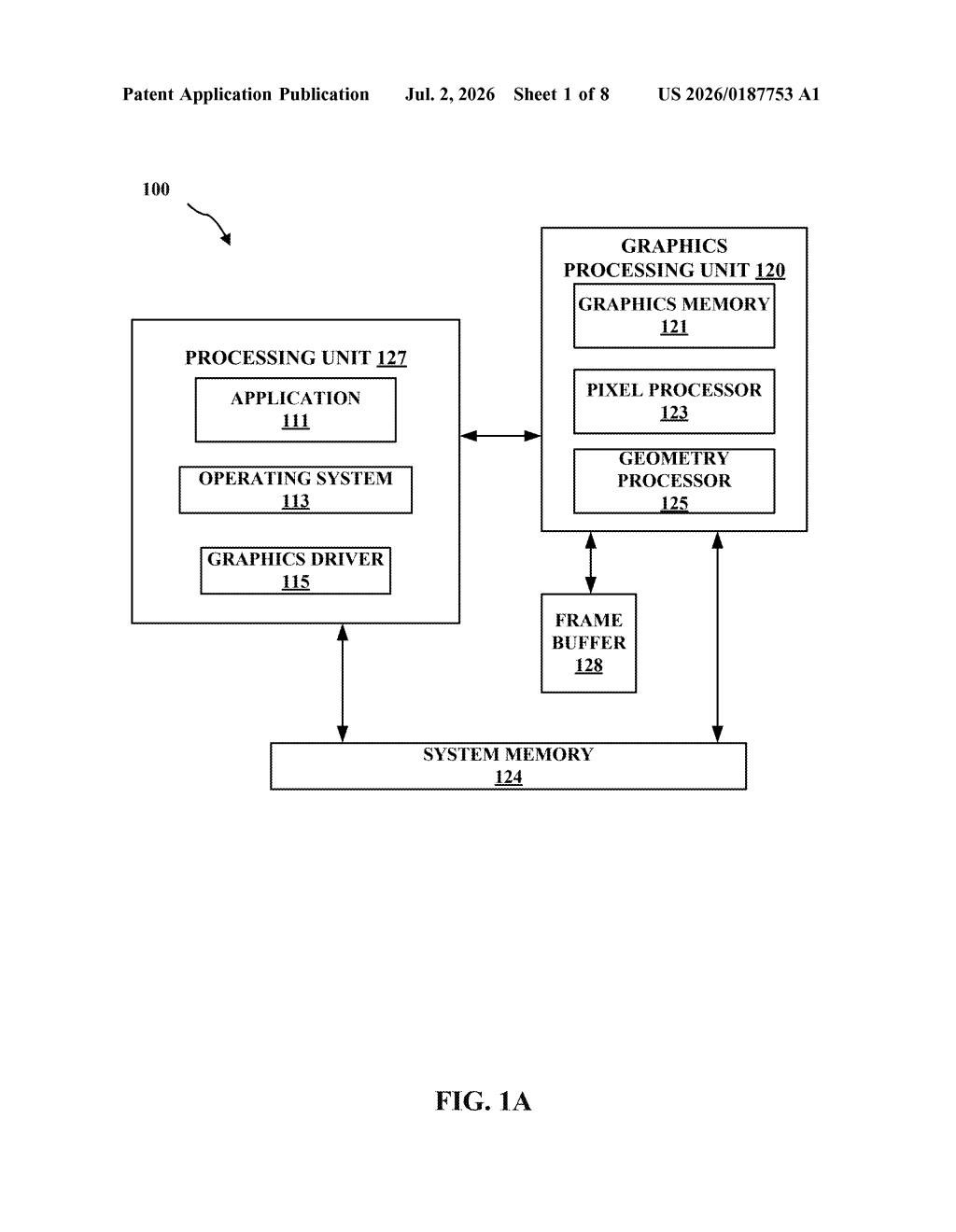
The patent describes a spatial upscaling algorithm designed to run on a graphics processing unit (GPU) during image rendering. When the system needs to create a new pixel that sits between existing pixels (called interpolation), it consults a neighborhood of surrounding pixels from the original lower-resolution image.
Traditional bilinear interpolation (the standard method used in most GPUs) weights neighboring pixels purely by distance: the closer a neighbor, the more it influences the new pixel's color. Qualcomm's method adds a second factor: intensity difference, meaning how much a neighbor's brightness (or color value) diverges from the local average brightness of the surrounding group.
The combined weight formula works like this:
- Neighbors that are physically close and have similar brightness to the local average get high weight.
- Neighbors that are far away or have very different brightness (for example, a bright pixel right next to a dark edge) get lower weight.
- The new pixel's final color is a blend of all neighbors, weighted by those scores.
The intensity-comparison step is what prevents edge pixels from bleeding across a boundary. By down-weighting outlier neighbors, the algorithm avoids averaging a bright value and a dark value into a muddy middle tone, which is exactly what causes the blurring effect in older methods.
What this means for mobile gaming and GPU rendering
Qualcomm makes the Snapdragon chips inside most Android phones, and those chips constantly face a trade-off: render at lower resolution to save power, then scale up before display. Better upscaling means you can push that trade-off further, getting more battery life or frame rate without sacrificing visual quality. For mobile gaming specifically, this kind of on-chip upscaling is a direct competitor to techniques like AMD's FSR or Nvidia's DLSS, which are built for desktop GPUs.
For everyday users, the visible difference would show up in sharpness of UI text, fine textures in games, and the crispness of video frames during fast motion. The patent applies at the hardware rendering level, so it could benefit any app that uses the GPU without developers having to change their code.
This is solid, unglamorous graphics engineering. Upscaling quality is a real battleground in mobile chips right now, and an algorithm that keeps edges sharp without requiring a neural network (which costs power) is genuinely useful. It's not a headline product, but it's exactly the kind of low-level work that separates a good display experience from a great one.
Get our take in your Top Stories
Liked this breakdown? Add Patentlyze as a preferred source on Google, and our plain-English take shows up more often in your Top Stories the next time Qualcomm patent news breaks.
There are more where this came from
We read every patent application Big Tech publishes and send you the ones worth knowing. Plain English, free, every week.
Want this weekly breakdown for a company we don't cover? Patentlyze Pro →