
Nvidia Files Patent to Pick the Right Lane Without Detailed Self-Driving Maps
Your phone's navigation app already says things like 'keep right to merge onto I-90 East.' Nvidia's new patent describes a car that takes that same advice and moves into the right lane by itself.
What Nvidia's lane-picking patent actually does
Many self-driving systems find their way by matching what the cameras see against an extremely detailed map, and those maps are costly to build and missing for plenty of roads. The ordinary map in your phone is a different story: it knows the route, but often not which lane you should be in.
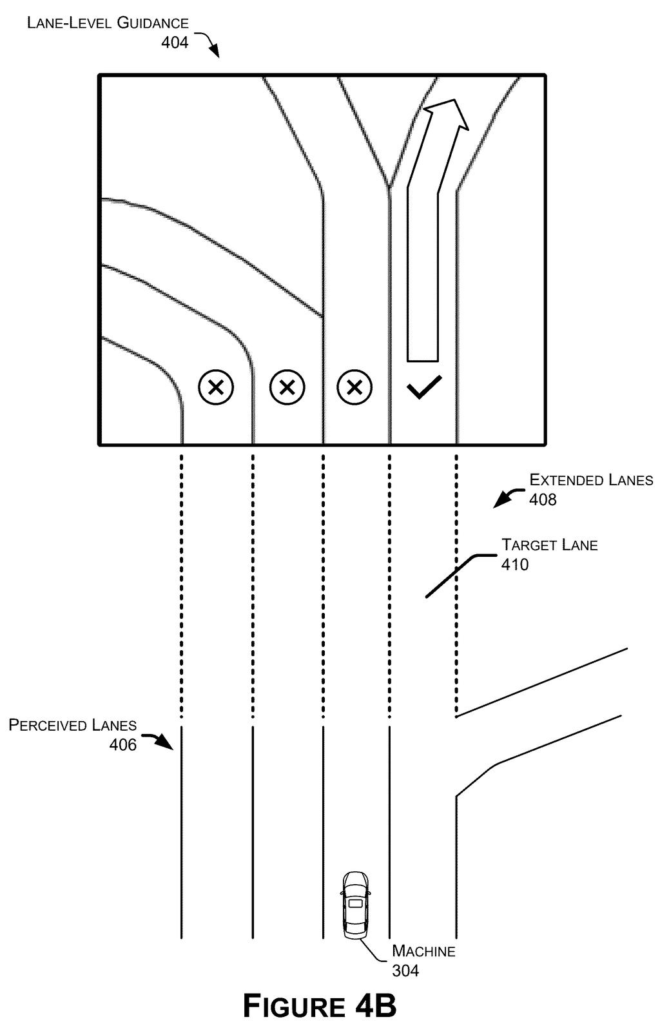
Nvidia's filing tries to close that gap. Say your navigation app announces, 'in one mile, use the right-most lane to merge onto I-90 East.' The car's sensors spot the painted lanes around it, work out which one it's in, and steer over on its own.
When the map or the directions are vague, the system falls back on simple road habits, like starting a right turn from the right lane. The idea is a car that still picks a sensible lane with whatever information it has.
determining, based at least on map data representing a navigation map and perception data representing at least one or more perceived lanes of a driving surface, one or more locations of a machine with respect to one or more lanes of one or more roads of the navigation map; …
Translation: The vehicle figures out its exact lane by combining standard map data with live camera views of the road.
How the car ranks maps, directions and rules
The filing splits the job into four parts: a matching component, a navigation component, a route optimizer and a planner. First, the system takes perception data (what the cameras, radar and lidar see, including lane lines and road edges) and matches those painted lanes to roads on a navigation map, the ordinary kind that shows road layout but not centimeter-level lane detail. That tells the car which road and which lane it is in. It also filters out lanes that don't belong to the route, such as bike lanes.
Next, the route optimizer picks target lanes using whatever the navigation system can offer, in a ranked order:
- First choice: lane connectivity, meaning map data on which lanes lead where, like a right-most lane that becomes an exit ramp.
- Second choice: the navigation system's text or voice guidance, such as 'use the right-most lane to take the Spokane Street exit.'
- Last resort: heuristic rules (rules of thumb) based on common traffic habits. If a right turn is 300 meters away, start moving right, but skip a shoulder or bike lane.
The chosen lane goes to a planner, which handles the steering, speeding up, slowing down or merging. The filing says this works on the stretch of road within sensor range, such as 50 or 100 meters. When several lanes would work, it can rank them by fewest lane changes, fewest cars, or fastest-moving traffic.
… without the requirement or need for high definition (HD) map data or granularity-may be used to control a machine (e.g., an autonomous or semi-autonomous machine) to operate within optimized or target lanes along a route.
Translation: The system guides the vehicle along the right path without needing expensive, highly detailed HD maps.
Why cheaper maps matter for Nvidia's driving tech
If you've ever missed an exit because you were stuck in the wrong lane, you know what this filing targets. A car that can use the same kind of directions your phone gives, instead of a costly detailed map of every road, could work in more places with less data to build and keep current. The filing says this may also cut the computing needed to line sensor data up with detailed maps, which helps decisions arrive fast enough for real traffic.
The filing also describes showing recommended lanes to passengers on a screen or by voice, and helping remote operators steer a vehicle. It is still a pending application: the examiner's first review rejected the claims as filed, which is routine at this stage and usually followed by amendments.
That makes this Nvidia's 105th filing we've tracked since May in our self-driving sensing race watchlist, adding to earlier applications on spotting pedestrians from distance sensors and following the same object across frames.
The trade is detail for reach. A car that trusts a phone-grade map gives up the certainty of a centimeter-accurate one, and it needs lane paint its cameras can actually see. Faded markings or a truck blocking the view could leave it guessing.
The weakest rung is the rule of thumb, such as drifting right 300 meters before a right turn. Plenty of real roads break that habit, and the filing's own exception for bike lanes and shoulders hints at how many more could pile up.
Putting that rung last, below the map's lane data and the spoken directions, limits the damage, and the trade reads as worth it. Detailed maps are costly to build and keep fresh, so a car that needs one is stuck in a few mapped places.
Get our take in your Top Stories
Liked this breakdown? Add Patentlyze as a preferred source on Google, and our plain-English take shows up more often in your Top Stories the next time Nvidia patent news breaks.
There are more where this came from
We read every patent application Big Tech publishes and send you the ones worth knowing. Plain English, free, every week.
The drawings
17 drawing sheets from US 2026/0338576 A1 · click any drawing to enlarge


Show the other 9 sheets


Want this weekly breakdown for a company we don't cover? Patentlyze Pro →
Be the first to weigh in