
Nvidia Patents a Way to Pre-Pack 3D Scene Geometry for Faster Rendering
Every time a GPU renders a 3D scene, it has to figure out how to cram thousands of triangles into memory as efficiently as possible. Nvidia's new patent proposes doing that work ahead of time, storing the best possible memory arrangements as reusable templates so the GPU never has to figure it out on the fly.
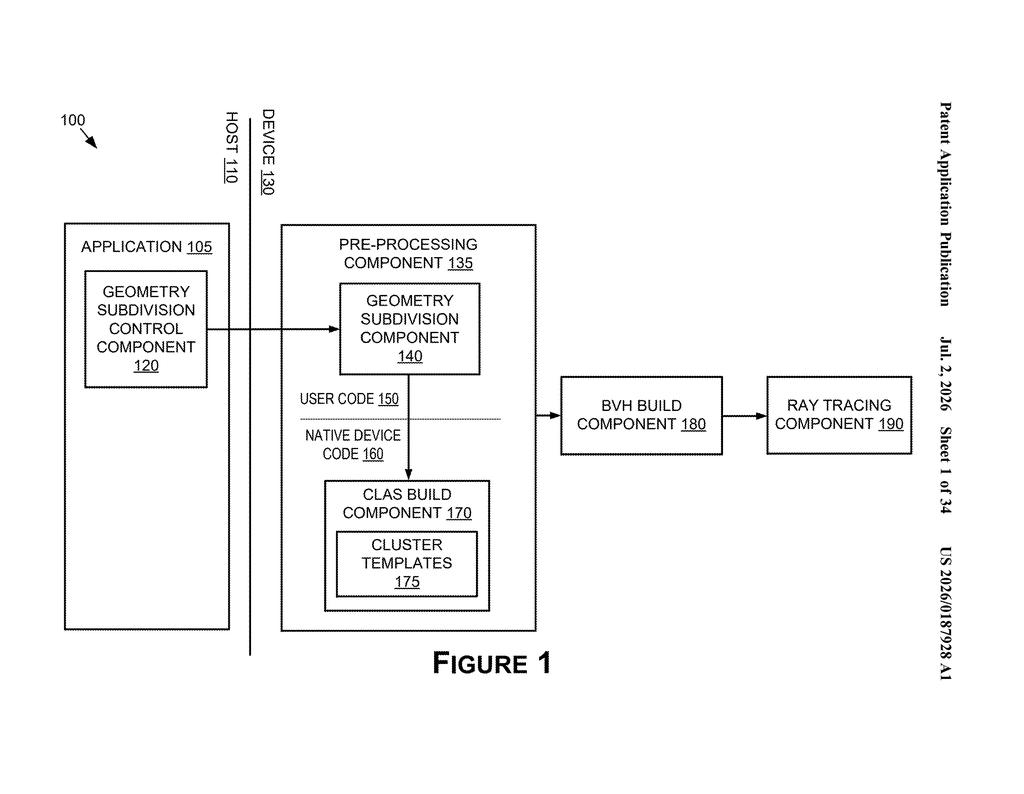
How Nvidia's pre-planned geometry packing speeds up 3D graphics
Imagine you're packing a moving truck. You could figure out how to arrange the boxes the day of the move, but it's much faster if someone already worked out the ideal arrangement for common box sizes and handed you a cheat sheet. That's the core idea here.
When your GPU draws a 3D scene, it has to organize millions of tiny triangles (the building blocks of every 3D surface) in memory in a way that it can read them back quickly. Normally, some of that organizing happens at render time, which costs precious milliseconds. Nvidia's patent describes precomputing the best memory arrangements for common triangle patterns and storing them as ready-to-use templates.
When the GPU encounters a familiar triangle pattern, it grabs the matching template instead of recalculating from scratch. The result is that rendering starts faster and the GPU spends more of its time actually drawing pixels rather than organizing data.
How the triblock layout optimizer builds cluster templates
The patent centers on something Nvidia calls triblock layouts, which are plans for how groups of triangles get packed into fixed-size memory blocks inside the GPU. The goal is to fit as many triangles as possible into as few memory blocks as possible, because fewer blocks means less memory traffic and faster rendering.
Rather than computing the ideal layout at render time for every scene, Nvidia's system runs an offline optimization pass that tries many different packing strategies for common triangle patterns (regular grids, irregular meshes, various levels of geometric detail) and scores each one. The scoring metric prioritizes minimizing the number of blocks used, and also tests rotations of the triangle pattern to find an arrangement that fits compactly in all directions.
The winning layout for each pattern and each compression level (how aggressively geometry is simplified) gets saved as a cluster template. At render time, the GPU scans incoming triangle clusters, identifies which precomputed template matches, and uses it directly to build a hierarchical tree structure (a spatial index that lets the GPU quickly find which triangles are relevant to any given pixel or ray).
- Offline: iterate over candidate layouts, score them, keep the best
- Store winners as cluster templates keyed by triangle pattern and compression level
- At render time: look up the matching template, build the scene hierarchy, render
What this means for real-time rendering on Nvidia GPUs
This is squarely aimed at real-time ray tracing and rasterization pipelines on Nvidia's current and future GPU architectures. The more geometry a game or visualization tool throws at the GPU, the more time is normally lost on data organization. Pre-baked templates shift that cost off the critical path entirely, which should translate to more consistent frame rates and headroom for denser scenes.
For developers, it also means that geometry compression (which already reduces memory bandwidth) becomes cheaper to use, since the compression-aware templates handle the hard layout decisions automatically. If Nvidia bakes this into its driver stack or its mesh shading infrastructure, game engines could benefit without any explicit developer work.
This is a low-glamour, high-value optimization patent. Pre-baking memory layouts is a classic systems trick, and applying it to GPU triangle clusters during the era of ever-denser 3D meshes is genuinely useful. It won't make headlines at a consumer event, but the kind of engineers who tune Nvidia's driver stack will care about this a lot.
Get our take in your Top Stories
Liked this breakdown? Add Patentlyze as a preferred source on Google, and our plain-English take shows up more often in your Top Stories the next time Nvidia patent news breaks.
There are more where this came from
We read every patent application Big Tech publishes and send you the ones worth knowing. Plain English, free, every week.
Want this weekly breakdown for a company we don't cover? Patentlyze Pro →