
Nvidia Patents a Way to Route AI Agent Tasks to the Right Workers Automatically
Every time an AI agent fires off a request, something has to decide which server handles it. Nvidia just filed a patent for a system that makes that choice by looking ahead at the work coming down the pipeline, not just what's happening right now.
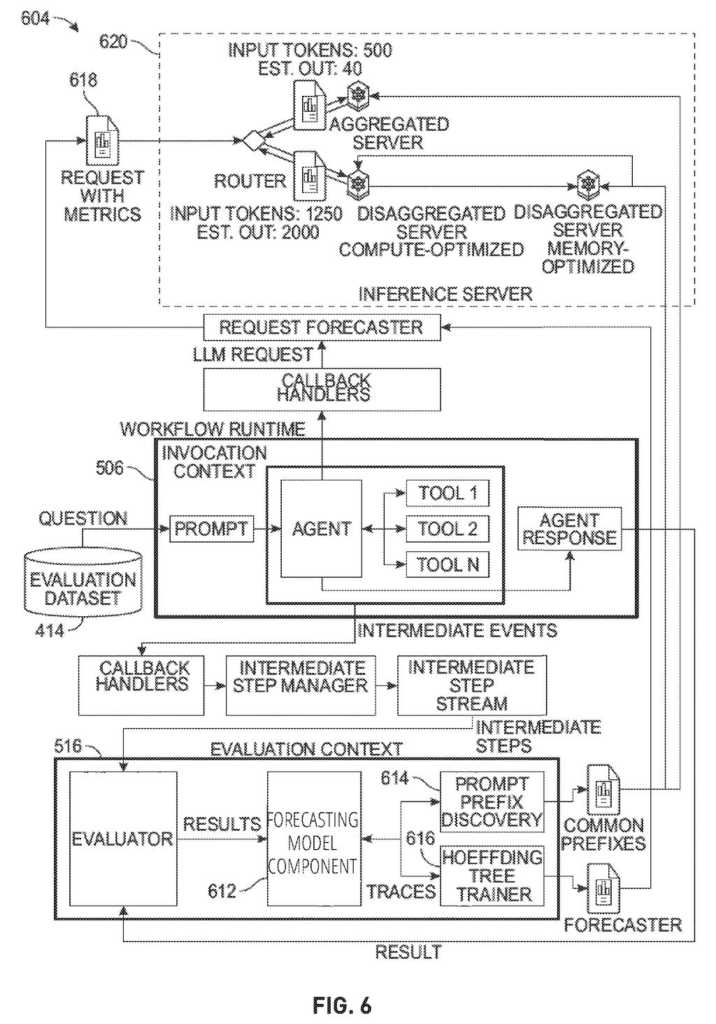
What Nvidia's AI traffic-routing patent actually does
Every time you ask an AI assistant to do something, a chain of smaller requests goes flying out to a cluster of servers. Each server picks up a piece of the job. The problem is that without any coordination, one server ends up slammed while another sits idle, and you wait longer than you should.
Nvidia's filing describes a routing system that doesn't just look at which server is least busy right now. It reads extra information attached to each incoming request, information about what kind of work is coming next, so it can send each task to a server that's already warmed up for that kind of job. Think of it like a restaurant host who seats you near the kitchen when you've pre-ordered a big meal, not just wherever there's an open table.
The technical piece that makes this interesting is the key-value cache: a fast-access memory pool that AI workers use to avoid recalculating things they've already figured out. By routing requests to servers that already have the right data cached, the system skips redundant work and gets answers back to you faster.
receiving, by a processor of an artificial intelligence (AI) agent system, one or more inference requests from one or more AI agent workflows, the one or more inference requests comprising metadata indicating one or more future workload characteristics …
Translation: The system catches incoming AI tasks along with extra data about how heavy the upcoming work will be.
How the router reads ahead to pick the right worker
The patent describes a three-step process running inside what Nvidia calls an AI agent system, which is essentially a coordinator layer sitting between your application and a pool of inference workers (the individual servers that run the AI model).
- Step 1 - Receive with metadata: Each incoming request carries extra tags called future workload characteristics. These tags hint at what the request will need, for example, whether it involves a long context window, repeated lookups, or a specific type of model task.
- Step 2 - Read the current state: The system checks two things simultaneously: the current load pattern on each worker (how busy they are) and each worker's key-value (KV) cache utilization. A KV cache stores intermediate computations so a server doesn't redo the same math; hitting a warm cache is dramatically faster than starting cold.
- Step 3 - Route intelligently: The system matches the incoming request's future needs against both the load data and the cache data, then sends the request to the worker most likely to handle it efficiently.
The result is a dispatch system that behaves more like a scheduler with a calendar than a dispatcher who only knows what's happening this second. It's designed specifically for multi-agent workflows, where a single user action might spawn dozens of chained AI calls.
… accesses current load patterns and key-value cache utilization of multiple inference workers and routes the requests to selected subsets of workers based on these factors …
Translation: It checks how busy the available processing units currently are before deciding where to send the new jobs.
What this means for AI assistants that feel slow or choppy
If you've ever watched an AI assistant think for a surprisingly long time on a simple follow-up question, uneven server load and wasted cache space are often the culprits. A routing layer like this one could shave real time off those pauses without requiring faster or more expensive hardware, just better coordination of what already exists.
For businesses running large AI pipelines, the savings compound. Each wasted cache miss costs compute cycles and electricity. A system that routes requests to workers already primed for the job reduces both. For everyday users, the payoff is simpler: AI tools that feel more consistent and less prone to random slowdowns during complex tasks.
Nvidia's 40th filing we've tracked in the AI chip wars since July adds to a pattern started with splitting AI steps across chips and running GPU and CPU code together.
The practical difference this makes is the gap between an AI assistant that answers you in two seconds and one that makes you wait eight. Nvidia's patent addresses how requests get assigned to the right computing resources at the right moment, and that routing decision, made thousands of times a second, is what determines whether the product feels fast or sluggish.
The interesting wrinkle is that each request would carry information about what it expects to need next, so the system can plan ahead rather than scramble to catch up. For someone using an AI tool, that translates to fewer moments where the assistant hesitates mid-task or loses its thread when juggling multiple steps.
The benefit arrives invisibly, baked into the product, which means users will simply notice that things work better without knowing why. That is precisely how good infrastructure operates.
There are more where this came from
We read every patent application Big Tech publishes and send you the ones worth knowing. Plain English, free, every week.
The drawings
13 drawing sheets from US 2026/0278422 A1 · click any drawing to enlarge


Want this weekly breakdown for a company we don't cover? Patentlyze Pro →