
OpenAI Patents a Moving Assistant That Keeps Waving Until You Look at It
Most assistants beep, buzz, or talk when they need you. This OpenAI patent describes one that physically waves, nods, or rolls toward you, then stops once you look its way or respond another way.
What OpenAI's attention-seeking assistant does
Ever had your phone buzz in another room while you were busy, and missed the reminder entirely? Sounds and vibrations are easy to ignore.
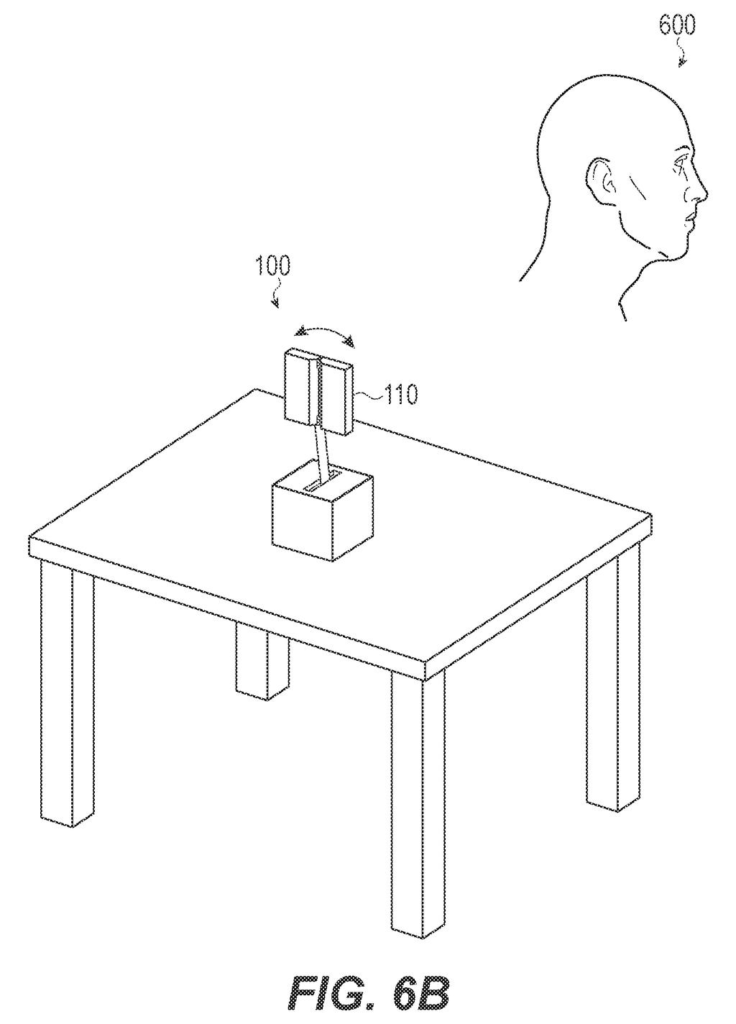
OpenAI's patent describes an assistant that tries a different tactic: it moves. The device has a camera and parts that can shift, such as a head that rocks on an arm, eyebrow-like pieces, or even wheels. When a reminder, message, or doorbell alert comes in, it starts a motion meant to catch your eye.
Then it checks whether you noticed. Its camera looks at you, and once you're looking its way, the motion stops and it delivers the news. If you keep ignoring it, it can try something bigger. It works in reverse too: glance at the device and it can perk up to show it's listening.
… cause the actuation system to produce a selected device motion configured to capture the user’s attention; capture an image of the user with the image capture system; analyze the image of the user to determine an attention state of the user …
Translation: The device moves to get your notice and watches you to see if you are looking.
How the device knows when you've looked up
The filing bundles three related ideas, each in its own independent claim. The first: when the device detects an event with news for you (an email, a calendar reminder, a timer, a visitor at the door), it picks a motion meant to grab your attention, takes a picture of you, and works out your attention state (whether you're looking at it). If you are, the motion stops.
The other two claims cover the reverse direction. If you speak to the device or make an attention cue (turning your head toward it, or aiming your gaze at it), it answers with a motion that says it noticed you and has entered an interactive mode (a state where it takes requests without a separate wake-up step). Examples include raising its head to face you, rolling so its front points at you, or moving eye-shaped or eyebrow-shaped parts.
The description fills in how it works:
- Choosing a motion: it picks from preset motions, or a "motion generation engine" (possibly a generative AI model) writes one on the spot. The stated principle is to use the least disruptive motion that will work, such as a subtle lid movement if you're sitting still.
- Checking attention: a machine-learning model trained on labeled photos of people returns a yes/no or a score from 0 to 10. Gaze tracking is another option.
- Escalating: if you don't respond, it can switch to a different motion or make the same one faster or bigger.
- Pointing: it can nod toward something, such as a door where a visitor is waiting.
… in accordance with a determination that the attention state of the user is indicative of attention being directed to the electronic device, cause the actuation system to cease producing the selected device motion.
Translation: Once it sees that you are finally paying attention, it stops moving.
Why a reminder that waves could beat a beep
Today's assistants mostly talk, buzz, or light up a screen. This filing describes one that uses body language and then checks whether the signal worked. For you, that could mean alerts that start gentle and get more insistent only if you ignore them, instead of every reminder arriving at the same volume.
The filing shows several forms: a head on an arm that opens and closes, a wheeled body with eyebrow-like parts, and a screen with animated eyes. It names no product, so read it as a design idea for a physical assistant, not a preview of something on shelves.
OpenAI's 37th filing in our OpenAI coverage since May adds to its work on how people interact with its assistants, following applications on keeping AI voice and on-screen text in sync and voice chat that knows when you're done talking.
To get your attention, the device first has to notice you. In the version that reacts to your glance, it may keep its camera watching for you while idle, and the filing says only that captured images may be stored or used by the device, not where they go or how long they stay.
Motors and moving parts also add cost, noise, and eventually failure. A device that waves at you about a grocery reminder, then waves bigger if you ignore it, is nagging with extra steps.
The one thing that keeps this design from becoming a pest is the stop rule: the motion ends when you look up, answer it, touch it, or the alert times out. That single constraint is what makes the whole trade feel close to worth it.
Get our take in your Top Stories
Liked this breakdown? Add Patentlyze as a preferred source on Google, and our plain-English take shows up more often in your Top Stories the next time OpenAI patent news breaks.
There are more where this came from
We read every patent application Big Tech publishes and send you the ones worth knowing. Plain English, free, every week.
The drawings
22 drawing sheets from US 2026/0310290 A1 · click any drawing to enlarge


Want this weekly breakdown for a company we don't cover? Patentlyze Pro →
Be the first to weigh in