
Qualcomm Patents a Way to Save Your Phone's State When the Battery Is Pulled
Most phones today have sealed batteries, but Qualcomm is solving a problem for the ones that don't: what happens to everything you were doing the moment the battery comes out.
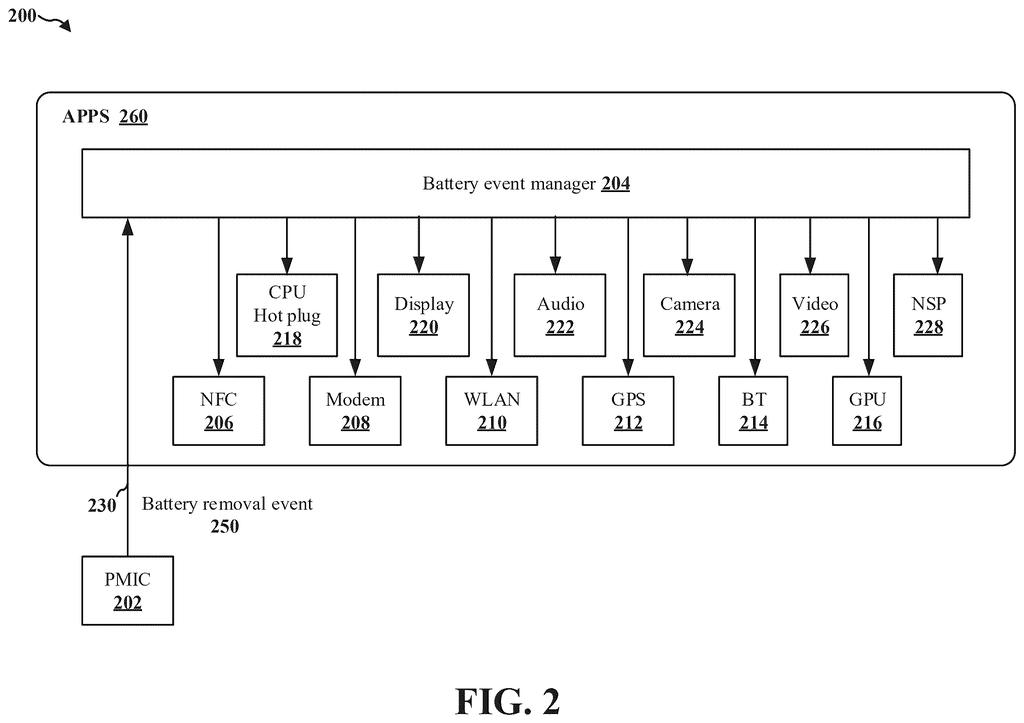
What Qualcomm's battery-removal rescue system actually does
You're in the middle of filling out a form or reading a document, and someone swaps the battery on your phone. Normally, everything you were doing would be gone the instant power cuts. Qualcomm's new patent describes a chip-level system that tries to stop that from happening.
The idea is that the moment the chip gets a warning that the battery is being removed, it starts a countdown. During that countdown, it progressively saves your open apps, settings, and session state to storage, going deeper into low-power mode to stretch out the remaining electricity as long as possible.
Think of it like an emergency evacuation plan built into the chip itself. The phone's processor gets a heads-up, slows itself down to save power, and copies everything important to safe storage before the lights go out. When you put a new battery in, your session is waiting for you.
receive information from a power management integrated circuit (PMIC) that a battery in the device was removed or will be removed; and store, based on the received information, context data associated with the device.
Translation: The chip gets a warning that the battery is coming out so it can quickly save your current data.
How the SoC timer stages the context-save sequence
The system centers on a piece of hardware called a System-on-a-Chip (SoC), which is the main processor inside a phone. The SoC receives a signal from a companion chip called a Power Management Integrated Circuit (PMIC), whose job is to monitor and regulate power. When the PMIC detects the battery is removed or about to be removed, it alerts the SoC immediately.
Once alerted, a software component inside the SoC called the battery event manager starts a timer and begins saving context data (essentially a snapshot of everything the device was doing: open apps, memory contents, system state). The process is staged across two timer thresholds:
- When the first threshold is crossed, the processor's main core drops into a deeper low-power mode (LPM), slowing itself down to conserve whatever charge remains in capacitors or residual power.
- When the second threshold is crossed, the system wakes up the device's DRAM (fast, temporary memory) long enough to copy all context data into non-volatile memory (storage that survives without power, like flash storage).
The staged approach is important because DRAM loses its contents the instant power dies, but non-volatile memory holds data indefinitely. By copying in time, the chip ensures a full restore is possible when a new battery arrives.
If the timer is greater than a second timer threshold, the battery event manager wakes up dynamic random access memory (DRAM) and copies the context data from the DRAM into non-volatile memory.
Translation: If enough time passes, the system copies your active memory into permanent storage so nothing is lost.
What this means for removable-battery Android devices
For most flagship phones today, this patent may seem beside the point because their batteries are sealed in. But a growing number of mid-range and budget Android devices, particularly in markets where users routinely carry spare batteries, still use removable designs. For those phones, an unplanned battery swap is basically the same as yanking the power cord from a desktop with no warning. This system gives the chip enough time to do what a laptop does when you close the lid.
The broader significance is at the chip architecture level. Qualcomm supplies processors to a huge share of the Android market, so a feature baked into the SoC would be available to any phone maker using that chip, without requiring them to design their own solution. This kind of low-level power-resilience work is part of the steady flow of Big Tech patent news around chip design that rarely gets attention but shapes how hundreds of millions of devices behave in everyday edge cases.
This is the 50th cell phone patent from Qualcomm we've tracked since May, a corpus that includes filings like reading multiple fingerprints through a display and a self-selecting boot power system.
The shipping path here is actually short by chip-patent standards. This is a software and firmware change to components Qualcomm already makes and ships in volume. There is no new hardware required; the PMIC-to-SoC communication channel the patent describes already exists in current Qualcomm reference designs. The main question is whether phone manufacturers have any commercial incentive to enable it.
Removable-battery phones are a shrinking category in premium tiers, so this feature is more likely to appear in a mid-range Snapdragon platform than to be headlined at a product launch. Still, the engineering here is tighter than it first looks.
Getting the timing right across two thresholds, while the chip is running on residual charge from capacitors, requires careful calibration. That part is harder than the patent makes it sound, and it will likely need device-specific tuning before any manufacturer ships it.
Get our take in your Top Stories
Liked this breakdown? Add Patentlyze as a preferred source on Google, and our plain-English take shows up more often in your Top Stories the next time Qualcomm patent news breaks.
There are more where this came from
We read every patent application Big Tech publishes and send you the ones worth knowing. Plain English, free, every week.
The drawings
6 drawing sheets from US 2026/0252159 A1 · click any drawing to enlarge


Want this weekly breakdown for a company we don't cover? Patentlyze Pro →
Be the first to weigh in