Qualcomm
Qualcomm · Automotive · Filed Feb 19, 2025 · USPTO published Aug 20, 2026 · Aug 20 release
Qualcomm Patents a Way to Spot Protruding Objects Around Moving Vehicles
A car's sensors can spot another car, but the open tailgate sticking three feet into your lane is a harder problem. Qualcomm's new patent tackles exactly that.
- Publication number
- US 2026/0241949 A1(US20260241949A1)
- Applicant
- QUALCOMM Incorporated
- Filed · Published
- Feb 19, 2025 · Aug 20, 2026
- Inventors
- Venkatraman Narayanan, Varun Ravi Kumar, Senthil Kumar Yogamani
- Status when we published
- Examiner raised objections; the company can respond
- Document
- 20 claims
- US classification
- 701/1
- Examiner
- YANG, WENYUAN (Art Unit 3667)
How Qualcomm's car AI finds things that stick out
A delivery truck idles at the curb with its rear doors swung wide open into traffic. A self-driving or driver-assist system sees the truck, but may not register that those doors are jutting into the lane where your car is about to travel.
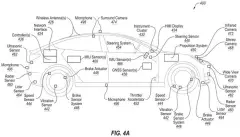
Qualcomm's patent describes a system that goes beyond simply spotting objects and also figures out how far they protrude into the space around a vehicle. It combines multiple sensors, camera images, depth readings, and so on, builds a top-down map of the area, and then runs a dedicated AI step focused purely on identifying parts of objects that stick out beyond their main body.
The result is an output that doesn't just say "truck ahead" but also describes the shape and reach of anything extending from that truck. That kind of detail is exactly what a vehicle needs to decide whether it has room to pass safely.
… applying a first machine learning model to the semantic information to generate refined semantic information that incorporates protrusion information …
Translation: The system uses AI to analyze visual data specifically to identify parts of objects that stick out from the main body.
How the system builds a 3D protrusion map from sensor data
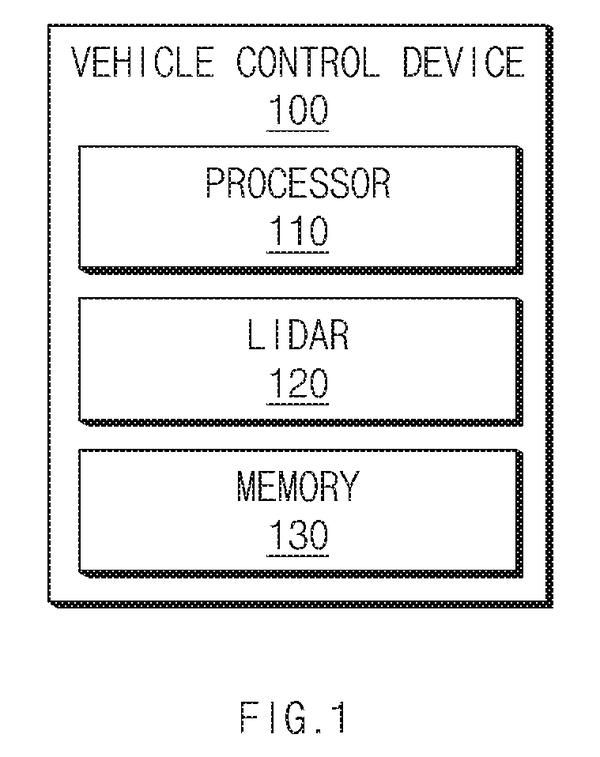
The system pulls in multimodal sensor data (meaning data from multiple sensor types at once, such as cameras and lidar) and processes it along two parallel tracks.
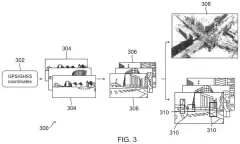
- BEV features: A Bird's Eye View representation, essentially a top-down grid map of the area around the car, is generated from the raw sensor readings. This gives the system a spatial layout of the scene.
- Semantic information: Separately, the system extracts labels and categories from the sensor data, identifying what kinds of objects are present (vehicles, pedestrians, barriers, etc.).
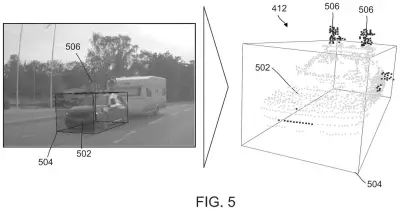
- Protrusion refinement: A dedicated machine learning model (described as using few-shot learning and meta-adapters, techniques that allow a model to generalize from very few training examples) processes the semantic information specifically to identify protrusion information, meaning the parts of objects that extend beyond their core footprint.
Those two streams are then merged to build a 3D scene representation. The final output tags each detected object not just with its location but with a description of any protrusion, giving downstream driving logic the precise geometry it needs to plan a safe path.
… generating, based on the one or more BEV features and the refined semantic information, a 3D scene representation of a scene surrounding a vehicle …
Translation: The software combines top-down map views with object details to build a three-dimensional model of the car's surroundings.
What this means for driver-assist safety systems
For anyone who has ever held their breath squeezing past a flatbed with rebar overhanging the side, this problem is viscerally real. Driver-assist systems today are generally good at detecting bounding boxes around objects but far less reliable at characterizing irregular shapes or parts of objects that extend into adjacent lanes. A system that explicitly models protrusions could reduce the class of edge-case collisions that happen not because the car missed an object but because it misjudged the object's reach.
Qualcomm's position as a chip and compute platform supplier for automotive systems means this kind of perception capability would likely live at the hardware-software interface, potentially shipped as part of a reference design that automakers and Tier 1 suppliers build on. The automotive perception space is one of the more active corners of the interesting tech patents Patentlyze tracks, and this filing reflects the shift from coarse detection toward fine-grained spatial understanding of every object in the scene.
Qualcomm's new filing is the 25th we've tracked since July in our self-driving sensing race, adding to work like cars finding each other via landmarks and one AI seeing through any camera.
Source: US 2026/0241949 A1 at the USPTO (PDF). Full patent text and figures are in the official publication.
Get our take in your Top Stories
Liked this breakdown? Add Patentlyze as a preferred source on Google, and our plain-English take shows up more often in your Top Stories the next time Qualcomm patent news breaks.
Add Patentlyze on Google
One click.
There are more where this came from
We read the new patents from Big Tech, carmakers and more and send you the ones worth knowing. Plain English, free, every week.
The drawings · 6 sheets
6 drawing sheets from US 2026/0241949 A1 · click any drawing to enlarge


More from Qualcomm
All 637 Qualcomm patents →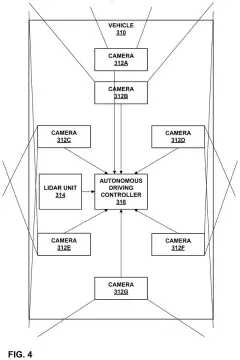
More in Automotive
All 432 Automotive patents →
Nvidia
Nvidia Patents a Way for Self-Driving Cars to Know When an Object Is Actually in Their Path
Nvidia
Nvidia Patents a System for Steering Autonomous Vehicles via VR Headset
Nvidia
Nvidia Patents a Way to Keep the Most Safety-Critical Car Features Running When Others Fail
Waymo (Google)