
Qualcomm Patents a Fix for Self-Driving Cars That See With Mismatched Cameras
Every camera on a self-driving car fires at a slightly different moment, and that tiny gap can make stationary objects look like they're moving. Qualcomm's new patent targets exactly that problem.
How Qualcomm syncs mismatched car camera feeds
A self-driving car rolls through an intersection at 35 mph while six cameras around its body each snap pictures at slightly different milliseconds. For you in the back seat, those tiny timing gaps are invisible, but to the car's brain they can make a parked bus appear to have shifted several feet.
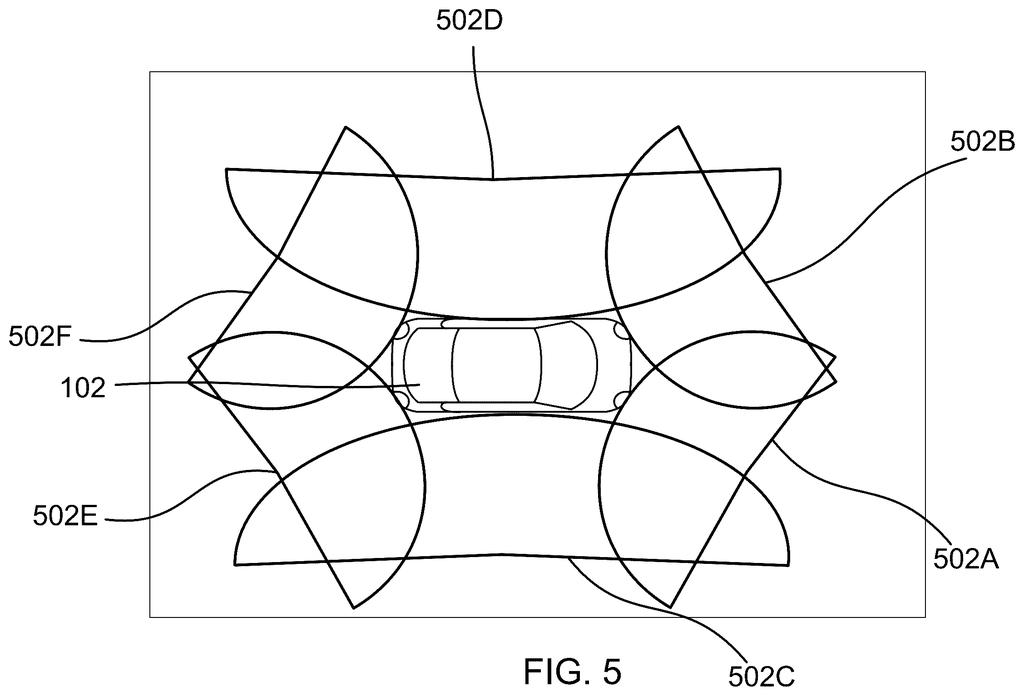
Qualcomm's patent describes a method to detect and correct those gaps automatically. The system looks at areas where two cameras' views overlap, compares what each camera sees in that shared zone, and uses the differences to figure out how much the vehicle moved between each shot. It then adjusts the full picture so every camera's data lines up as though they all fired at the same instant.
The goal is a cleaner, more accurate overhead map of the car's surroundings, often called a bird's eye view, which self-driving systems rely on to identify lanes, pedestrians, and obstacles. Better-aligned data going in means fewer errors coming out.
obtaining sensor data generated by one or more sensors of a vehicle, wherein the sensor data includes images from a plurality of cameras, and wherein at least two of the images have different ToCs …
Translation: The system collects video from multiple car cameras that are recording at slightly different moments in time.
How the timing fix compares overlapping camera zones
Modern autonomous vehicles stitch together feeds from front, rear, and side cameras into a single top-down representation of the road, a bird's eye view (BEV). The problem is that cameras on a moving vehicle don't all capture their frames at the same millisecond. These offsets are called time of capture (ToC) differences, and even a 30-millisecond gap at highway speed translates into real spatial error when the images are merged.
Qualcomm's method works in three steps:
- Extract BEV features from each camera's image individually. A feature in this context means a compact mathematical description of what the camera sees, like the edge of a lane marking or the corner of a vehicle.
- Compare overlapping zones. Adjacent cameras share a strip of the scene. The method looks at what each camera recorded in that shared strip and measures the disagreement between the two versions.
- Apply ToC compensation. Using the measured disagreement, the system calculates a correction and warps each camera's features so they all align to a common reference moment, producing compensated BEV features.
The patent specifies that this correction is derived directly from the sensor data itself rather than relying on a separate motion sensor like a gyroscope, which means it can catch real-world timing drift that hardware timestamps might miss.
… applying ToC compensation to the BEV features based on comparing the overlapping features to generate compensated BEV features.
Translation: The software aligns these mismatched images by comparing the parts of the road that appear in both camera views.
What this means for autonomous vehicle perception chips
Perception accuracy is the foundational metric for autonomous driving safety, and timing misalignment is one of its quieter enemies. Camera synchronization errors compound with speed: the faster the vehicle, the bigger the spatial error introduced by even small ToC gaps. A method that corrects for this at the feature level, before the data is handed to higher-level object-detection models, can reduce false positives and missed detections across the whole perception stack.
For Qualcomm specifically, this kind of on-chip processing fits squarely into its automotive silicon business, where it competes to supply the processors that run perception software in next-generation vehicles. The filing signals continued investment in making camera-fusion pipelines more reliable without adding extra sensors or heavy compute overhead. Teams building autonomous systems or ADAS (advanced driver assistance) platforms can follow this thread alongside other latest Big Tech patents in the automotive perception and chip design space.
Qualcomm's 26th filing we've tracked since July in our self-driving sensing race watchlist follows work like one on spotting protruding objects and one on cars sharing landmarks.
The trade-off here is real. Using overlapping camera views to fix timing errors is clever and avoids costly extra hardware, but it only works if those shared views actually contain clear, distinct objects for the system to measure against.
On a snowy road or a bare highway at night, there may be almost nothing useful in the overlap zone. That is a genuine weak spot, and it matters most precisely when getting the timing right is critical.
Even so, skipping the expensive synchronized clock hardware is a sensible choice for most vehicles. The logic holds for the vast majority of everyday driving situations.
Get our take in your Top Stories
Liked this breakdown? Add Patentlyze as a preferred source on Google, and our plain-English take shows up more often in your Top Stories the next time Qualcomm patent news breaks.
There are more where this came from
We read every patent application Big Tech publishes and send you the ones worth knowing. Plain English, free, every week.
The drawings
6 drawing sheets from US 2026/0245350 A1 · click any drawing to enlarge


Want this weekly breakdown for a company we don't cover? Patentlyze Pro →
Be the first to weigh in