
Qualcomm Patents a Way to Route Phone Signals In and Out Through Different Windows
Your phone talks to the cell network through your office window, but what if the signal going out and the signal coming in traveled through different panes of glass? That's exactly what Qualcomm is patenting.
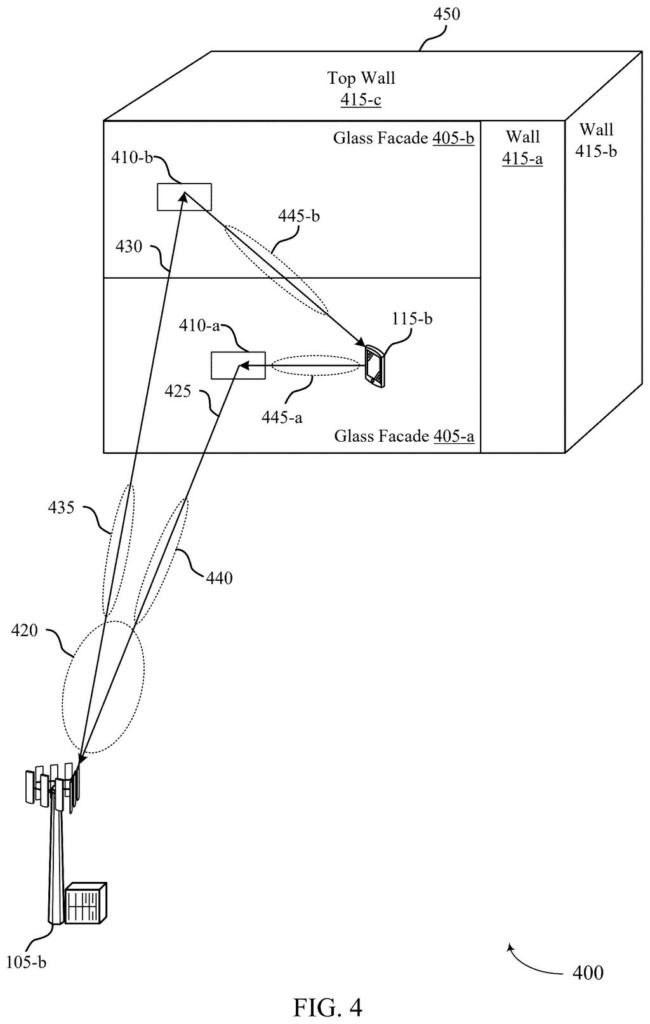
What Qualcomm's split-beam window signal trick actually does
Ever tried to make a call from deep inside a building and watched the bars vanish? The problem is usually the glass and walls blocking the signal between your phone and the nearest cell tower.
Qualcomm's patent describes a system where special conductive coatings on glass surfaces, called transmissive surfaces, let radio signals pass through. The twist here is that your phone doesn't have to use the same window for both receiving and sending. It could pull your incoming call data through one window facing a nearby tower and push your outgoing voice or data through a different window with a clearer line of sight.
The phone and the network coordinate in advance, agreeing on which window handles which direction of traffic. The switch can happen automatically when certain conditions are met, like when signal quality drops on one surface but stays strong on another. The goal is steadier, faster indoor and in-vehicle wireless connections without any action required from you.
Structures such as buildings or vehicles may include transmissive surfaces (TSs) on glass surfaces that allow penetration of radio frequency signals through the glass surface.
Translation: Buildings and vehicles can use special glass surfaces to let radio signals pass through.
How the UE negotiates two separate transmissive surfaces
The patent describes a user equipment (UE, meaning your phone or tablet) that communicates with a cell network through glass panels embedded with radio-frequency-transparent coatings, which Qualcomm calls transmissive surfaces (TSs). These surfaces act like selective windows for specific radio beams, bending (refracting) signals rather than blocking them.
The core idea is uplink/downlink decoupling: the beam path your device uses to receive data (downlink) can be completely separate from the path it uses to send data (uplink). Concretely, the UE receives incoming messages through a first set of beams aligned with one TS, and transmits outgoing messages through a second set of beams aligned with a different TS.
Coordination happens via control signaling exchanged between the UE and the network before data flows. This negotiation tells both sides which surface handles which direction, and which beam angles to use for each. The system also defines triggering conditions, specific thresholds (think: signal quality falling below a cutoff on one surface) that prompt the device to switch which surface it uses for uplink or downlink.
- First transmissive surface: handles downlink beams and associated control signaling
- Second transmissive surface: handles uplink beams on a different physical path
- Triggering condition: an event or measurement that initiates the split-surface arrangement
communicate, with a network entity, control signaling associated with downlink beamforming via a first transmissive surface between the UE and the network entity, wherein the control signaling is further associated with uplink beamforming via a second transmissive surface between the UE and the network entity; …
Translation: The phone manages incoming and outgoing signals through two completely different windows.
What this means for 5G coverage inside buildings and cars
For anyone who regularly loses signal inside office towers, hospitals, or cars with heavily tinted windows, this kind of technology is directly aimed at your frustration. Buildings with treated glass block a lot of 5G millimeter-wave signals, and the usual workaround involves expensive repeaters or distributed antenna systems installed throughout the structure.
By letting a phone pick different windows for sending versus receiving, the system can work around localized interference, reflections, or physical obstructions that affect only one direction. Qualcomm's bet on in-building and in-vehicle 5G connectivity shows up here as a hardware-plus-protocol play, one that would require glass manufacturers, building designers, and network operators to all agree on a common standard before any phone could actually use it.
That makes this Qualcomm's 405th filing in our Qualcomm coverage since May, adding to a sensor thread that includes radio that senses and talks and the bright-dark camera trick.
Getting this idea from patent to product requires three things that don't yet exist at scale: special glass in buildings and vehicles that lets radio signals pass through cleanly, carrier software smart enough to route your uploads and downloads through different windows, and phone chips with new logic to manage the whole arrangement.
The shortest path to something real is probably through cars, not offices. A single vehicle manufacturer controls both the glass and the software environment, which sidesteps the messier problem of convincing a glass supplier, a building landlord, and a wireless carrier to coordinate.
Even that shorter path takes years, and this document resolves none of the hardware or coordination questions it raises. Qualcomm is planting a flag for when the surrounding infrastructure eventually catches up.
There are more where this came from
We read every patent application Big Tech publishes and send you the ones worth knowing. Plain English, free, every week.
The drawings
11 drawing sheets from US 2026/0280611 A1 · click any drawing to enlarge


Want this weekly breakdown for a company we don't cover? Patentlyze Pro →