
Qualcomm Files Patent for Wireless Audio That Patches Its Own Dropouts
Wireless audio can fix a lost piece of itself without asking the sender to try again, because backup data rides along in the stream. Qualcomm's filing says two backup blocks can turn 3 recovery attempts into 9.
What Qualcomm's audio repair patent actually does
Every time you stream a song or play a game over wireless headphones, the sound travels in tiny bundles called packets, and now and then one gets lost on the way. You hear it as a crackle, a skip or a brief dropout.
Qualcomm's filing describes a way to repair that loss without asking the sender to try again, which takes time fast-moving games don't have. Along with the sound, the sender tucks in a few backup blocks, each built by mixing together pieces of nearby audio. If one chunk goes missing, your headphones use a backup block plus the chunks that did arrive to rebuild it.
According to the filing, two backup blocks can turn 3 recovery attempts into 9. The result is sound that holds together better when your connection gets crowded or flaky.
… determine that at least a portion of the encoded audio bitstream is corrupted; perform error correction, based on the error correction data, to recover at least the portion of the encoded audio bitstream and obtain error corrected audio data; …
Translation: The device figures out when data is damaged and uses backup information to fix it.
How a spare audio block rebuilds a lost one
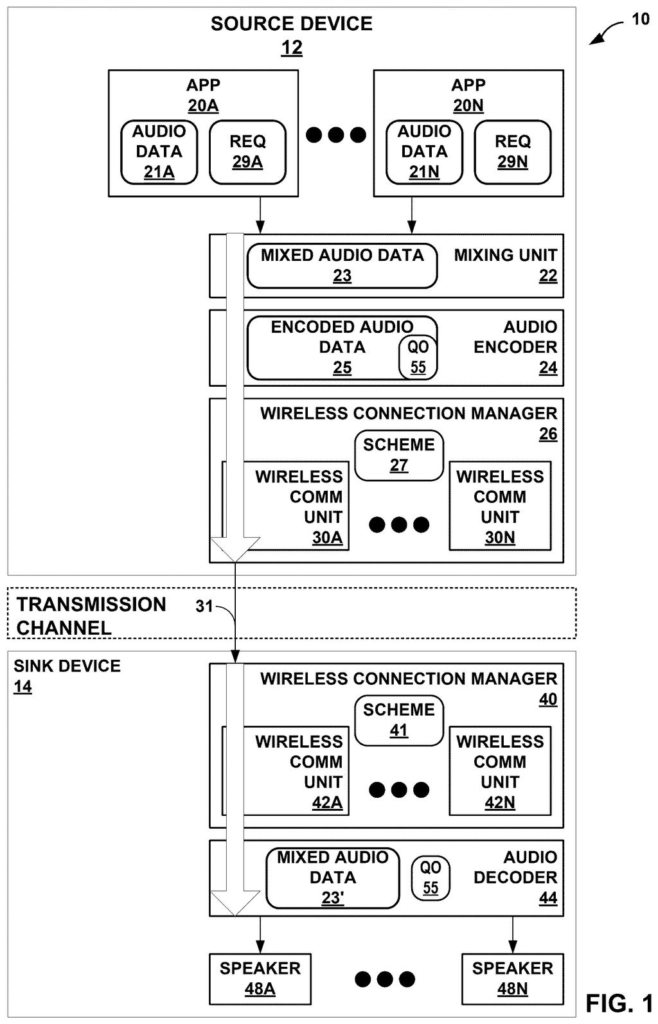
The filing covers both ends of the link. On the sending side, the encoder (the software that compresses audio for transmission) creates forward error correction data, which is extra recovery information sent ahead of time so the receiver can repair losses without a resend, and writes it into the audio stream. On the receiving side, the decoder spots a corrupted or missing piece, repairs it with that data, slots the fix back into the stream, then decodes and plays it.
In the basic version, each recovery block is the XOR of the two previous audio blocks (a bit-by-bit comparison that lets you work backward to a missing piece) and travels in a later packet. Packets arrive in groups of four with sequence numbers, so the decoder notices a gap, grabs the recovery block from the next packet, combines it with the packet that did arrive, and rebuilds the lost one.
A fancier version adds a jitter queue (a waiting area that puts packets back in order, since they arrive at uneven times) and a 64-bit holes mask (a checklist of which packets are missing). The decoder checks every recovery block against the checklist, applies the ones that fit, and repeats until nothing more can be fixed.
In the filing's example, a 132-byte audio frame comes with 800 bytes of extra detail for lossless quality, plus two recovery blocks totaling 264 bytes. In the basic design, that lossless detail is not itself protected.
… insert the error corrected audio data into the encoded audio bitstream, decode the encoded audio bitstream to obtain decoded audio data, render, based on the decoded audio data, one or more speaker feeds, and output, for playback, the one or more speaker feeds.
Translation: It patches the fixed audio back into the stream so your speakers can play it smoothly.
What Qualcomm's fix means for wireless gaming audio
If you game with wireless headphones, the practical payoff is fewer crackles and skips when your Wi-Fi or Bluetooth connection gets busy. Games need sound to arrive inside a tight time window, so there may be time for only two resend attempts. Sending recovery data up front sidesteps the waiting.
It also speaks to lossless audio, a bit-perfect copy of the original sound that many listeners want but wireless links struggle to carry reliably. The description pairs this repair method with a way to layer lossless accuracy on top of existing audio codecs, and it names Qualcomm's own aptX family as one place the idea could apply. Whether any of it reaches products is unknown.
Qualcomm's 504th filing in our Qualcomm coverage since May adds to a run that includes battery-free store tags and phones reporting AI limits.
Every repair scheme costs something, and this one pays in three places. The recovery blocks add 264 bytes to a payload of roughly 930 bytes in the filing's example, so the stream gets heavier right when a crowded connection can least afford it.
A repair also has to wait for a later packet carrying the recovery block, so the fix arrives a beat after the loss. And in the basic design, the lossless detail goes unprotected, so a rebuilt packet may sound fine to you while falling short of bit-perfect.
For game audio, a fast, slightly imperfect repair beats a perfect one that arrives too late, so the trade reads as sensible. Spending more than a quarter of extra bandwidth to avoid an audible dropout is a bargain most listeners would take.
Get our take in your Top Stories
Liked this breakdown? Add Patentlyze as a preferred source on Google, and our plain-English take shows up more often in your Top Stories the next time Qualcomm patent news breaks.
There are more where this came from
We read every patent application Big Tech publishes and send you the ones worth knowing. Plain English, free, every week.
The drawings
16 drawing sheets from US 2026/0311707 A1 · click any drawing to enlarge


Want this weekly breakdown for a company we don't cover? Patentlyze Pro →
Be the first to weigh in