
Qualcomm Files Patent for Battery-Free Store Tags That Help Your Phone Find Products
Qualcomm describes sticker-sized tags with no battery that run on radio waves, then use them to guide your phone through a store and log how long you linger in each aisle.
What Qualcomm's battery-free store tags do
Every time you stroll down a store aisle with your phone in your pocket, the store has no easy way to know which aisle you're in. Qualcomm's patent application describes a cheap fix: small sticky tags with no battery at all, placed along shelves and walls.
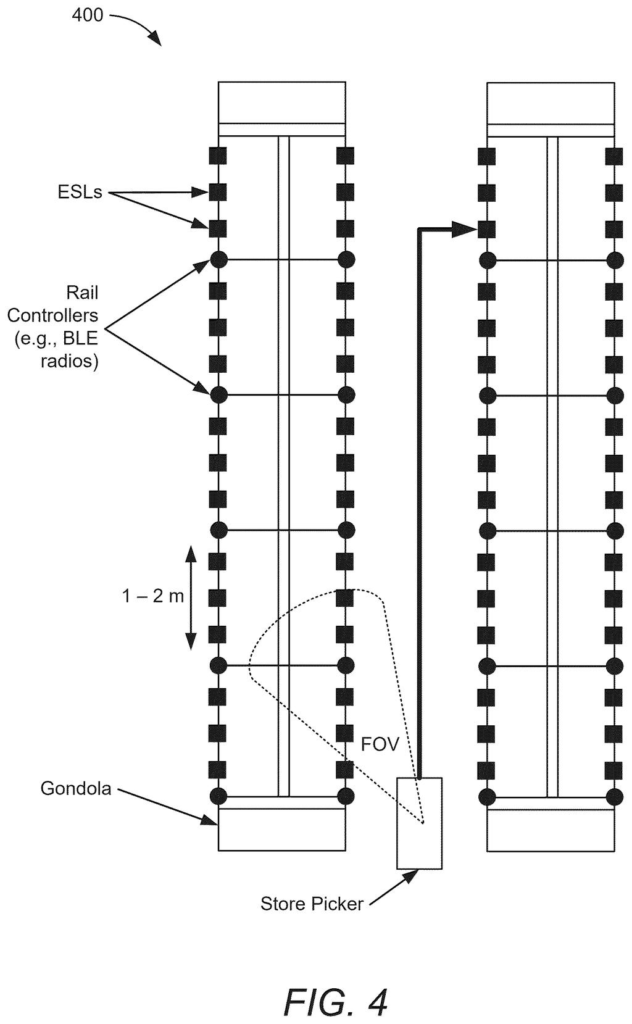
The tags get their power from radio waves beamed at them from a transmitter, much like RFID tags. Once charged, each tag sends out a short Bluetooth signal that identifies it. Your phone hears the signals and reports how strong they were, and a store server works out where you are, so an app could guide you to the cereal.
The filing also covers two other uses: telling a shelf label to change what it displays, and logging how many shoppers pass a tag and how long they stay near it.
receive, via the one or more antennas, an energizing waveform including control information, wherein the control information indicates a configuration for beacon signal transmission by the eTag …
Translation: The tag gets power and instructions over the air from a nearby device.
How the tags take turns sending signals
The core idea is a battery-free tag (the filing calls it an energy harvesting tag, or eTag) that collects energy from a broadcast radio signal and stores it in a small capacitor, a part that holds a charge. The description says a tag can harvest energy from a transmitter up to 20 meters away. The same broadcast also carries instructions.
Those instructions tell each tag three things:
- Spatial interleaving factor: a cluster size. Size 1 means every tag in an aisle sends a signal; size 5 means every fifth tag does.
- Time slot offset: which slice of the next short time window to use. The example has a 12.5 millisecond window split into 20 slots.
- Channel: which Bluetooth Low Energy frequency to use.
Each tag stores a lookup table, so the broadcast only needs a short ID number. A tag that has not finished charging skips its turn. A flag bit can also separate shelf tags from tags attached to inventory, so neither talks over the shelf labels' own radios.
The other claims cover a tag passing a display command (text, color, shape, pattern) to a shelf label, and a server that logs tag ID, signal strength and timestamp into a database of shopper behavior.
… transmitting, during a subsequent subframe, a beacon signal according to the configuration.
Translation: The tag replies by broadcasting its location signal at a scheduled time.
Why shelf labels and shoppers both feel this
The practical payoff is for the store's own gear. The filing says electronic shelf labels that beacon often to help phones find products drain their batteries. With battery-free tags doing the beaconing, the labels could signal rarely or not at all, so their batteries last longer.
For you, it points to in-store navigation that guides you to a product, and shelf labels that react when you stop nearby. It also points to something less cozy: a server counting how many phones pass the entrance and who lingers at a shelf, so a store can aim ads at you. Whether shoppers like that trade will matter as much as the radio engineering.
Qualcomm's 503rd filing in our Qualcomm coverage since May adds to a run that includes phones reporting AI limits to towers and self-moving home antenna boxes.
Shelf labels give up their batteries in this design, and the store pays for that by adding a separate charging transmitter plus a second layer of tags to run the whole system. A tag that has not finished charging simply skips its assigned window, so a crowded aisle could have gaps in coverage exactly when accurate readings matter most.
The scheduling holds everything together and is also the most fragile part. Every tag, label, and piece of tracked inventory shares the same narrow time windows and radio channels, which means a single server has to keep every device's timing perfectly synchronized or the whole coordination falls apart.
The positioning feature asks shoppers to accept being tracked aisle by aisle, and the document mentions user preferences without explaining how permission gets collected. For in-store navigation that trade seems reasonable; for serving targeted ads based on where you lingered, it is a much harder sell.
Get our take in your Top Stories
Liked this breakdown? Add Patentlyze as a preferred source on Google, and our plain-English take shows up more often in your Top Stories the next time Qualcomm patent news breaks.
There are more where this came from
We read every patent application Big Tech publishes and send you the ones worth knowing. Plain English, free, every week.
The drawings
13 drawing sheets from US 2026/0312437 A1 · click any drawing to enlarge


Want this weekly breakdown for a company we don't cover? Patentlyze Pro →
Be the first to weigh in