
Qualcomm Patents a GPU Trick That Stops Redrawing the Same Points Twice
Every 3D scene on your phone is built from thousands of shared corner points, and right now GPUs often recalculate those same points multiple times. Qualcomm's new patent describes a way to do that work once and reuse the results.
What Qualcomm's vertex reuse system actually saves you
Imagine you're drawing a brick wall and every brick shares corners with its neighbors. A clumsy approach would be to measure and redraw each shared corner for every single brick. That's roughly what some mobile GPUs do when they render 3D scenes, and it wastes time and power.
Qualcomm's patent describes a system that calculates each corner point (called a vertex) only once and stores the result at a specific location in memory. It then builds a lookup table so that every triangle or polygon that shares a corner just reads from that stored location instead of recalculating from scratch.
For you, the practical benefit would be a game or an app that looks the same but uses fewer compute cycles to get there. Fewer cycles can mean faster frame rates, a cooler phone, or longer battery life, ideally some combination of all three.
… generate a primitive connectivity table that associates each primitive of the set of primitives with a corresponding subset of the set of memory addresses based on the corresponding subset of the set of vertices; …
Translation: It builds a lookup table connecting shapes directly to where their points are stored in memory.
How the primitive connectivity table routes shared vertices
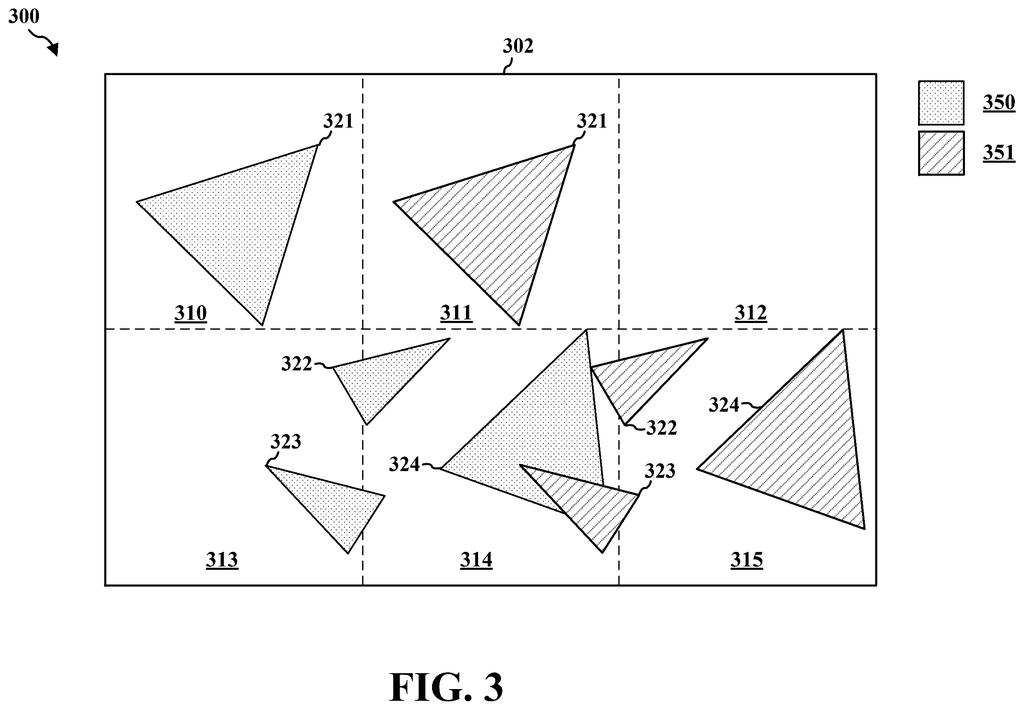
A 3D object in a game or app is made from a mesh: a web of small shapes (usually triangles, called primitives) that share corner points called vertices. Processing a vertex means calculating where it lands on your screen, how light hits it, and how it should be colored or shaded. In a dense mesh, many triangles share the same vertex, so without special handling, that vertex might be processed over and over.
Qualcomm's approach adds a coordination step between two stages of the GPU pipeline:
- The GPU processes the full set of vertices and writes each result to a specific memory address.
- It then builds a primitive connectivity table, essentially a ledger mapping each triangle to the memory addresses of its corners.
- When the GPU moves on to processing the primitives (triangles), it reads pre-computed vertex data from that ledger instead of repeating the vertex work.
The system is designed for merged shaders, a GPU architecture where what used to be separate processing stages are combined into one. That combination creates extra bookkeeping challenges around vertex sharing, which is the specific problem this table-based approach is meant to solve.
The patent focuses on making this work efficiently inside the chip's memory and scheduling systems, so the reuse benefit doesn't get eaten up by the overhead of maintaining the table itself.
This disclosure provides systems, devices, apparatus, and methods, including computer programs encoded on storage media, for merged shader vertex reuse.
Translation: The patent describes a technique for sharing and reusing vertex data in graphics shaders.
What this means for mobile gaming and battery life
Mobile GPUs are always under pressure: they need to render complex scenes while sharing a battery with a radio, a screen, and a processor. Any technique that cuts redundant computation without changing the final image is directly valuable, because the savings show up as frames per second or minutes of battery life, things you actually notice.
This particular filing is narrow and implementation-focused rather than a sweeping architecture change. If Qualcomm ships this in a future Snapdragon chip, the benefit would be most visible in graphically dense games or AR applications where meshes are complex and shared vertices are numerous. Everyday app users probably wouldn't notice a difference, but mobile gamers and developers targeting high-fidelity graphics on Snapdragon devices might.
Qualcomm's 15th filing we've tracked in our GPU rendering watchlist since July builds on photo-realistic image fix and AI game frame polish.
When a phone game stutters through a dense scene or the battery drains faster than expected during a long session, the cause is often invisible: the graphics chip redoing work it already finished moments ago. Qualcomm's patent targets exactly that waste, building a smarter record-keeping system so the chip remembers what it has already drawn and skips repeating it.
The practical result is a game that holds its frame rate when things get complicated on screen, or a phone that stays cooler and lasts longer without the user changing anything about how they play.
The engineering here is about getting the bookkeeping right, because a mistake means either wasted effort or visible glitches. Done well, the whole experience simply feels more solid, with no visible sign that anything clever happened underneath.
There are more where this came from
We read every patent application Big Tech publishes and send you the ones worth knowing. Plain English, free, every week.
The drawings
8 drawing sheets from US 2026/0301297 A1 · click any drawing to enlarge


Want this weekly breakdown for a company we don't cover? Patentlyze Pro →
Be the first to weigh in