
A New Qualcomm Patent Teaches Phones to Spot Fake Signals That Cut Off Service
One forged message can send your phone to a corner of the 5G channel where nobody is listening, and your connection stalls. Qualcomm's patent gives the phone a way to catch the trick and tell the network.
What Qualcomm's fake-signal patent actually does
You're on a train platform streaming a video, and the picture freezes. Your phone didn't lose coverage. It was told to move to a part of the radio channel the tower isn't watching, and the order came from an attacker, not the tower.
A forged order like that is possible because the temporary ID that scrambles your phone's instructions is sent unprotected when the phone first connects. Qualcomm's patent has your phone double-check itself after every switch. Did the tower follow up? Is the signal in the new spot worse than in the old one? Are your upload requests going unanswered?
If the answers look bad, the phone sends the network a short report: when it happened, how strong the signal was, and where you were. The network then decides whether it was an attack or a harmless glitch.
switch to a first bandwidth part (BWP) based on a received downlink control information (DCI); determine a security event based on a switch to the first BWP; generate a security report based on the determined security event …
Translation: The phone detects a suspicious network command, realizes it is a security threat, and creates a report about it.
How your phone decides a channel switch is fake
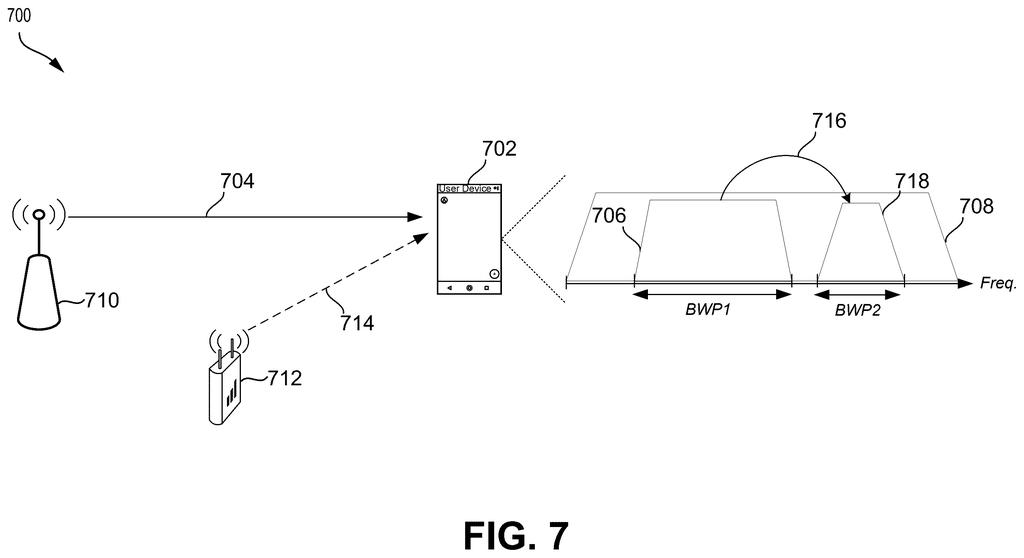
Modern 5G networks split a channel into sub-bands called bandwidth parts (BWPs) and move your phone between them depending on how much data it needs. The tower gives the order with a control message called downlink control information (DCI), which is scrambled with a temporary ID for your phone (the C-RNTI). That ID is sent unprotected when the phone first connects, so an attacker who catches it can forge a DCI message and push the phone into the wrong sub-band.
Under the patent, after the phone switches it watches for signs the switch was invalid. The filing lists several checks:
- No further control message arrives in the new sub-band within a set time, while a reference signal (a known test signal the tower sends so phones can measure signal strength) in another sub-band is strong.
- The reference signal in the new sub-band is weak, or worse than it was in the old one.
- Too many HARQ retransmission requests (the automatic 'please resend that' messages) pile up.
- The phone asks several times for permission to upload data and never gets a grant.
The time limits and signal thresholds can be set at the factory, sent by the network, or adjusted from what the phone has seen as normal in that location. When a check trips, the phone builds a report (how long it lasted, measured signal quality, number of retries, its location, which sub-band and the message format) and sends it to a base station or another network function.
Disclosed are systems and techniques for event reporting. For instance, a process can include switching to a first bandwidth part (BWP) based on a received downlink control information (DCI); determining a security event based on a switch to the first BWP …
Translation: The patent describes a method where a phone spots a rogue signal forcing a network switch and flags it as an attack.
What forged-command reports mean for your phone
For you, the payoff is a phone and a network that can notice a targeted attack instead of just dropping your connection with no explanation. The filing says even a single forged message can cause a lost connection, and the location details in the reports could help the network trace where the fake commands come from. Reports also let the network separate real attacks from false alarms, such as a stray message that looks valid by chance.
It's early. The examiner's first review rejected the claims as filed, which is routine and usually followed by amendments, and a patent application is not a product. The phone-side checks also depend on carriers' networks, which would have to collect the reports and act on them.
Qualcomm's 578th filing in our Qualcomm coverage since May adds to a run that includes the Wi-Fi AI traffic patent and the single-lens depth camera patent.
The hardware story is short: there isn't one. Every check in the filing relies on measurements a phone modem already takes, such as signal strength, resend counts and unanswered upload requests, so the shortest route to a product is modem software.
What has to exist first is the other end. A report only helps if the carrier's network is ready to receive it, sort real attacks from false alarms, and respond. Carriers and network equipment makers would need to agree on what the report looks like, and that coordination takes far longer than writing the phone code.
Bottom line: sensible, low-drama and plausible to build, but you would probably never see it. If it ships, it shows up as fewer mystery dropouts and a carrier that notices attacks on its own.
Get our take in your Top Stories
Liked this breakdown? Add Patentlyze as a preferred source on Google, and our plain-English take shows up more often in your Top Stories the next time Qualcomm patent news breaks.
There are more where this came from
We read every patent application Big Tech publishes and send you the ones worth knowing. Plain English, free, every week.
The drawings
9 drawing sheets from US 2026/0352426 A1 · click any drawing to enlarge


Show the other 1 sheets

Want this weekly breakdown for a company we don't cover? Patentlyze Pro →
Be the first to weigh in