
Qualcomm
Qualcomm · Networking · Filed May 16, 2025 · USPTO published Nov 19, 2026 · This week's release
Qualcomm Files Patent for Phones That Change How They Track Nearby Devices Indoors and Out
Your phone can measure distance to a nearby gadget two ways, one gentle on the battery and one precise to the centimeter. Qualcomm describes a phone that picks between them on its own and tells the other device to follow.
- Publication number
- US 2026/0371299 A1(US20260371299A1)
- Applicant
- QUALCOMM Incorporated
- Filed · Published
- May 16, 2025 · Nov 19, 2026
- Inventors
- Yiyue CHEN, Marwen ZORGUI, Sony AKKARAKARAN
- Status when we published
- Waiting for an examiner
- Document
- 20 claims
- US classification
- 455/456.1
What Qualcomm's Bluetooth-to-UWB switching does
Every time you carry your phone from your living room to the sidewalk, the radio waves it uses to sense nearby gadgets start behaving differently. Indoors, signals bounce off walls and furniture. Outside, there is usually a clear line between you and whatever you are tracking.
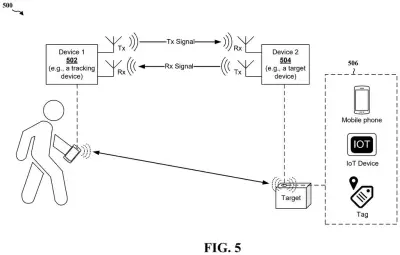
Your phone can already measure distance to things like earbuds, a car key or a door lock using two technologies. Bluetooth sips battery and reaches far. Ultra-wideband (UWB) can pin a location down to within centimeters but uses more power. Qualcomm's patent application describes a phone that checks a list of conditions and picks whichever fits the moment.
Once it decides, it tells the other device to switch too, so both sides stay in sync. The conditions include indoors or outdoors, how far apart the devices are, battery level, how confident each reading is, and whether Wi-Fi is crowding the airwaves.
obtain a set of triggering conditions for selecting or switching between Bluetooth ranging or ultrawide band (UWB) ranging; select or switch to the Bluetooth ranging or the UWB ranging based on at least one triggering condition in the set of triggering conditions being satisfied …
Translation: The phone sets up rules for when to switch between Bluetooth and UWB tracking.
How the phone picks between two tracking radios
The main claim covers three steps on a phone (the filing calls it a user equipment, or UE): get a set of triggering conditions, switch to Bluetooth ranging or UWB ranging when at least one condition is met, and send the other device an indication to switch as well. "Ranging" just means measuring the distance between two devices.
The conditions can come from the other device, from a network server, or be preloaded in the phone's memory. The filing gives many examples:
- Surroundings: outdoors or a clear line of sight favors Bluetooth, while indoors or bouncing signals favor UWB. The phone can read a signal graph (the channel impulse response) for a clear peak, use sensors, or even note a metro turnstile scan.
- Distance: beyond a set threshold, such as 10, 30 or 100 meters, favors Bluetooth. Closer favors UWB.
- Confidence: how consistent recent readings are, or the output of an AI model.
- Battery: a low level favors Bluetooth.
- Crowding: whether Wi-Fi or other traffic is occupying the channel.
When several conditions apply, the phone can give each a priority, score both technologies and pick the higher score. A switch can be done by turning off the antennas of the other radio. The phone can also tell its partner which condition caused the switch.
Aspects presented herein may enable a first user equipment (UE) to dynamically switch between Bluetooth ranging and ultrawide band (UWB) ranging based on a set of triggering conditions while performing ranging with a second UE, thereby improving the overall performance of the ranging.
Translation: Your phone can automatically swap how it measures distance to another device to make tracking work better.
What this means for car keys and door locks
The filing points to digital car keys and home door locks as popular uses for this kind of distance measuring, where your phone or watch needs to know how close you are before it unlocks or turns on lights. Those uses reward precision, but precision costs battery. A phone that uses the cheaper radio when it can and the precise one when it must could keep both accuracy and battery life in check.
The idea also covers the plain case of finding a pair of earbuds. Far away or outdoors, a rough Bluetooth reading may do. In the hallway, centimeter-level UWB is what you want. Because the phone tells the other device to switch too, a tag or accessory could follow along, which matters for any product with a tracking tag in it.
This is the 625th Qualcomm filing in our Qualcomm coverage since May, adding to work like the self-driving explainer and the map-matching method.
Source: US 2026/0371299 A1 at the USPTO (PDF). Full patent text and figures are in the official publication.
Get our take in your Top Stories
Liked this breakdown? Add Patentlyze as a preferred source on Google, and our plain-English take shows up more often in your Top Stories the next time Qualcomm patent news breaks.
Add Patentlyze on Google
One click.
There are more where this came from
We read every patent application Big Tech publishes and send you the ones worth knowing. Plain English, free, every week.
The drawings · 10 sheets
10 drawing sheets from US 2026/0371299 A1 · click any drawing to enlarge


Show the other 2 sheets


More from Qualcomm
All 637 Qualcomm patents →
More in Networking
All 516 Networking patents →
Intel
Intel Files Patent for Keeping Neighboring Cell Towers From Drowning Out Each Other's Radar
Qualcomm
Qualcomm Patents Phones That Use Radio Signals as Radar and Report Back in Plain Words
Qualcomm
Qualcomm Files Patent for Wi-Fi That Can Tell a Game From a Video Call
Nvidia
No comments yet