
Intel
Intel · Networking · Filed Apr 4, 2025 · USPTO published Nov 12, 2026 · This week's release
Intel Files Patent for Keeping Neighboring Cell Towers From Drowning Out Each Other's Radar
Intel is working on how future cell towers could double as radar without neighbors shouting over the faint echoes the radar depends on.
- Publication number
- US 2026/0358473 A1(US20260358473A1)
- Applicant
- Intel Corporation
- Filed · Published
- Apr 4, 2025 · Nov 12, 2026
- Inventors
- Fatemeh Hamidi-Sepehr, Thushara Hewavithana, Mark Lehne, Qian Li, Debdeep Chatterjee
- Status when we published
- Waiting for an examiner
- Document
- 20 claims
- US classification
- 342/60
- Examiner
- CROSS, JULIANA MARIA (Art Unit 3648)
- Parent application
- National Stage Entry of PCT/US2023/078815 (filed Nov 6, 2023)(PCTUS2023078815)
What Intel's radar-and-calls tower patent does
Ever tried to hear a friend whisper across a crowded party while the person next to you is shouting? That is roughly the problem facing a cell tower that also works as radar.
Future wireless networks, often called 6G, are expected to do two jobs at once: carry your calls and data, and sense the world by bouncing radio waves off cars, people and buildings and listening for the echo. That echo is faint, because the signal travels out and back. Signals from neighboring towers can easily drown it out.
Intel's filing describes three ways to keep towers out of each other's way. Each tower gets its own set of frequency slots, a bit like separate lanes on a highway. Each uses a different noise-like code, so neighbors' signals look like static to one another. And neighbors can go silent on a schedule, so one tower gets a clear moment to listen.
… processor circuitry communicatively coupled to the memory interface, the processor circuitry to execute instructions for a sensing entity to: map a first set of sensing modulated symbols to time and frequency resources of an orthogonal frequency division multiplexing (OFDM) resource grid …
Translation: The internal hardware organizes radar signals onto specific radio frequencies so they do not crash into each other.
How towers share frequencies, codes and quiet time
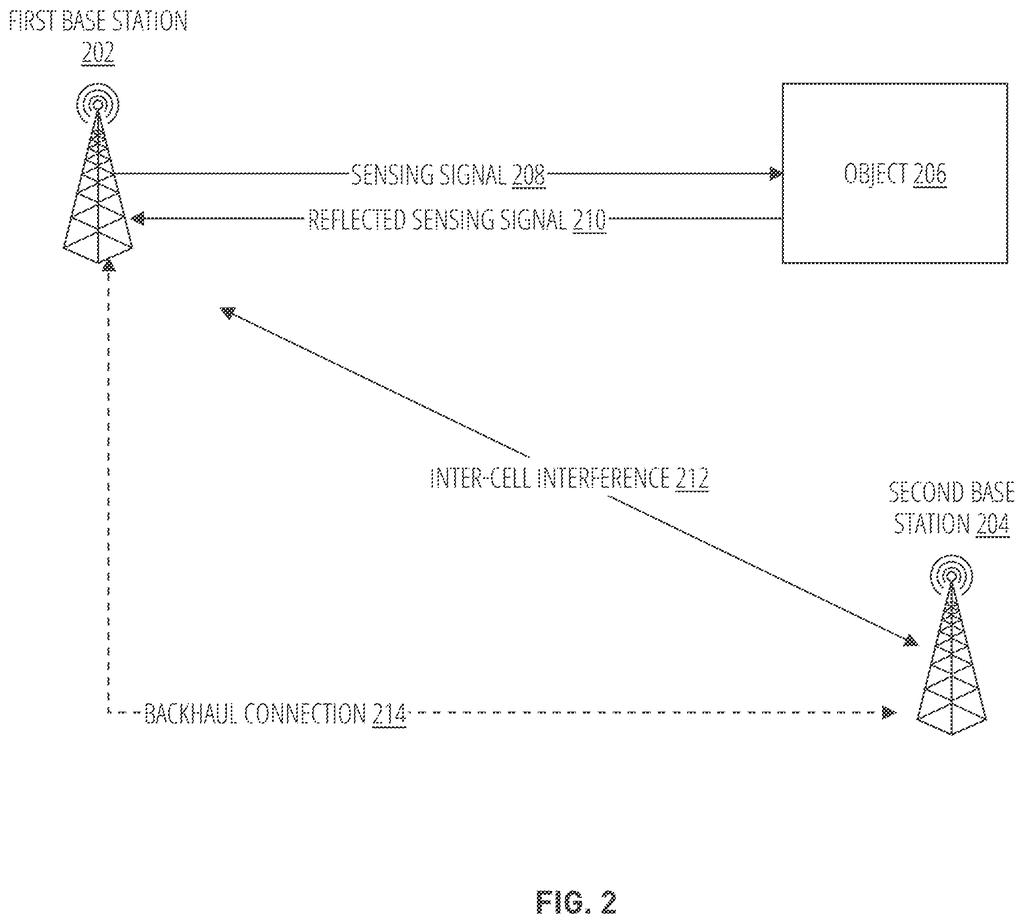
The filing is about joint communication and sensing (JCAS), where one base station both talks to phones and acts like radar. It sends a signal, listens for the reflection off an object, and works out details. The claims list the object's identity, location, range, angle or speed.
The main trouble is interference from neighboring towers. A reflected signal travels out and back, so it is much weaker than a direct signal from a nearby tower. The filing covers three ways to separate the signals:
- Frequency comb: the tower places its sensing symbols (the units of its radio signal) on every Nth subcarrier (a narrow slice of the frequency band), and each tower starts from a different offset. The description says up to three or four towers can share the same time this way without hurting range detection, and power can be boosted to make up for the unused slots.
- Codes: sensing signals use a pseudo-random sequence (a long, noise-like pattern) designed to be pseudo-orthogonal, meaning easy to tell apart, from the patterns neighbors use, including the scrambling on regular data channels. Cover codes add a random phase over time.
- Muting: using the 5G positioning signal format, a tower stays silent for several symbols, slots or subframes so another can sense. Individual repetitions can be muted through a bitmap (a string of on/off bits), and control messages can start or stop the muting.
… wherein the first set of sensing modulated symbols are mapped to a set of comb-structured subcarriers over one or more consecutive OFDM symbols to reduce interference with a second set of modulated symbols within a same frequency bandwidth …
Translation: Spacing out the signals in a comb pattern prevents nearby cell towers from drowning out each other's radar.
What this means for towers that double as radar
If networks start sensing as well as connecting, that sensing has to work in dense areas where many towers overlap. This filing is Intel's attempt at the traffic rules for that: who transmits on which frequency slots, with which code, and at what moment. Without rules like these, a tower's radar could get worse in exactly the crowded places where it would be most useful.
The filing ties its designs to existing 5G positioning signals and names 5G and 6G networks as targets. It names no product, and a published application is not a granted patent. For you, any payoff would arrive as a network feature your carrier offers someday, not as something you buy.
Intel's 197th filing in our Intel coverage since May adds to a pattern that includes reusing AI software on newer chips and splitting graphics chips into custom slices.
Source: US 2026/0358473 A1 at the USPTO (PDF). Full patent text and figures are in the official publication.
Get our take in your Top Stories
Liked this breakdown? Add Patentlyze as a preferred source on Google, and our plain-English take shows up more often in your Top Stories the next time Intel patent news breaks.
Add Patentlyze on Google
One click.
There are more where this came from
We read every patent application Big Tech publishes and send you the ones worth knowing. Plain English, free, every week.
The drawings · 27 sheets
27 drawing sheets from US 2026/0358473 A1 · click any drawing to enlarge


Show the other 19 sheets


More from Intel
All 197 Intel patents →

More in Networking
All 498 Networking patents →
Google
Google Files Patent for Telling Cell Towers What Your VR Stream Needs
Apple
Apple Files Patent to Keep Airplane Connections Alive Between Cell Towers
Qualcomm
Qualcomm Files Patent for Using Phones and Cell Towers as Landmarks for Cameras
Apple
No comments yet