
Salesforce Files Patent for Headset Stories That Let You Walk Through Your Data
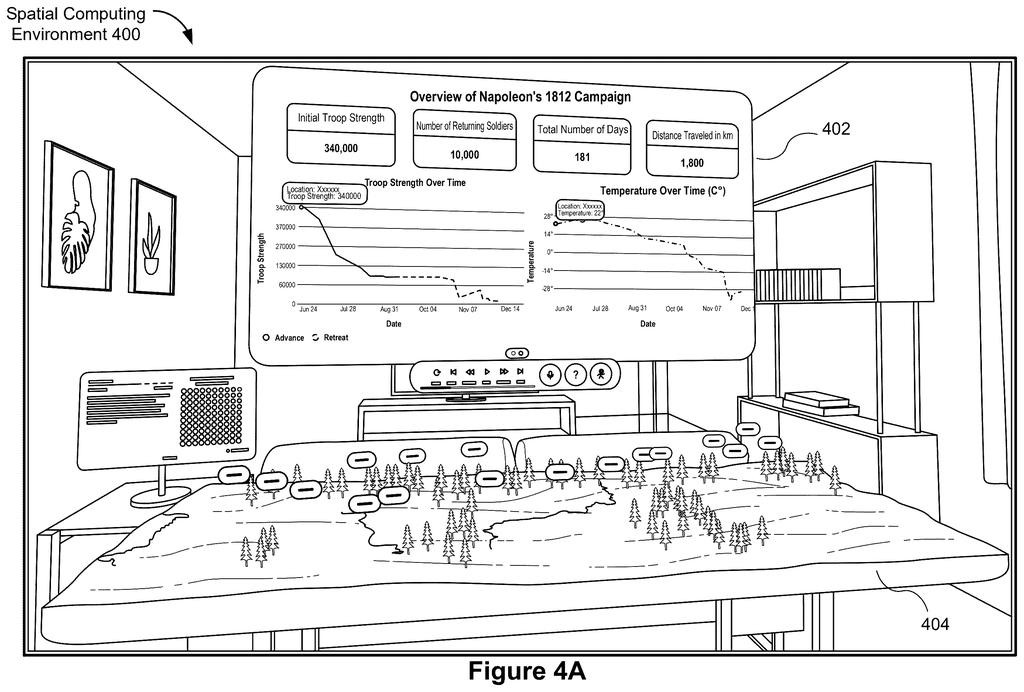
Salesforce's filing turns Napoleon's doomed march into Russia into a 3D world you can walk through, with troop and temperature charts moving in step with the narration. The same toolkit could, in principle, do it for any story told with data.
What Salesforce's headset data stories do
A famous chart of Napoleon's 1812 march into Russia shows an army shrinking as it crawls across a flat page. You can read it, but you can't stand inside it.
Salesforce has filed a patent for a toolkit that turns data like that into a story you walk through while wearing a headset. A builder feeds in a list of events (where, when, what happened) plus 3D models such as terrain. The toolkit ties each piece of data to a spot in the 3D world and writes the rules for how the story moves along.
You can let a narrator guide you, or explore on your own. Look at a city marker, tap your fingers, and a card pops up with the numbers. Pick a place like the Kremlin and you are dropped into a full 3D scene of it, with sound. The filing's own demo does this for Napoleon's campaign on an Apple Vision Pro.
obtaining structured event data and one or more spatial visual assets corresponding to a first data narrative; binding portions of the structured event data to respective scene objects associated with the one or more spatial visual assets, including associating the respective scene objects with spatial metadata and temporal metadata; …
Translation: The system takes business data and 3D visual assets, then ties them together using location and time details.
How data rows become places you can enter
Claim 1 describes software that runs on one computer and sends a finished interactive story to a separate headset. It starts with structured event data (a time-ordered list with locations, times and details about each event) and 3D models such as terrain or buildings.
From there, the system works through a series of steps:
- Binding: each piece of data is linked to an object in the 3D scene, along with its position and the moment it happens.
- Story rules: the system writes the rules for moving between scenes. The filing describes this as a state machine (a map of scenes, the conditions that trigger a switch, and the animations in between).
- Extras: it generates data cards, spoken narration and spatial markers (pins anchored to places in the scene). The description says written text can be turned into speech with a text-to-speech model.
- Overview and drill-down: an overview with charts or dashboards synced to the 3D view, plus links from each object to its details and to a close-up immersive scene.
On the headset, playback can run as a guided walkthrough or as free exploration, and gaze, gesture or voice commands select objects. The description says preparing these links ahead of time means the headset doesn't have to rebuild scene relationships on the fly.
Two other independent claims cover a four-module toolkit and a method where the story's order, narration or branching adapts to your gaze, gestures and voice.
… generates interaction-linked presentation data that associates a respective scene object of the respective scene objects with context-specific narrative content and a corresponding localized immersive presentation.
Translation: It creates interactive elements so users can experience specific stories tied to particular 3D objects in the space.
What headset data stories could mean for work
If you've ever squinted at a dashboard trying to follow how numbers changed over time and place, this is the problem the filing says it is after. It argues that flat charts and maps on desktop screens make complex data harder to follow, and that a headset could let a story unfold around you while a chart stays in view.
The practical hook is authoring. The toolkit is aimed at the people who build these stories, so a team could feed in a spreadsheet and 3D models and get a guided tour that viewers can also poke around in. The filing's demo runs on Apple Vision Pro and names HoloLens and Meta Quest as other options. Whether many workplaces will want to read their data inside a headset is the open question.
Salesforce's 95th filing in our Salesforce coverage since May continues a pattern of AI assistant work seen in the search rewrite patent and the fake caller patent.
Claim 1 is wide on the ideas and picky on the steps. It covers software that takes event data and 3D models, links each piece of data to an object in a 3D scene with a place and a time attached, writes the story's rules, builds an overview, and sends everything to a headset that is a separate device.
The claim never mentions history, maps, gaze or voice. Those show up only in later claims, so the first claim's wording would reach a museum tour, a city planning briefing or a company's quarterly numbers laid out in 3D, as long as every step is present. A product missing one of those pieces, such as a headset app with no overview screen, would sit outside the wording of claim 1.
The narrower claims carry the specifics: a set of rules for which scene comes next, selection by gaze, gesture or voice, and a guided mode alongside free exploration. If claim 1 holds up, it would reach well past this one Napoleon demo.
Get our take in your Top Stories
Liked this breakdown? Add Patentlyze as a preferred source on Google, and our plain-English take shows up more often in your Top Stories the next time Salesforce patent news breaks.
There are more where this came from
We read every patent application Big Tech publishes and send you the ones worth knowing. Plain English, free, every week.
The drawings
31 drawing sheets from US 2026/0320926 A1 · click any drawing to enlarge


Show the other 23 sheets


Want this weekly breakdown for a company we don't cover? Patentlyze Pro →
Be the first to weigh in