
Samsung Patents Brighter Camera Feeds for Headsets Used in Dim Rooms
A headset that shows you the world through cameras has an obvious weakness: dark rooms turn the picture muddy and grainy. Samsung's new patent describes a fix that re-tunes the brightness for every frame.
What Samsung's low-light headset patent does
A headset wearer steps into a dimly lit living room, and the live video of the room playing in front of their eyes turns dark, muddy and speckled with grain. That is a real problem for headsets that show you the world through cameras instead of clear lenses.
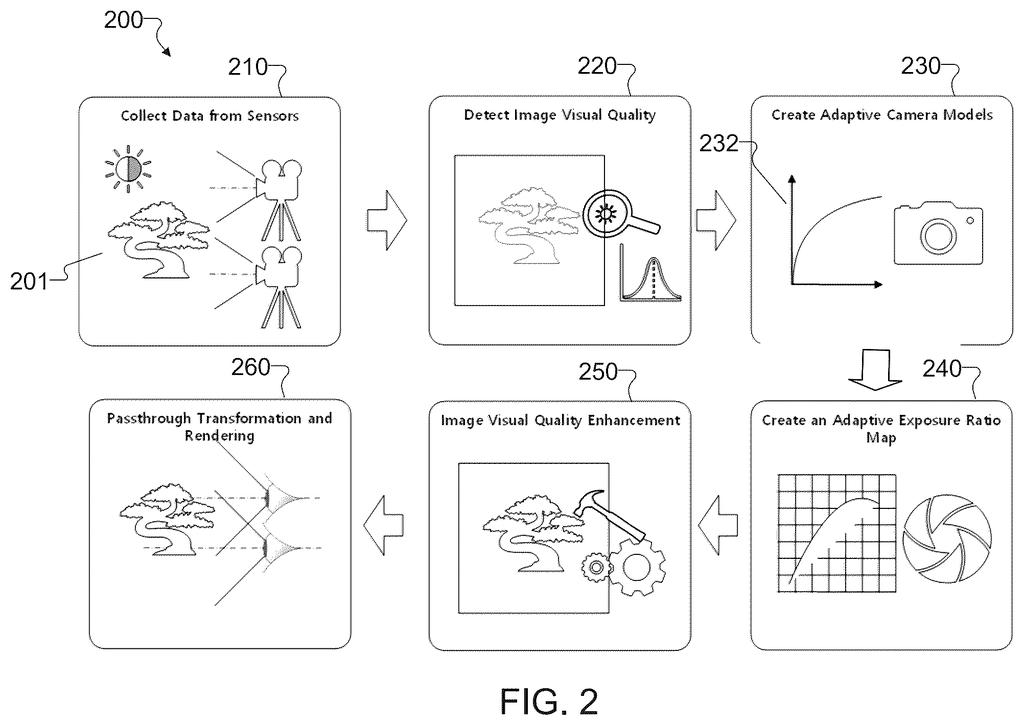
Samsung's patent describes a way to fix that on the fly. The headset checks each camera frame for brightness, contrast and noise, then works out what kind of lighting it is dealing with. It lifts the dark spots pixel by pixel, and if the whole picture is still too dim, it adjusts the overall exposure.
The key idea is that the settings are not fixed. A single preset brightening recipe can leave a brighter scene washed out. Here the recipe changes with the scene, so you would get a clearer view whether the room is dim, normal or bright.
… generating, using the at least one processing device, an adaptive camera model by modeling a light environment associated with the image data; …
Translation: The system studies the lighting conditions in the room to build a custom camera model.
How the headset brightens each pixel on its own
The patent covers a way for a headset to clean up the live camera view before it reaches your eyes. Each frame first gets a quick quality check: how bright it is, how much contrast it has, and how noisy (speckled) it looks, measured across the whole frame and in smaller regions.
From those measurements, the device builds an adaptive camera model. This is a mathematical stand-in for how the camera turns light into pixel values, paired with a brightness transformation (a rule for how a picture changes when exposure changes). The filing names two example shapes for it, a Beta-Gamma model and a Sigmoid model, and the model's settings are recalculated from the frame's average color values instead of being fixed in advance.
Next comes an adaptive exposure ratio map: a per-pixel table saying how much to brighten each spot. To make it, the device estimates how light falls across the scene by solving a minimization problem (a calculation that finds the best-fitting answer under a set of rules). That keeps shapes and edges while smoothing fine texture.
The rest of the pipeline looks like this:
- Brighten dark pixels using the model and the map.
- Check whether the whole frame still needs a lift, and adjust the overall exposure if so.
- Correct for lens distortion and head movement, then show the final frames on the display.
The filing also describes skipping the enhancement when a frame already looks good enough.
Why dim rooms are the test for passthrough headsets
If you wear a headset that shows the world through cameras, dim rooms are where it falls down: dark, murky, noisy video makes it hard to see what is around you. A fix that adjusts to the lighting frame by frame could make evening and indoor use more comfortable, especially if you want to walk around a room while wearing it.
The idea also reaches past headsets. The filing says the same approach could apply to general image processing, where any camera that has to cope with changing light could use it. And because camera video is how these headsets blend real surroundings with digital objects, a clearer view of the room helps anything layered on top of it.
Samsung's 60th filing we've tracked since May in the AR glasses race builds on ideas like single-lens alerts and smoother headset video.
Little has to exist first. The method needs no new lenses, sensors or screens, only software running on the cameras and chips a passthrough headset already carries. The shortest route to a product is an update to the camera pipeline.
The open question is speed. Every frame has to be analyzed, brightened and displayed with almost no delay, or the view starts to feel off. The filing says its shortcut for estimating light is fast and light on computing, but it gives no timing, no test results and no before-and-after images.
Verdict: a sensible, routine image-quality upgrade that could reach users as a software tweak, and one you would notice mostly in dim rooms.
Get our take in your Top Stories
Liked this breakdown? Add Patentlyze as a preferred source on Google, and our plain-English take shows up more often in your Top Stories the next time Samsung patent news breaks.
There are more where this came from
We read every patent application Big Tech publishes and send you the ones worth knowing. Plain English, free, every week.
The drawings
5 drawing sheets from US 2026/0311308 A1 · click any drawing to enlarge


Want this weekly breakdown for a company we don't cover? Patentlyze Pro →
Be the first to weigh in