
Salesforce Patents Push Notifications That Let You Act on Business Data From Your Lock Screen
Salesforce is patenting a way to let workers approve a deal, update a record, or close a support ticket directly from a phone's lock screen, no app required. The notification itself is built in real time from the actual data that changed.
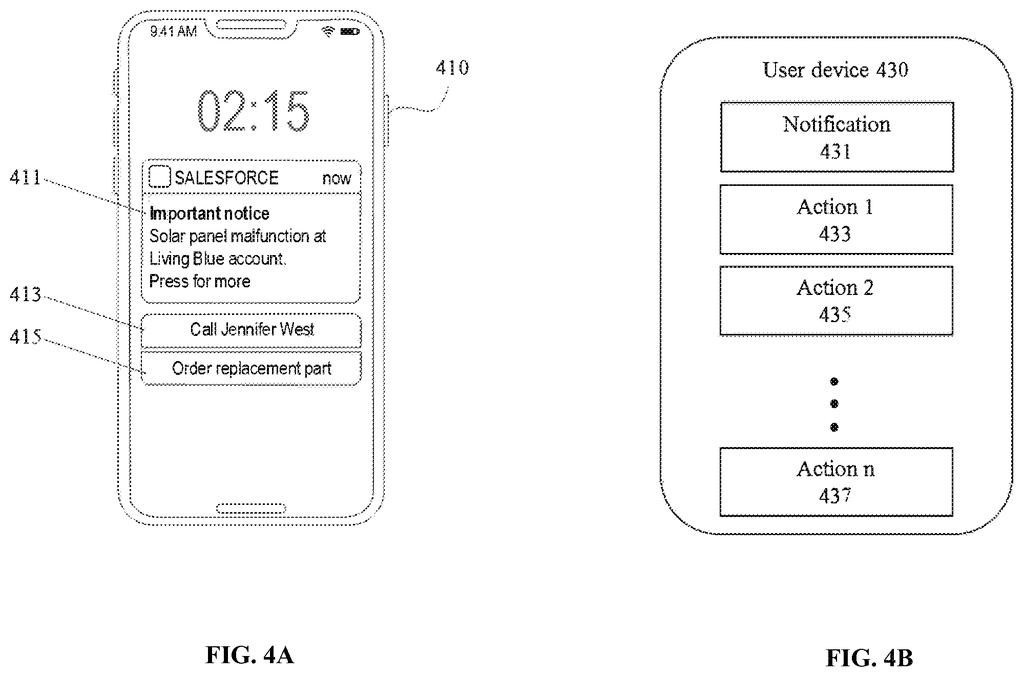
What Salesforce's one-tap lock-screen alerts actually do
Imagine your phone buzzes because a big sales deal just moved to a new stage in your company's CRM. Right now, you'd probably swipe to open the app, wait for it to load, find the right record, and then take whatever action you need. Salesforce's patent describes a system that cuts all of that out.
Instead, the notification that pops up on your lock screen already knows the details of that specific deal, pulled live from the database. Alongside the alert, it shows you a short list of buttons, like "Approve," "Follow Up," or "Reassign," tailored to that exact situation. You tap one, and it's done.
The key idea is that both the message text and the action buttons are built automatically when the change happens, mixing fixed template text with real data from the record. A manager at a company using Salesforce could set up those templates once, and every employee gets personalized, actionable alerts from that point on.
the device displays the notification message and the action message part on a lock screen of the device automatically in response to receiving the push notification without opening the client application; and in response to a user selection of one of the one or more actions, the respective action is executed using the database system automatically …
Translation: Users can take action directly from their lock screen without needing to open the app.
How the notification and action list get built from live records
The patent describes a two-part push notification system. The first part is the notification message itself, which has a fixed template (like "A deal has been updated") combined with variable fields pulled directly from the database record that changed, so the alert reads something like "Acme Corp deal moved to Negotiation stage."
The second part is the action message: a list of one-tap buttons automatically generated alongside the notification. Each button has a fixed text label and is pre-loaded with all the information needed to actually execute that action against the database when tapped.
The whole thing appears on the device's lock screen without requiring the user to open the app. When a button is tapped, the system executes the action directly in the backend database, automatically.
A few things worth noting about the architecture:
- Actions are defined by the business (the "customer" in Salesforce's terminology, meaning the company using the platform), not by individual users
- The action list is generated automatically when the triggering event occurs, not pre-cached
- Execution happens through the database system, so the record is actually updated, not just flagged for later
… forming a notification and a list of actions defined by a customer using fields from the object associated with the event, and presenting the notification and the actions to a user device that's associated to the object.
Translation: Businesses can customize the alerts and available actions using specific data fields.
What this means for sales and support teams on mobile
For anyone who works in sales, customer support, or operations, a big chunk of the day is spent responding to small but time-sensitive changes in a CRM or ERP system. This patent is aimed squarely at reducing that friction. If a support manager can approve an escalation or a sales rep can update a deal stage without unlocking their phone and navigating an app, response times drop and fewer things slip through.
From Salesforce's competitive angle, this is also about making its mobile experience feel more native and immediate, closer to the way consumer apps like Slack or email already work. If Salesforce notifications become genuinely actionable rather than just informational, the platform becomes stickier for mobile-first teams.
This is a real quality-of-life improvement for enterprise mobile users, not a flashy AI story. The technical novelty is modest, but the practical payoff is clear: fewer taps, faster decisions, and less context-switching for people who live in CRM tools. Worth watching to see how Salesforce rolls it out across its product lines.
There are more where this came from
We read every patent application Big Tech publishes and send you the ones worth knowing. Plain English, free, every week.
The drawings
5 drawing sheets from US 2026/0230538 A1 · click any drawing to enlarge


Want this weekly breakdown for a company we don't cover? Patentlyze Pro →
Be the first to weigh in