
Samsung Patents Technology That Shrinks AI Programs Without Sacrificing Their Accuracy
Running a full-size AI model on a phone chip is like trying to pour a river through a garden hose. Samsung's new patent describes a system that figures out exactly where to squeeze the pipe without losing what matters.
How Samsung shrinks AI without breaking what it does
You're recording a video and your Galaxy phone is running AI features in real time: background blur, scene recognition, auto-framing. All of that takes serious computing power, and phone chips have limits.
To run these AI models without killing performance or battery life, engineers shrink them through a process called quantization, which reduces the precision of the math the model does. The tricky part is that not every section of an AI model tolerates shrinking equally well. Squeezing the wrong part too hard degrades the output.
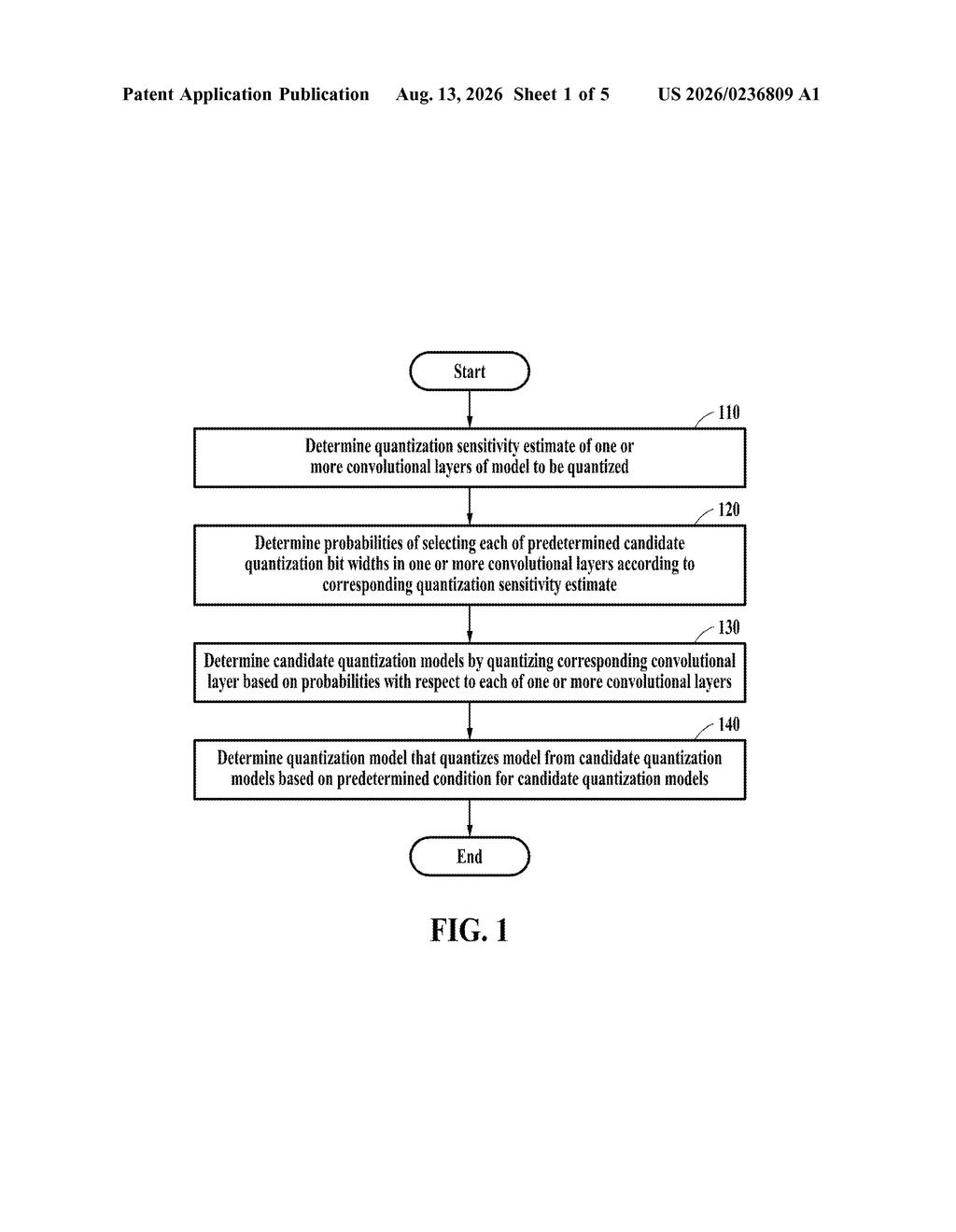
Samsung's patent describes a system that first measures how sensitive each layer of a model is to compression. Layers that are fragile get gentle compression; layers that can take it get squeezed harder. The result is a leaner model that still performs well, without a human engineer having to hand-tune every decision.
determine quantization sensitivity estimates (QSEs) of one or more convolutional layers included in a model to be quantized; according to a corresponding QSE, determine probabilities of selecting predetermined candidate quantization bit widths in each of the one or more convolutional layers …
Translation: The system calculates how much each part of an AI model can be compressed without losing its ability to perform accurately.
How sensitivity scores drive the bit-width selection
The patent covers a method for mixed-precision quantization of neural networks, meaning different parts of the model get compressed to different levels of numeric precision rather than applying one blunt setting across the whole thing.
Here is how the process works:
- The system calculates a quantization sensitivity estimate (QSE) for each convolutional layer (a convolutional layer is a building block in image-processing AI that detects visual patterns). The QSE is essentially a score for how much a layer's output degrades when you reduce its precision.
- Based on that score, the system assigns probabilities to a set of candidate bit widths (8-bit, 4-bit, 2-bit, and so on) for each layer. A sensitive layer gets a high probability of keeping more precision; a resilient layer gets a high probability of being compressed further.
- The system then generates multiple candidate quantization models by sampling from those probability distributions, producing a range of compressed versions of the original model.
- Finally, it evaluates those candidates against a predetermined condition (such as a target accuracy or memory budget) and selects the best one.
The key insight is replacing brute-force search across every possible bit-width combination with a probability-driven sampling approach, which is far faster to compute.
… based on the determined probabilities for the one or more convolutional layers, determine candidate quantization models for the model by quantizing the one or more convolutional layers, and based on a predetermined condition for the candidate quantization models, quantize the model by selecting a quantization model from the candidate quantization models.
Translation: The device creates several smaller versions of the AI and automatically picks the best one that meets its performance goals.
What this means for on-device AI on Samsung phones
On-device AI is only useful if it actually fits on the device. As Samsung pushes Galaxy AI features deeper into its phones and tablets, the gap between what a large model can do and what a mobile chip can handle becomes a real engineering bottleneck. A smarter compression pipeline means Samsung can potentially ship more capable AI features without requiring its highest-end Exynos or Snapdragon silicon.
The broader context matters too: automated model compression is becoming a standard part of how chip-level AI gets deployed, and Samsung filing in this space signals it wants to own the tooling, not just license it. Coverage of new Big Tech patents in on-device AI compression shows this is a crowded area, with Apple, Qualcomm, and others all staking claims to how models get squeezed before they reach your pocket.
The problem this patent attacks is real and expensive: hand-tuning quantization across hundreds of model layers is slow, error-prone, and requires specialized expertise that most teams don't have. A sensitivity-driven probabilistic approach is a well-motivated answer to that cost. Where the filing is less persuasive is in its novelty; sensitivity-aware mixed-precision quantization has been an active research area for several years, and the patent's contribution appears to be a specific procedural pipeline rather than a fundamentally new idea. Whether Samsung's implementation is differentiated enough to matter in practice depends on details the filing doesn't fully expose.
There are more where this came from
We read every patent application Big Tech publishes and send you the ones worth knowing. Plain English, free, every week.
The drawings
5 drawing sheets from US 2026/0236809 A1 · click any drawing to enlarge


Want this weekly breakdown for a company we don't cover? Patentlyze Pro →
Be the first to weigh in