
Samsung Patents an AI Photo Editor That Borrows From Your Other Photos
Removing someone from a photo or stretching its edges usually means guessing what should fill the gap. Samsung's new patent describes a system that doesn't guess, it looks at other photos you took around the same time to borrow the visual details it needs.
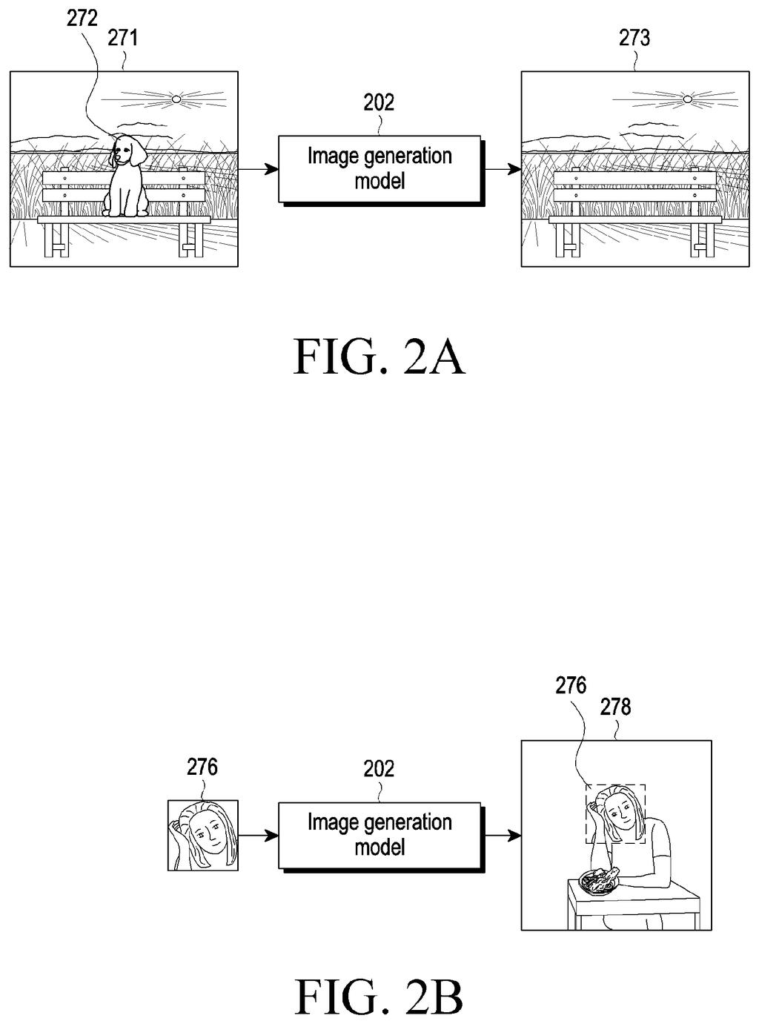
What Samsung's nearby-photo editing system actually does
Imagine you took a burst of five photos at a family gathering, and in your favorite one, a stranger's arm is creeping in from the edge. You want to erase it, but the background behind it is a complicated brick wall pattern the phone has never seen before.
Samsung's patent describes a system that, instead of inventing pixels from scratch, searches your camera roll for photos taken at nearly the same moment or of the same subject. It pulls visual details from those nearby shots, like the texture of that brick wall, and uses them to fill in the erased area or to extend the photo's edges.
The result is a third, combined image that looks far more like your scene than a generic AI fill would. The system works for both inpainting (filling a hole inside a photo) and outpainting (expanding the photo beyond its original frame).
… identify a second image that is captured within a capture threshold of an acquisition time of the first image stored in the memory or is related to a subject of the first image; …
Translation: The software searches your gallery for photos taken around the same time or featuring the same subject.
How the device finds and uses a second image to fill gaps
The patent describes a process with a few distinct steps:
- Trigger: When you ask to edit a photo (the "first image"), the device searches for a "second image" that was either captured within a time window of the first or shares the same subject.
- Feature extraction: The device pulls feature information from that second image. In practice, this means low-level visual data like colors, textures, and structural patterns that characterize the scene.
- Painting operation: Using both the original photo and that borrowed feature data, the system runs an inpainting or outpainting pass. Inpainting fills a deleted region inside the photo; outpainting generates new content beyond the original borders.
- Output: A third image is produced that combines the original photo with the newly generated region, stitched together as a single result.
The key design choice is the source of reference data. Rather than relying purely on a general AI model trained on internet images, the system grounds its fill in actual photos from the same shoot. This gives the model something concrete to match against: the real lighting, real background, and real subject from that specific place and time.
What this means for AI editing on Galaxy devices
Most phone AI editors today fill deleted or extended areas using large general-purpose models that have never seen your specific scene. The results can look plausible but generic, especially for unusual textures or consistent backgrounds across multiple shots. By pulling from your own camera roll, Samsung's approach ties the generated content to reality in a way a model working alone cannot.
For Galaxy users, this could make editing tools like object eraser and photo expansion meaningfully more reliable in everyday situations, like travel photos, family events, or any burst-shooting scenario. The tradeoff is that the system depends entirely on whether a suitable nearby photo actually exists. If you only took one shot, or the second image doesn't contain the needed visual overlap, the system presumably falls back to standard generation, and the quality gap would be immediately obvious.
Samsung's 22nd filing we've tracked in our AI photo editing race since July builds on ideas like targeted pixel touch-ups and placing people in movie scenes.
Samsung's system gets smarter fills by borrowing detail from nearby photos, but that advantage evaporates the moment you're editing a one-of-a-kind shot with nothing similar in your camera roll. The better the reference, the better the result, which means the quality is uneven by design.
The tradeoff reads as reasonable, because most people shoot in bursts and end up with dozens of near-identical frames anyway. Using that existing pile of similar photos as raw material costs the user nothing and asks nothing different of them.
The real unknown is how the device decides which nearby photo is actually useful. That selection logic is where the whole approach could fail, and the patent says almost nothing about it.
There are more where this came from
We read every patent application Big Tech publishes and send you the ones worth knowing. Plain English, free, every week.
The drawings
8 drawing sheets from US 2026/0278754 A1 · click any drawing to enlarge


Want this weekly breakdown for a company we don't cover? Patentlyze Pro →
Be the first to weigh in