Samsung
Samsung · AI / ML · Filed Apr 7, 2026 · USPTO published Aug 20, 2026 · Aug 20 release
Samsung Patents an AI That Reshapes How Close or Far a Subject Looks in Old Photos
Wide-angle selfies squish faces; zoom lenses flatten them. Samsung is patenting a way to fix that distortion after the photo is already taken, using an AI model that re-renders your subject as if a completely different lens had been used.
- Publication number
- US 2026/0245184 A1(US20260245184A1)
- Applicant
- SAMSUNG ELECTRONICS CO., LTD.
- Filed · Published
- Apr 7, 2026 · Aug 20, 2026
- Inventors
- Sungtae KIM, Jihun MUN, Jiyoon PARK, Nagyeom YOO, Daeyoung HYUN
- Status when we published
- Waiting for an examiner
- Document
- 20 claims
- US classification
- 345/629
- Parent application
- Continuation of PCT/KR2024/016139 (filed Oct 23, 2024)(PCTKR2024016139)
What Samsung's post-shot focal length fix actually does
You're looking back at a group photo and the person closest to the camera looks oddly stretched, the way wide-angle lenses do to faces. The focal length you shot at is baked into the image, and until now, there was no real way to fix it.
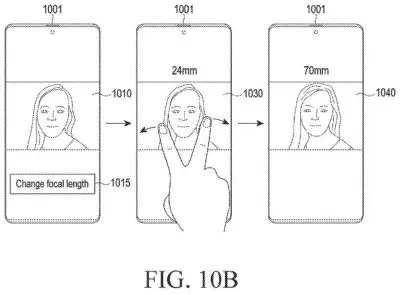
Samsung's patent describes a system where you pick a target focal length after the fact, and an AI model re-draws your subject to match how they would have looked if that lens had been used instead. The background is handled separately, so the two layers can be composited back into a single, corrected photo.
The result is a photo that looks like it was taken with a different lens entirely, without you having to reshoot anything. You stay in your camera roll; the AI does the optical work.
… identify a first subject image corresponding to a first subject included in the first image and a first background image corresponding to a first background included in the first image, obtain, using an artificial intelligence (AI) model, a second subject image by transforming the first subject image based on a target focal length …
Translation: The AI separates the person from the background and alters their appearance for a different camera zoom.
How the AI model separates subject from background and reshapes
The patent describes a four-step process running on the device's processor:
- Capture: A first image is taken at a known focal length (say, 12mm wide-angle).
- Separation: When you ask to edit, the device identifies the subject image (the person or object in focus) and the background image as two distinct layers, similar to how portrait-mode segmentation works today.
- AI transformation: An on-device AI model takes the subject layer and warps or reshapes it to match the geometry of a target focal length you choose (say, 85mm portrait-length). Longer focal lengths compress depth and flatten features; shorter ones exaggerate perspective. The model is trained to understand that relationship and apply it to the pixels of your subject.
- Recomposition: A second, corrected image is assembled with the transformed subject placed back over the background, producing a final photo that corresponds to the target focal length.
The key technical claim is that the subject and background are treated as separate editing targets, which lets the system reshape the subject's geometry without distorting an already-correct background. The AI model does the heavy lifting of knowing how a 24mm nose differs from an 85mm nose.
… acquire a second image corresponding to the target focal length, the second image including the second subject image modified on the basis of the target focal length.
Translation: The final photo shows the subject adjusted to match what they would look like at the new focal length.
What this means for smartphone portrait photography
For smartphone cameras, this is a meaningful gap to close. Phones carry multiple fixed lenses (ultra-wide, main, telephoto), and the best lens for a given situation is not always the one you grabbed in the moment. Portrait shots taken on wide-angle cameras produce unflattering facial geometry that no amount of filter work fully fixes today. A post-capture focal length correction would let anyone retroactively fix that without reshooting.
The approach also fits neatly into Samsung's existing Galaxy AI editing suite, where tools like Generative Edit already manipulate photo layers on-device. This patent extends that philosophy into the optical domain rather than just content removal or fill. For anyone following how AI is rewriting what a smartphone camera can do, this filing sits squarely in the stream of Big Tech patent news around AI-powered computational photography.
Samsung's 15th filing we've tracked in our AI photo editing race since July builds on ideas like sketching photos in the viewfinder and filling missing photo elements.
Source: US 2026/0245184 A1 at the USPTO (PDF). Full patent text and figures are in the official publication.
Get our take in your Top Stories
Liked this breakdown? Add Patentlyze as a preferred source on Google, and our plain-English take shows up more often in your Top Stories the next time Samsung patent news breaks.
Add Patentlyze on Google
One click.
There are more where this came from
We read the new patents from Big Tech, carmakers and more and send you the ones worth knowing. Plain English, free, every week.
The drawings · 16 sheets
16 drawing sheets from US 2026/0245184 A1 · click any drawing to enlarge


Show the other 8 sheets


More from Samsung
All 1,662 Samsung patents →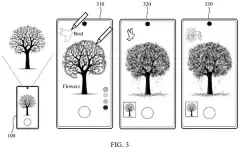
More in AI image & video
All 226 AI image & video patents →
Google
Google Patents a Step-by-Step Noise-Removal System for Generating AI Video
Adobe
Adobe Patents a Second-Pass AI That Cleans Up Messy Edges in Photo Edits
Intel
Intel Patents a Way to Blend AI-Generated Video Into Live Camera Footage in Real Time
Adobe