
Samsung Files Patent for a Soundtrack Generator That Learns What You Like to Hear
Most movie scores and slideshow songs are picked to please a crowd. Samsung's patent application describes software that writes new music for what you're watching, shaped by your own listening and viewing history.
What Samsung's taste-matched music generator does
A birthday slideshow pops up on a phone, and the music behind it is the same sentimental tune everyone else gets. Movie soundtracks work the same way: they are made to please a crowd, not you.
Samsung's patent application describes software that writes brand-new music for whatever you're watching, shaped by your own habits. It looks at what you've played, watched and listened to on your TV, phone, earbuds and other devices (with your permission, the filing says). It also studies the video or photos themselves, plus details like the time of day, the season and the weather.
Put those together and the system composes a track meant to fit both the scene and your taste. You can also just type what you want, such as a mood or a genre, and get music built around that.
generating, by an encoder of a transformer model, a user behavior embedding from user behavior data …
Translation: An AI encoder analyzes your past actions to figure out your listening habits.
How Samsung blends your habits with the scene
The system has several stages that feed into each other.
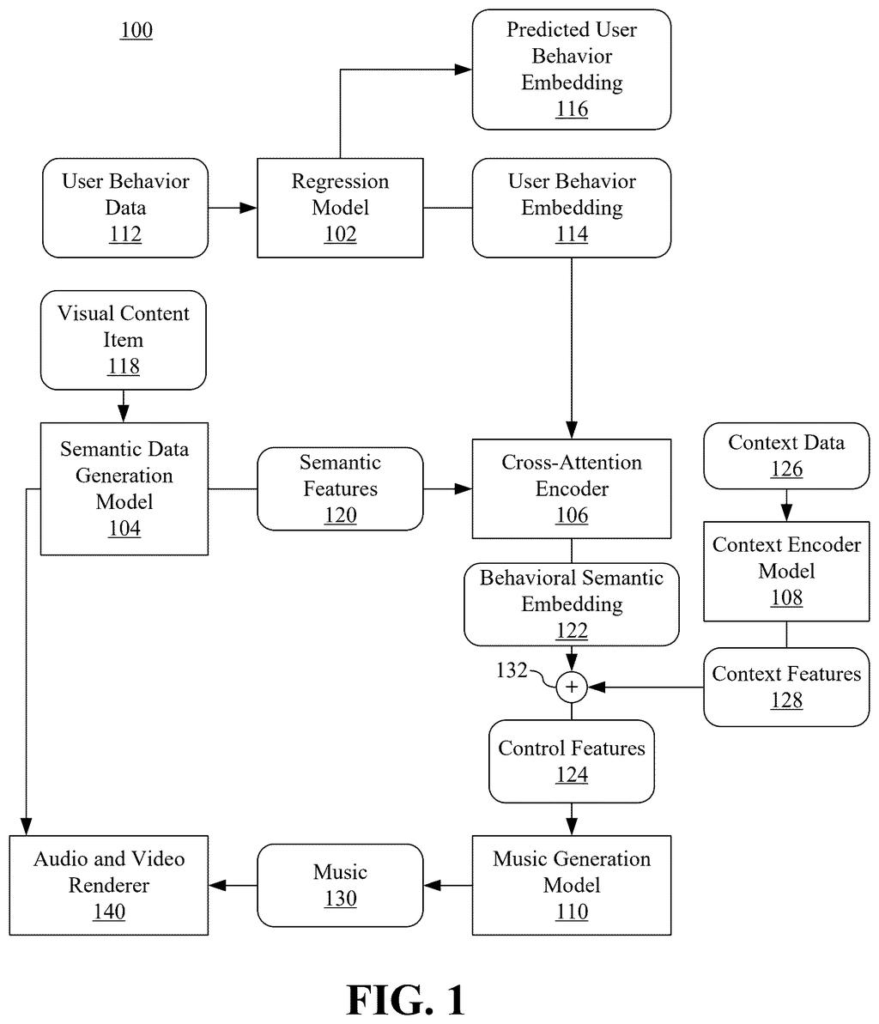
Step 1: a taste profile. Your viewing and listening history (genres, titles, artists, cast) is turned into text and tagged with when each item happened. A transformer (an AI model that is good at reading sequences) condenses it into a user behavior embedding, which is a compact numeric fingerprint of your taste.
Step 2: understanding the scene. A second model pulls semantic features (the meaning of the content) from the input. For video, separate encoders can read the picture, the audio and the closed captions. Alternatively, one large vision-language model describes the video in text. An optional pruning step turns down channels that add little. A scene with only background sound effects might rely on the picture alone, while sparse but important dialogue gets boosted.
Step 3: matching taste to scene. A cross-attention encoder (a model that lets one set of information pick out the relevant parts of another) lets your taste fingerprint decide which scene details matter. The result is combined with context such as time, date, season and weather.
Step 4: composing. A music generation model, described as a diffusion model (it refines random noise into audio step by step), produces the track. The filing also describes adding an analysis of your personal photos and videos to the taste profile.
What this could mean for Samsung TVs and phones
The filing points at screens people already own. It names televisions, phones, earbuds and smart glasses as sources of your habits, and slideshows, home videos, movies and ambient-mode displays as places the music could play. It even mentions Samsung's Bixby assistant as one way to analyze your personal media, so this fits the device ecosystem Samsung already sells.
For you, the change would be small but easy to notice. Photo montages and screensavers could come with music that sounds like your playlists instead of generic stock tracks. It would also need access to a lot of your viewing and listening data. This is a patent application, not a product, so there is no sign yet it will ship.
Samsung's seventh filing in the AI recommendation space we've tracked since June follows earlier applications like one for paused-show recaps and one checking its own health tips.
You would notice this most in your own photo slideshows and home videos. The music would sound like something you'd pick yourself, where today it is chosen to offend no one and so tends to move nobody.
The system has to know a lot about you. It reads what you watch and play across your TV, phone and earbuds, so the feature only works if you are comfortable handing that over. The filing says the data is collected with your permission, and that permission is the part to read closely.
Whether a generated tune can match a favorite song is the open question. A slideshow set to a brand-new track may feel fresh the first time and forgettable the fifth. A movie night with a score aimed at you is still an easy idea to like.
Get our take in your Top Stories
Liked this breakdown? Add Patentlyze as a preferred source on Google, and our plain-English take shows up more often in your Top Stories the next time Samsung patent news breaks.
There are more where this came from
We read every patent application Big Tech publishes and send you the ones worth knowing. Plain English, free, every week.
The drawings
11 drawing sheets from US 2026/0321232 A1 · click any drawing to enlarge


Show the other 3 sheets


Want this weekly breakdown for a company we don't cover? Patentlyze Pro →
Be the first to weigh in