Samsung
Samsung · AR / VR · Filed Apr 9, 2026 · USPTO published Aug 27, 2026 · Aug 27 release
Samsung Patent Wants Your VR Headset To Stop You Breaking Things
If you've ever knocked a lamp off a table mid-VR session, you know the problem Samsung is trying to solve. A new patent describes a headset that watches what you're doing inside a virtual world and figures out where your arms are likely to travel in the real one, before you hit anything.
- Publication number
- US 2026/0251904 A1(US20260251904A1)
- Applicant
- SAMSUNG ELECTRONICS CO., LTD.
- Filed · Published
- Apr 9, 2026 · Aug 27, 2026
- Inventors
- Rahul AGRAWAL, Shivali BHATNAGAR, Prathmesh Shirish MANURKAR, Kaushik DAS
- Status when we published
- Waiting for an examiner
- Document
- 15 claims
- US classification
- 345/8
- Parent application
- Continuation of PCT/KR2024/009515 (filed Jul 4, 2024)(PCTKR2024009515)
What Samsung's collision-warning AR headset actually does
AR and VR headsets already block out your view of the room. Today, most headsets handle collision risk by either showing a basic grid when you get too close to a boundary, or doing nothing at all. Samsung wants to do something more targeted: read what you're actually doing in the virtual experience and predict which parts of your real room are about to be in danger.
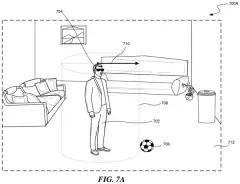
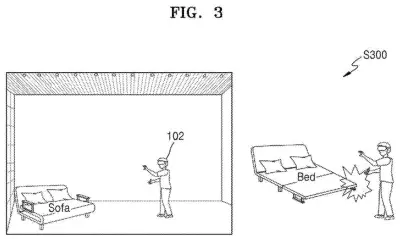
Here's how that plays out for you. Say you're playing a virtual tennis game. Instead of waiting for your hand to cross a static boundary line, the headset would recognize you're about to serve, map out the arc your arm is likely to swing through, and check whether a bookshelf or your coffee mug is sitting in that path. If something is, it changes what you see on screen, perhaps fading in a warning or shifting the virtual scene, before the collision happens.
The system grades the risk, too. A lamp two feet inside your swing path gets treated differently than one barely clipping the edge. The response the headset shows you scales to how bad the potential collision actually is.
… determining a range of movements of the user in a real-world based on the at least one activity of the user; detecting at least one real-world object in the range of movements of the user in the real-world; …
Translation: The headset figures out how you will move and looks for nearby obstacles in your room.
How the HMD predicts your swing radius and spots obstacles
The core idea is that a head-mounted display (HMD) should understand the context of what a user is doing virtually, not just where their physical body is at a given moment.
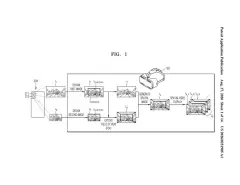
The patent describes a four-step process the device runs continuously:
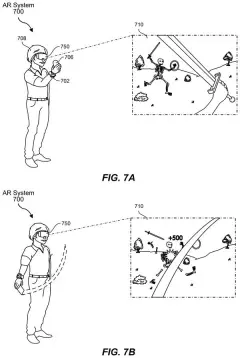
- Activity detection: The headset reads the content on screen and identifies what kind of movement the virtual experience requires. A sword-fighting scene implies wide, sweeping arm motion; a seated menu interaction implies almost none.
- Movement range prediction: Based on that activity, the system estimates the volume of real-world space the user's body is likely to occupy during the action, not just where they are now, but where they're about to be.
- Object detection within that range: The headset's cameras or sensors scan for real-world objects (furniture, walls, people) sitting inside that predicted movement zone.
- Collision degree scoring: The system assigns a severity score to each detected object based on how deeply it overlaps with the user's expected path, then adjusts the virtual display accordingly.
The display adjustment, which the patent calls "altering" or "changing" the content, is deliberately left flexible. It could mean a visual warning overlay, a repositioned virtual scene, a haptic alert, or something else. The key technical claim is the prediction loop: infer motion from context, map it to real space, and respond before contact happens rather than after.
… altering the content being displayed on the XR apparatus based on the determined degree of collision of the at least one real-world entity.
Translation: It changes what you see in virtual reality to keep you from hitting things around you.
What this means for Samsung's next wave of XR hardware
Samsung is pushing hard into XR hardware, and one of the most persistent knocks against VR headsets from everyday users is that they feel unsafe to use in normal living spaces. A system that actively predicts collision risk based on what you're doing virtually, rather than just where you're standing, is a meaningful step toward making headsets usable outside dedicated play spaces. If this works as described, it narrows the gap between "safe to use" and "actually fun to use" in apartments, hotel rooms, or anywhere without a cleared six-by-six-foot zone.
The approach also signals something about where Samsung sees the competitive line in XR. Spatial safety features are increasingly table-stakes, and filing a patent around predictive, activity-aware collision avoidance puts Samsung in the same technical conversation as other headset makers working on pass-through and guardian systems. AR hardware is one of the more active areas across this week's Big Tech patents, and Samsung's focus on pre-collision intelligence rather than reactive warnings suggests its XR team is thinking about the experience of users who don't want to manage a safety system at all.
That makes this Samsung's 40th filing we've tracked since May in the AR glasses race, a watchlist that includes its camera-pointing AR window and merged dual-camera view applications.
Source: US 2026/0251904 A1 at the USPTO (PDF). Full patent text and figures are in the official publication.
Get our take in your Top Stories
Liked this breakdown? Add Patentlyze as a preferred source on Google, and our plain-English take shows up more often in your Top Stories the next time Samsung patent news breaks.
Add Patentlyze on Google
One click.
There are more where this came from
We read the new patents from Big Tech, carmakers and more and send you the ones worth knowing. Plain English, free, every week.
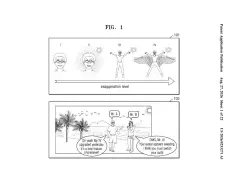
The drawings · 21 sheets
21 drawing sheets from US 2026/0251904 A1 · click any drawing to enlarge


Show the other 13 sheets