
Samsung Patents a System That Reroutes Data When a Memory Chip Gets Overloaded
When one memory chip in a server gets slammed with requests, the whole system slows down. Samsung's new patent describes a switch that redistributes the load before that bottleneck bites.
What Samsung's memory traffic-shifting actually does
Memory chips in large computers have a speed limit. When too many programs try to read or write data to the same chip at once, everything queues up and slows down, much like a single checkout lane backing up at a grocery store.
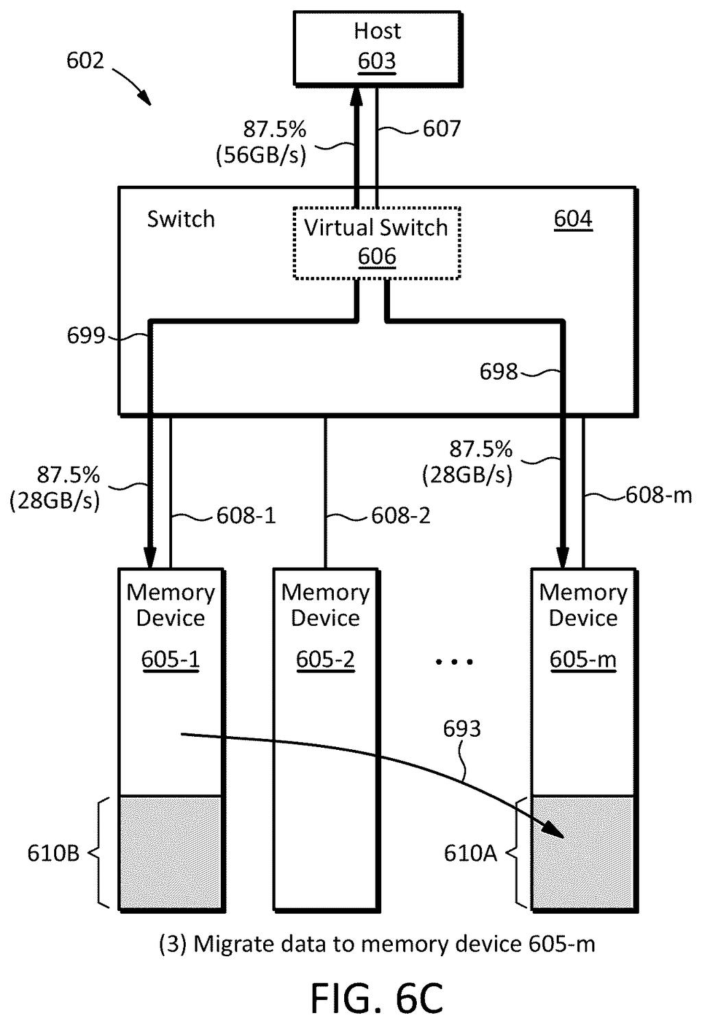
Samsung's patent describes a switch that sits between the computers doing the work (called hosts) and the memory chips storing the data. When the switch detects that one chip is getting overwhelmed, it automatically copies a portion of that chip's data over to a second, less-busy chip. Future requests for that data then get redirected to the roomier chip instead.
The system also picks which host computer gets the job of copying the data, based on how busy the overloaded chip already is. The goal is to keep data moving at full speed without asking anyone to manually reshuffle anything.
… transferring, based on a throughput of the first memory device, using a second memory access link between the switch and a second memory device, a portion of the data from the first memory device to the second memory device.
Translation: When one memory chip gets too busy, the system moves some of its data over to a different chip.
How the switch decides when and where to move data
The patent describes a memory architecture built around a central switch, a hardware router that manages connections between one or more host processors and multiple memory devices. Each connection is called a memory access link.
The switch monitors the throughput of each attached memory device (that is, how much data is flowing through it per second). When a memory device's throughput degrades, signaling that it is becoming a bottleneck, the switch triggers a data migration: a portion of the data sitting on the congested device gets copied over a second link to a different, less-loaded memory device.
Once the migration completes, host requests for that data are redirected to the new location. The patent also specifies that the system selects which host processor performs the copy operation, again based on the throughput reading of the congested device. This avoids making an already-struggling chip do extra work during the transfer.
Key components the patent covers:
- Switch: the central traffic manager between hosts and memory chips
- Throughput monitoring: continuous measurement of each memory link's data rate
- Selective migration: moving only the relevant data slice, not the whole device's contents
- Host selection: picking the least-disruptive processor to carry out the copy
… selecting, based on the throughput of the first memory device, one of the at least one host to perform the transferring.
Translation: The system decides which computer processor is best suited to handle the data migration.
What this means for servers running memory-hungry workloads
In data centers and AI training clusters, memory bandwidth is one of the first things that runs out. When a single memory chip becomes a chokepoint, the processors waiting on it stall, and that stalling cascades through the whole job. A switch that can automatically redistribute data before the queue gets out of hand could keep those workloads running at closer to their rated speed without operators having to step in.
For everyday users, the direct effect is invisible but real: the cloud services and AI applications you use run on exactly this kind of infrastructure. Faster, more consistent memory handling translates into quicker responses and fewer timeouts on the back end.
Samsung's 57th filing we've tracked since June in the AI chip wars watchlist adds to earlier work like one on rerouting conflicting memory and one on borrowing extra storage on how chips manage data pressure.
This patent sits closer to a hardware specification than a finished feature. The described system requires a purpose-built switch with real-time throughput visibility across all its memory links, which means new silicon or at minimum new firmware for existing switch chips. That is not a short path to shipping.
The core idea, dynamic data migration triggered by live performance metrics, is well-understood in storage systems but applying it at the memory level with sub-millisecond reaction times is harder than it sounds. The patent does not describe how the switch avoids making things worse by triggering migrations during the very congestion it is trying to fix, which is the genuinely tricky part of any live-migration system.
As a directional signal, this fits Samsung's position as both a memory chip maker and a supplier to hyperscale data centers. Filing around memory-switch architecture keeps options open for future products aimed at AI infrastructure buyers, where memory bandwidth is the constant complaint.
There are more where this came from
We read every patent application Big Tech publishes and send you the ones worth knowing. Plain English, free, every week.
The drawings
18 drawing sheets from US 2026/0277446 A1 · click any drawing to enlarge


Want this weekly breakdown for a company we don't cover? Patentlyze Pro →
Be the first to weigh in