
Amazon Files Patent for a Voice Assistant That Clicks Through Websites for You
Tell an assistant 'go back' and your web page obeys; ask it a question and it answers out loud. Amazon's patent application is about telling those two kinds of requests apart.
What Amazon's two-channel assistant actually does
You're filling out a long form on a website while talking to a voice assistant on your phone. You say, 'my address is 31 Hudson Yards, New York,' and the address box fills itself in. Then you ask, 'what's your pricing?' and the assistant answers out loud.
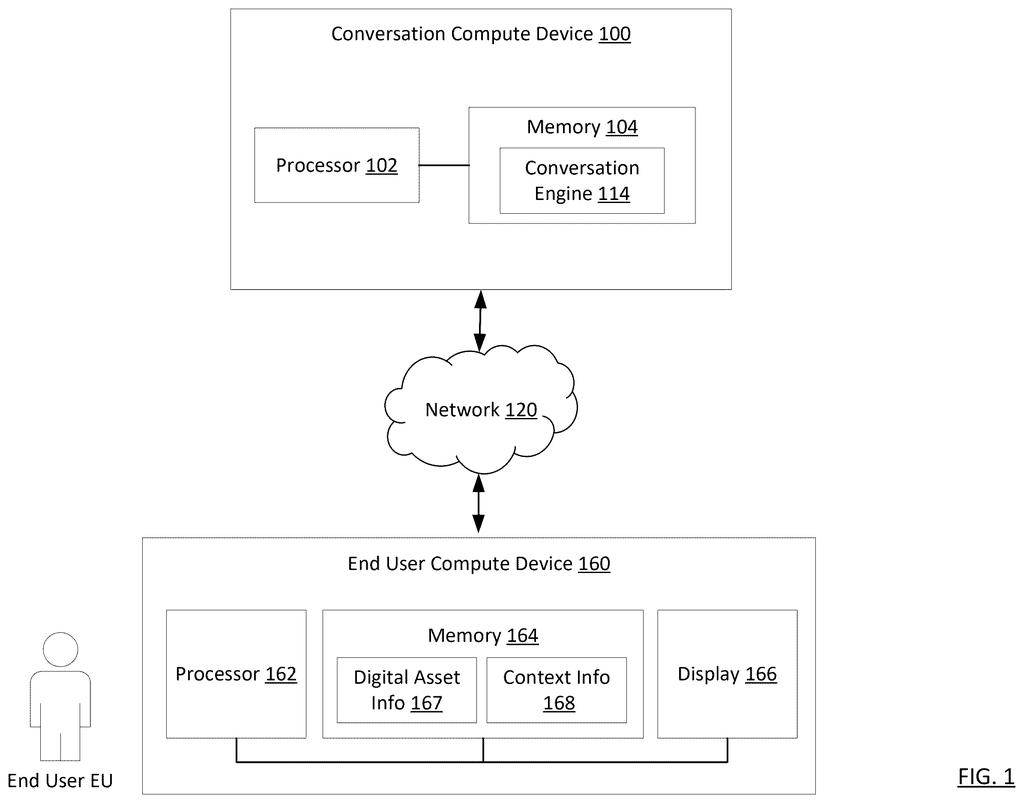
Amazon's patent application describes how to make that work. Your talk with the assistant and the website you're looking at travel on two separate links, and the patent keeps them in sync so both share one picture of what you're doing. Each thing you say gets sorted: is it an order for the page, like 'go back' or 'filter these results,' or a question that needs an answer?
Orders go to the page. Questions get answered in your chat or voice call. If you pack several requests into one breath, the system can split them up and handle each one on its own.
… perform a semantic analysis on the end user input to classify an intent of the user into at least one of a first class or a second class, the first class indicative of a command to directly manipulate a user interface of the digital asset, the second class corresponding to a conversational query seeking information …
Translation: The system figures out if you want it to click something on the screen or just answer a question.
How the assistant sorts commands from questions
The setup uses two links to your device, called channels. The first channel carries a request, for example from a phone call or a chat window. The system replies over it with connection details for a second channel, such as a text message with a link or a code you type into a website. Once connected, the two channels are synchronized, meaning they share one session record (the filing calls it a shared session context) of what's going on.
As you talk or type, the system receives your words plus context information about the page you're on, such as which form fields are showing. That page data can arrive when the system asks for it through an API call (a standard way for programs to request information from each other), or a browser extension can push it automatically.
Then a semantic analysis (reading for meaning, not just keywords) sorts each input:
- Command to change the page: navigation, filling in a field, or a custom action. The system sends an instruction with a label and metadata, such as the page address, over the first channel, and your device carries it out.
- Conversational question: the answer goes back as a natural language message over the second channel. Open-ended questions can be handed to a large language model (an AI that writes text) to draft the reply.
Input unrelated to the session can be ignored, and a mixed sentence can be split so each piece goes to the right channel.
An instruction that includes an indication of the first class and relevant metadata to cause a compute device to execute the instruction to be sent over the first channel and in response to the end user input being classified as the first class.
Translation: It sends automated commands to interact directly with the website when you ask it to take action.
Why this matters for phone menus and web forms
If you've ever been told 'please visit our website' at the end of a phone menu, this is the gap the filing targets. Instead of dropping you, the assistant stays with you while the page does what you ask. That could help anyone stuck with a clunky form, someone with limited dexterity, or a driver who can't touch a screen. The filing names hands-free situations like driving and surgery.
For companies, the filing pitches lower call center costs and round-the-clock self-service, plus data on both what users say and what they do. It lists schools, banks, insurers, travel and tech support as example uses. It describes a method, and it doesn't name any Amazon product that would use it.
One more thing to know: the patent office has already approved this application, and Amazon has paid the fee to have it issued, so it should become a granted patent soon. The final granted claims may read a little differently from the version described here.
Amazon's 11th filing we've tracked in our Alexa taking real-world action watch since May builds on earlier applications covering personality selection before replies and turning requests into software commands.
The cost of this design sits in the sorting step. Every sentence you say gets labeled as an order or a question, and a wrong label means the page jumps somewhere you didn't want, or the assistant chats when you wanted action. The filing says mixed sentences get split into pieces, which helps, but each piece is another chance to guess wrong.
There's a second cost: access. For the page to react, it has to share what's on your screen with the assistant, through a browser extension or a connection the website owner sets up. That takes the site's cooperation and gives a service a view of your form entries, including your name and address.
Even so, the trade looks worth making for long forms and hands-busy moments, where talking beats tapping. Dropping unrelated chatter instead of replying is a sensible guard against false alarms. How rarely the sorter misfires will decide whether people use it twice.
Get our take in your Top Stories
Liked this breakdown? Add Patentlyze as a preferred source on Google, and our plain-English take shows up more often in your Top Stories the next time Amazon patent news breaks.
There are more where this came from
We read every patent application Big Tech publishes and send you the ones worth knowing. Plain English, free, every week.
The drawings
4 drawing sheets from US 2026/0312784 A1 · click any drawing to enlarge


Want this weekly breakdown for a company we don't cover? Patentlyze Pro →
Be the first to weigh in