
Samsung Patents a Five-Lens Camera Stack With Tightly Controlled Spacing
Samsung has filed a patent for a five-lens camera design where the physical gaps between specific lenses must fall within a precise mathematical range, suggesting the company is working on a tightly optimized optics stack for compact imaging devices.
What Samsung's five-lens camera arrangement actually does
You're trying to snap a photo with your phone, and the camera has to squeeze high-quality optics into a body barely thicker than a few coins. That's the core engineering problem Samsung is tackling here.
This patent describes a camera module built from five lenses stacked in a specific order, each with a particular shape and light-bending strength. The order and spacing aren't arbitrary. Samsung spells out a formula that controls how much breathing room sits between the middle lenses, keeping aberrations (the blurring and color fringing that plague cheap cameras) under control.
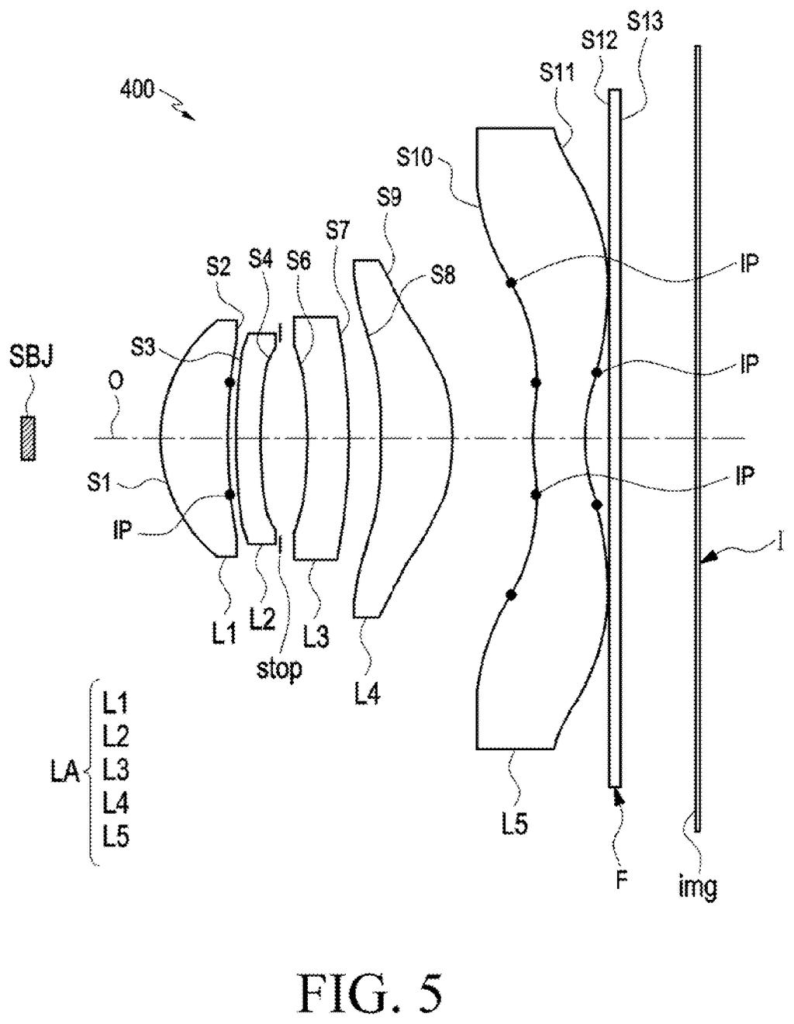
The fifth and final lens is shaped so its front surface bulges outward toward the scene you're shooting while its back surface curves inward in the center, a configuration that helps clean up the light right before it hits the sensor. The whole assembly is designed to be compact enough for a phone or small electronic device.
… a fifth lens having an object-side surface that is convex and a sensor-side surface that is concave in a central region …
Translation: The final lens features one side that curves outward and another side that curves inward at the center.
How the lens gaps and curvatures work together
The patent describes a five-element lens assembly where each lens has a defined refractive power (how strongly it bends light, either converging it or spreading it).
The arrangement goes like this:
- Lens 1: positive power, meaning it starts gathering and converging light from the scene.
- Lenses 2 and 3: both negative power, spreading the light out to correct distortions introduced by the first lens.
- Lens 4: a meniscus shape (curved like a contact lens, convex toward the sensor) with positive power, and it gets thinner toward its edges, helping direct light cleanly onto the center of the sensor.
- Lens 5: convex on the front (subject side) and concave in the center on the back (sensor side), with negative power, acting as a final corrective element.
The key engineering constraint is a ratio formula. Let T23 be the air gap between lenses 2 and 3, T34 the gap between lenses 3 and 4, and T45 the gap between lenses 4 and 5. The patent requires that (T34 + T45) divided by T23 falls between 1.5 and 3. In plain terms: the combined spacing in the back half of the stack must be 1.5 to 3 times larger than the spacing near the front. This ratio keeps light rays hitting the sensor at angles that avoid chromatic aberration (color fringing) and field curvature (edges going soft).
What this means for future Samsung camera hardware
For consumers, better lens engineering in a compact stack can translate directly into sharper photos, especially at the edges of the frame, and reduced color distortion in high-contrast scenes. Samsung makes both smartphone camera systems and standalone image sensors, so a refined lens design like this could appear in a future Galaxy phone camera module or in sensors Samsung supplies to other manufacturers.
That said, a lens geometry patent is one piece of a very large puzzle. Pairing this stack with the right sensor, image signal processor, and software tuning is what actually produces a finished camera product. This filing shows Samsung is iterating on the optics side, but the distance from a patent to a shipping module involves substantial additional engineering work.
Samsung's 128th filing we've tracked since May in our camera sensor work watchlist follows earlier applications on zone-based portrait blur and AI sharpening for XR headsets.
Getting this into a phone requires building real physical parts, not writing code. Five precisely shaped lenses have to be manufactured, stacked, and held in exact alignment, which means factories, tooling, and tolerance testing before a single prototype exists.
The patent describes a specific mathematical relationship between the tiny air gaps separating those lenses. That constraint is the heart of the design: it defines which combinations of size and image quality are actually achievable, which is a harder problem than it sounds when the whole assembly has to fit behind a phone's back panel.
The shortest path to a product runs through optical simulation, physical prototyping, and manufacturing validation, none of which are quick. This document shows Samsung's engineers working at a deep level of lens design, but there is no shortcut from a filed patent to a camera you can buy.
There are more where this came from
We read every patent application Big Tech publishes and send you the ones worth knowing. Plain English, free, every week.
The drawings
19 drawing sheets from US 2026/0276953 A1 · click any drawing to enlarge


Want this weekly breakdown for a company we don't cover? Patentlyze Pro →