
Samsung Patents a Spring-Loaded Gear Hinge for Its Foldable Phones
Samsung has filed a patent for a hinge mechanism that uses interlocking gears and a compressed spring to keep a foldable phone's two halves moving together smoothly, without extra motors or electronic controls.
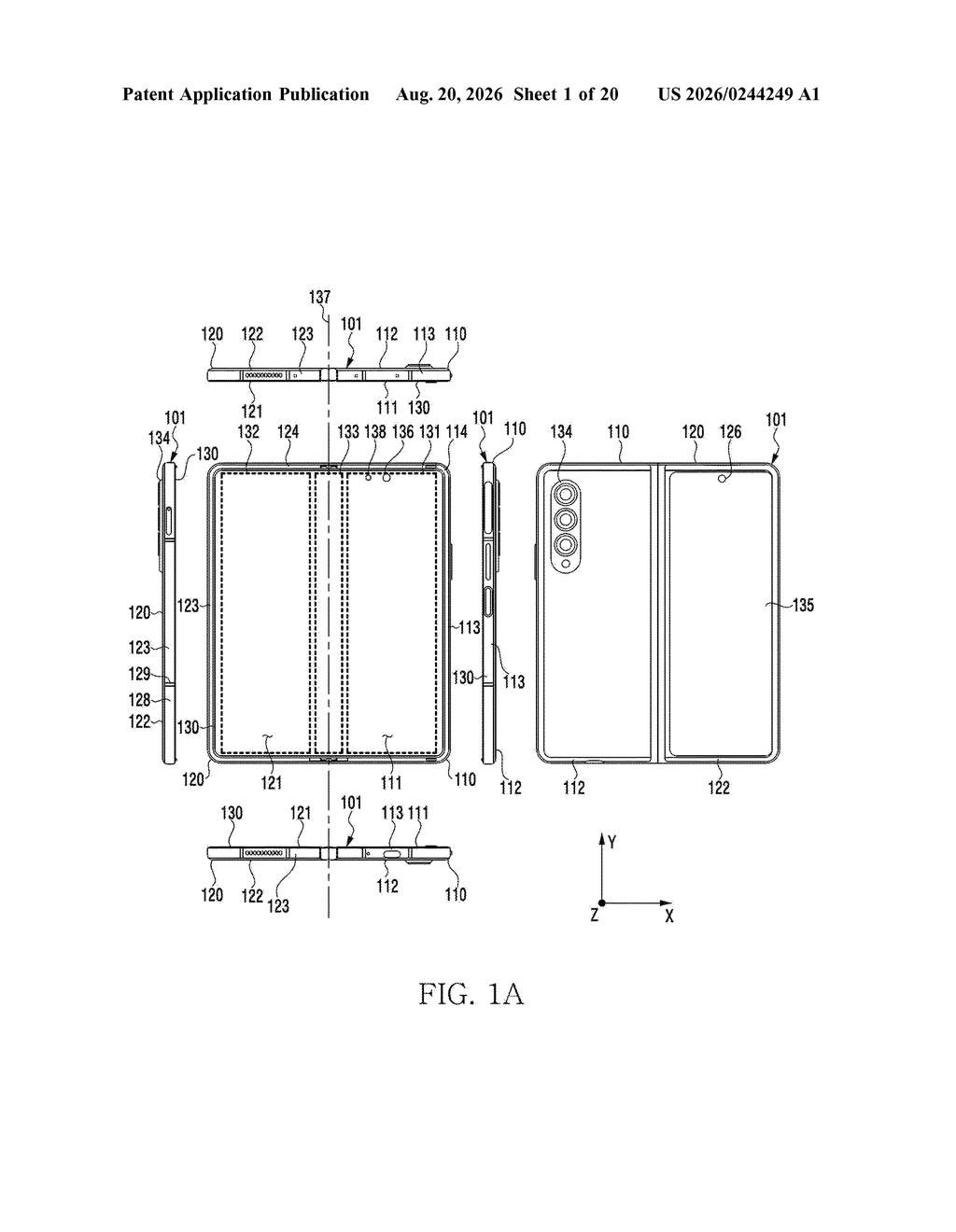
What Samsung's new folding hinge actually does
A folding phone sits half-open on a table, and instead of snapping shut or flopping all the way open, it holds exactly where you left it. That kind of controlled resistance is harder to engineer than it looks, and it's what this Samsung patent is trying to solve.
The patent describes a hinge built around two small gears, one attached to each half of the phone, that connect to a shared spring through a pair of sliding rack gears (think of a rack gear as the straight-toothed strip you see inside a car's steering column). When you fold or unfold the device, the gears turn, the rack gears slide, and the spring pushes back just enough to keep both halves moving in unison.
The result is a fold that feels deliberate, not wobbly. Both panels stay synchronized, and the spring provides a consistent amount of resistance throughout the motion, so the phone doesn't feel like it's fighting you or giving up on you at different points in the fold.
… an elastic member, disposed between the first rack gear and the second rack gear, configured to press the first rack gear and the second rack gear in a direction toward the first gear and the second gear, respectively …
Translation: A spring pushes the gears together to keep the fold steady.
How the rack gears and spring control the fold
At the center of this patent is a hinge assembly made up of several coordinated parts. Each half of the phone connects to a rotator that includes a small circular gear. These two gears spin on parallel axes, meaning they're side by side, both rotating in their own lane.
Engaged with each gear is a rack gear, a straight, toothed bar that slides back and forth as the circular gear turns (the same principle converts steering-wheel rotation into side-to-side wheel movement in a car). The two rack gears face each other inside the hinge body, with an elastic member (a spring or spring-like component) seated between them.
When you open the phone, the gears turn, pushing the rack gears outward against the spring's resistance. When you close it, the spring pushes the rack gears back in, keeping constant pressure on both gears simultaneously. A guide rail constrains the rack gears so they only slide in the intended direction, preventing wobble or misalignment.
The key claim covers all of these elements together:
- Two rotating gears, one per housing panel
- Two rack gears, one per rotating gear
- A single elastic member between the two rack gears
- A guide that keeps the rack gears on track
The spring doesn't just provide feel; it actively presses both rack gears toward their respective circular gears at all times, which helps keep the mesh tight and reduces mechanical slop.
… a first rotator including a first gear configured to rotate about a first axis, connecting to the first housing, a second rotator body, including a second gear configured to rotate about a second axis parallel to the first axis, connecting to the second housing …
Translation: Two parallel rotating gears connect to the two halves of the phone.
What this means for foldable phone durability
Foldable phones are already on the market, but hinge feel is one of the most-criticized aspects of these devices. Too loose, and the screen flops around. Too stiff, and opening the phone one-handed becomes a chore. A gear-and-spring system that mechanically links both halves could give Samsung's engineers precise, tunable control over that resistance without relying on software or additional actuators.
The patent's approach is entirely mechanical, which means fewer failure points over thousands of fold cycles. Foldable hinge durability is a category where Samsung has faced public scrutiny, and a tighter mechanical sync between both panels could also reduce the uneven stress that contributes to crease formation in the display. Samsung's foldable hinge engineering sits alongside a broader wave of hardware-level design work tracked across the latest Big Tech patents, where the mechanical bones of thin, folding devices are being rebuilt from the ground up.
Samsung's 57th filing we've tracked on our foldable phone watchlist since May adds to work like one on a rail speaker and a two-layer screen adhesive.
Claim 1 is interesting because it is specific and broad at the same time. It nails down one particular setup: two toothed sliding bars, one spring sitting between them, a guide, and one gear per casing. That precision means a rival company could probably dodge it just by moving the spring to a different spot or pushing force through a different path.
Yet the claim still covers the whole mechanical chain, from the outer casing down to the sliding bars and spring, without saying what material to use or how many teeth the gears need. That gives Samsung freedom to use this across phones and tablets of many different sizes.
If approved, the patent would block a setup that is actually the most obvious way to build this kind of hinge. That makes it a solid defensive tool for Samsung, even if it does not shut down every other hinge design a competitor might try.
Get our take in your Top Stories
Liked this breakdown? Add Patentlyze as a preferred source on Google, and our plain-English take shows up more often in your Top Stories the next time Samsung patent news breaks.
There are more where this came from
We read every patent application Big Tech publishes and send you the ones worth knowing. Plain English, free, every week.
The drawings
20 drawing sheets from US 2026/0244249 A1 · click any drawing to enlarge


Want this weekly breakdown for a company we don't cover? Patentlyze Pro →
Be the first to weigh in