
Samsung Files Patent for Gates That Widen Their Reach When Your Body Blocks the Signal
Your own body can hide your phone from a station gate. Samsung's filing has the phone notice when that happens and start talking to the gate from farther away.
What Samsung's gate-zone stretching does
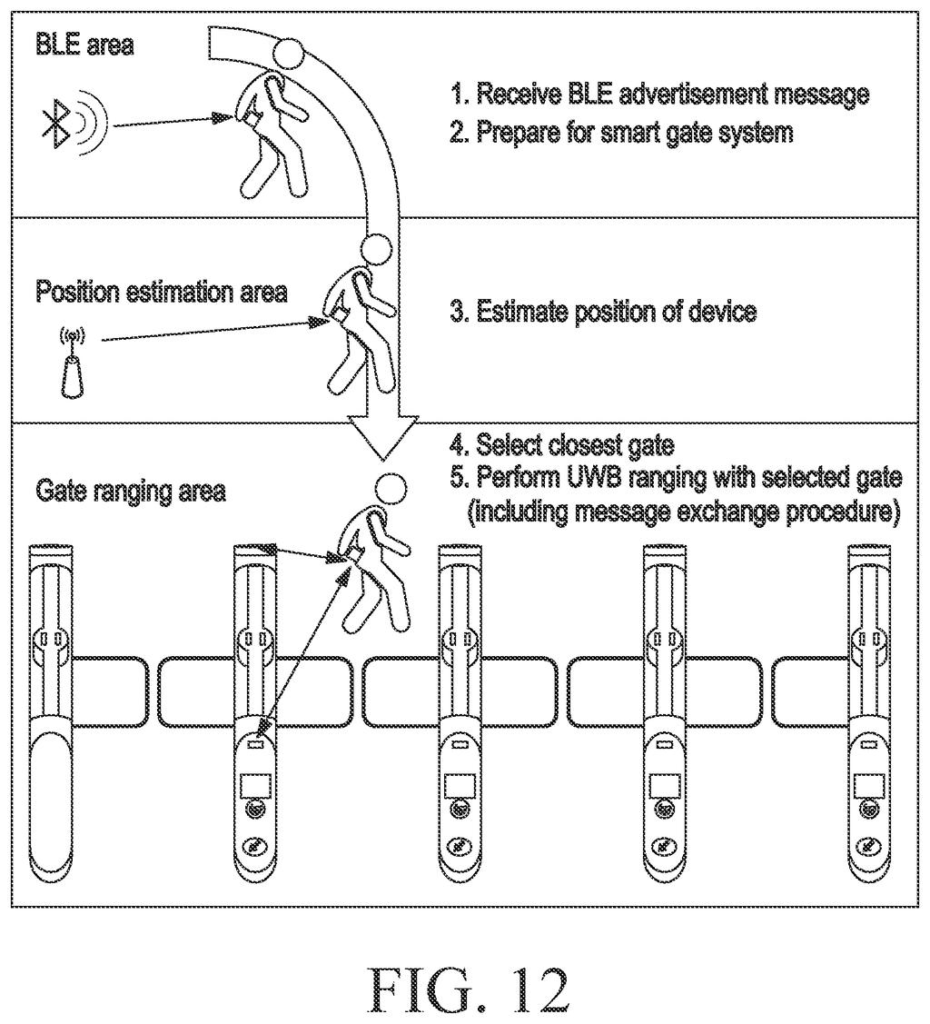
You're hurrying into a train station with your phone in your back pocket and a crowd pressing in around you. The gate is supposed to notice your phone and open as you walk up, but your body is blocking the phone's radio signals, so the phone thinks you're farther back than you really are.
Samsung's filing goes after that problem. Your phone listens to short radio signals from fixed beacons around the station, and a trained AI model guesses how clear a path each signal had to reach you. If the average is poor, the phone widens the zone where it starts its handshake with the gate, so the handshake begins earlier.
The filing also describes shaping that wider zone around the station's floor plan and where crowds tend to walk. It adds a second guess about whether your phone is in your hand or your pocket, which changes when the gate opens.
… maintaining an initially set gate access area in case that the electronic device is in the LOS environment; and adjusting the gate access area according to a value of the average LOS probability in case that the electronic device is in the LOS environment …
Translation: The system keeps the sensor range normal when nothing blocks the signal, but expands it when your body gets in the way.
How the phone scores its signal clarity
The filing covers a phone that uses UWB (ultra-wideband, a short-range radio technology that is good at measuring distance) to work with tagless station gates. Beacons around the station, called anchors, broadcast timing messages, and the phone uses them to work out where it is.
The phone feeds each beacon's signal into a trained convolutional neural network (an AI model good at spotting patterns in signal shapes). The model outputs a probability that the signal had a clear line of sight to the phone. The phone then averages those probabilities across beacons. In the filing's example, six beacons average out to 0.405.
The description says that when the average is above a threshold (0.5 in the example), the phone keeps the gate's original gate access area. That is the zone where the phone and gate begin their distance-checking handshake for a transaction. When the average is lower, the phone stretches that area, by as much as 1.3 times at the extreme, scaling in a straight line between the thresholds.
- Map limits: extra area is added only in directions the building allows, using preset maximum extendable zones.
- Crowd shaping: zones where more people walk, based on paths reported by other users' phones, can get a bigger share.
- Pose check: a second model uses ranging data and motion sensors to guess whether the phone is in a hand or a pocket, then adjusts the zone where the gate actually opens.
The description also says smoothing the model's outputs with a moving average raised back-pocket accuracy from 75.4% to 90.6%.
Why Samsung's gate patent suits rush hour
If you commute through a station with phone-based gates, the practical win is fewer awkward pauses. A gate that hesitates because your body is blocking your phone slows you down, and it slows everyone behind you too.
The filing treats this as a signal-quality problem that the phone can measure for itself. The idea is that the phone adjusts its own behavior as conditions change, rather than the operator tuning every gate by hand. The filing says the same line-of-sight check could also help with digital car keys and payment terminals. For now it reads as a refinement of tagless gate entry rather than a new product.
Samsung's 93rd filing we've tracked since May in our 5G and network push builds on work like predicting signal drops with AI and two plans on one eSIM.
A gate that hesitates for one second sounds minor until hundreds of people queue behind it at rush hour. Every stall adds up, and a phone in a back pocket is an everyday situation rather than a rare one.
The fix matches the size of that problem. The phone checks how clear its signal is, and when the answer is poor it starts the gate handshake from farther away. That is a small adjustment with one clear job.
The filing's reported jump to about 91% accuracy for back-pocket phones shows the underlying guess can be made reliable. Whether it holds up in a real, crowded station is something a patent filing cannot show.
Get our take in your Top Stories
Liked this breakdown? Add Patentlyze as a preferred source on Google, and our plain-English take shows up more often in your Top Stories the next time Samsung patent news breaks.
There are more where this came from
We read every patent application Big Tech publishes and send you the ones worth knowing. Plain English, free, every week.
The drawings
26 drawing sheets from US 2026/0328928 A1 · click any drawing to enlarge


Show the other 18 sheets


Want this weekly breakdown for a company we don't cover? Patentlyze Pro →
Be the first to weigh in