
Samsung Files Patent to Keep Two Phone Plans Running on One eSIM Chip
Switching on a second phone plan can knock out the one you were already using. Samsung's filing describes a short handshake inside the phone that resets only the connection being changed.
What Samsung's one-chip dual SIM idea does
Ever switched to a new phone plan and watched your existing connection drop? On a phone with a single built-in eSIM chip, that can happen, because the chip is normally set up to run only one plan at a time. Turning on plan B can shut off plan A.
Samsung's filing describes a way around it. Each active plan gets its own port, which is like a separate lane between the chip and the phone's radio hardware. When you pick a plan to turn on, the phone tells the chip which plan and which lane to use, and whether that lane needs a refresh first.
If it does, only that lane gets refreshed before the new plan switches on. The plan running in the other lane keeps its connection, so you get dual SIM behavior without adding a second chip.
… sending, by the LPA to an embedded universal integrated circuit card (eUICC) in the device, a first message to enable the target profile, the first message including a refresh flag indicating whether a refresh operation of a target port corresponding to the target profile is required and a port number of the target port …
Translation: The software tells the phone chip to activate a new carrier profile and notes if the connection needs a reset.
How the refresh flag and port number work
The filing is about the eSIM chip inside a phone, formally an eUICC (embedded universal integrated circuit card). It stores your carrier plans as software bundles called profiles. Today only one profile can be switched on at a time. Samsung describes giving each active profile its own virtual port, a separate lane over the single physical link between the chip and the phone's modem.
The claims cover the switching handshake:
- The LPA (local profile assistant, the phone software that manages eSIM plans) picks the profile to turn on and sends the chip an enable message containing a port number and a refresh flag.
- If the flag says a refresh is needed, the chip sends the baseband (the modem's radio processor) a message to refresh that port.
- The baseband answers with a terminal response (an acknowledgment) or resets the port.
- The chip then enables the profile on that port, switching off any other profile already on it.
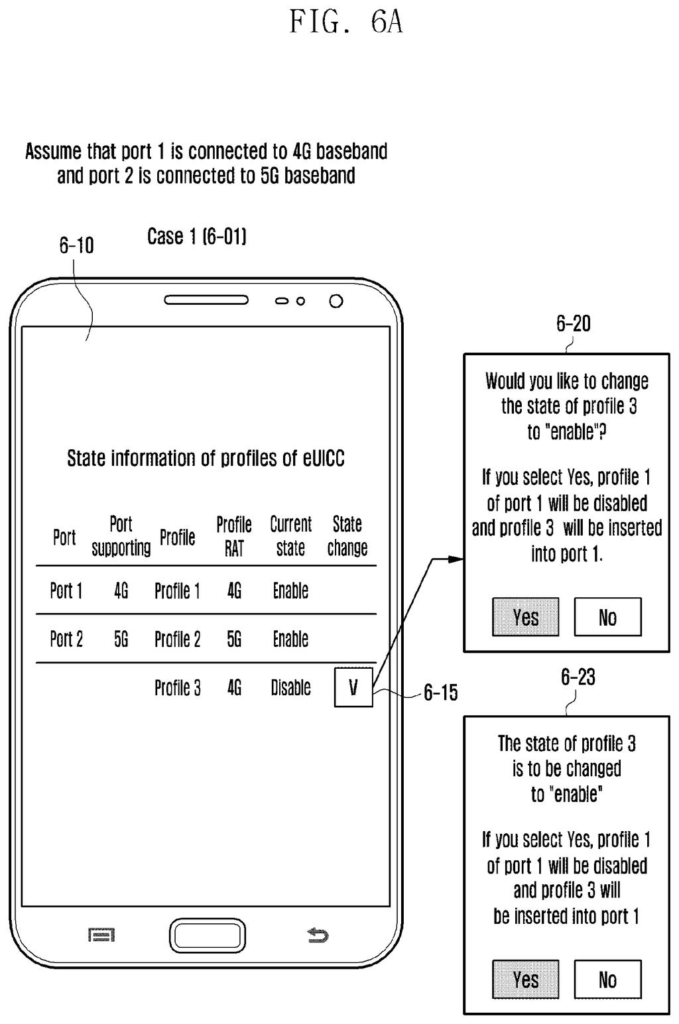
The description explains why the flag matters. In the older approach, a change could make the modem wipe its saved data for every plan, including one you were still using. The filing also describes a settings screen that shows which port is tied to 4G or 5G radio and whether it is in use, plus a version where a carrier's server picks the port remotely. Those are variations, not the core of the claims.
The disclosure relates to a method and apparatus for connecting communication by downloading and installing one or more communication services in a terminal in a wireless communication system.
Translation: This patent describes how phones download and set up digital cellular services without physical cards.
What this means for dual SIM on your phone
For you, the payoff is dual SIM that works on a phone with one eSIM chip. You could keep a home plan and a travel plan active together, and changing one would not cut off the other. The filing says a call or data session on one plan should not be dropped just because you enabled a different one.
For phone makers, the description points to savings. A single chip and a single physical connection can serve two or more radios, which avoids buying a second eSIM chip and finding room for it inside the phone. Carriers also benefit, since their plan keeps working even when a customer changes something on the other plan.
Samsung's 91st filing we've tracked since May in our 5G and network push follows work like satellite timing for phones and per-model AI identity on 5G.
Claim 1 is narrow. It covers one specific handshake: the phone software sends an enable message carrying a port number and a refresh flag, and the radio side either acknowledges or resets that port. It says nothing broad about running two plans at once, so a rival could build dual SIM on one chip a different way.
The flag and port number are what matter here. If granted, the claims would cover phones and chips that use that exact exchange. The dependent claims add small details, such as sending the message on a separate port or switching off whatever plan already sits on the target port.
This filing is a continuation of earlier applications, and one of them is already a granted patent according to the description. The bigger dual SIM idea likely lives in those earlier filings. This one claims a plumbing step that you would never notice, which is the best kind for a feature like this to be.
Get our take in your Top Stories
Liked this breakdown? Add Patentlyze as a preferred source on Google, and our plain-English take shows up more often in your Top Stories the next time Samsung patent news breaks.
There are more where this came from
We read every patent application Big Tech publishes and send you the ones worth knowing. Plain English, free, every week.
The drawings
21 drawing sheets from US 2026/0333017 A1 · click any drawing to enlarge


Show the other 13 sheets


Want this weekly breakdown for a company we don't cover? Patentlyze Pro →
Be the first to weigh in