
Samsung Patents a Way to Pick the Right Person's Gesture in a Crowded Room
When several people are sitting in front of a Samsung TV and waving their hands, how does the TV know whose gesture counts? A new Samsung patent has a specific answer: it checks who's holding the remote.
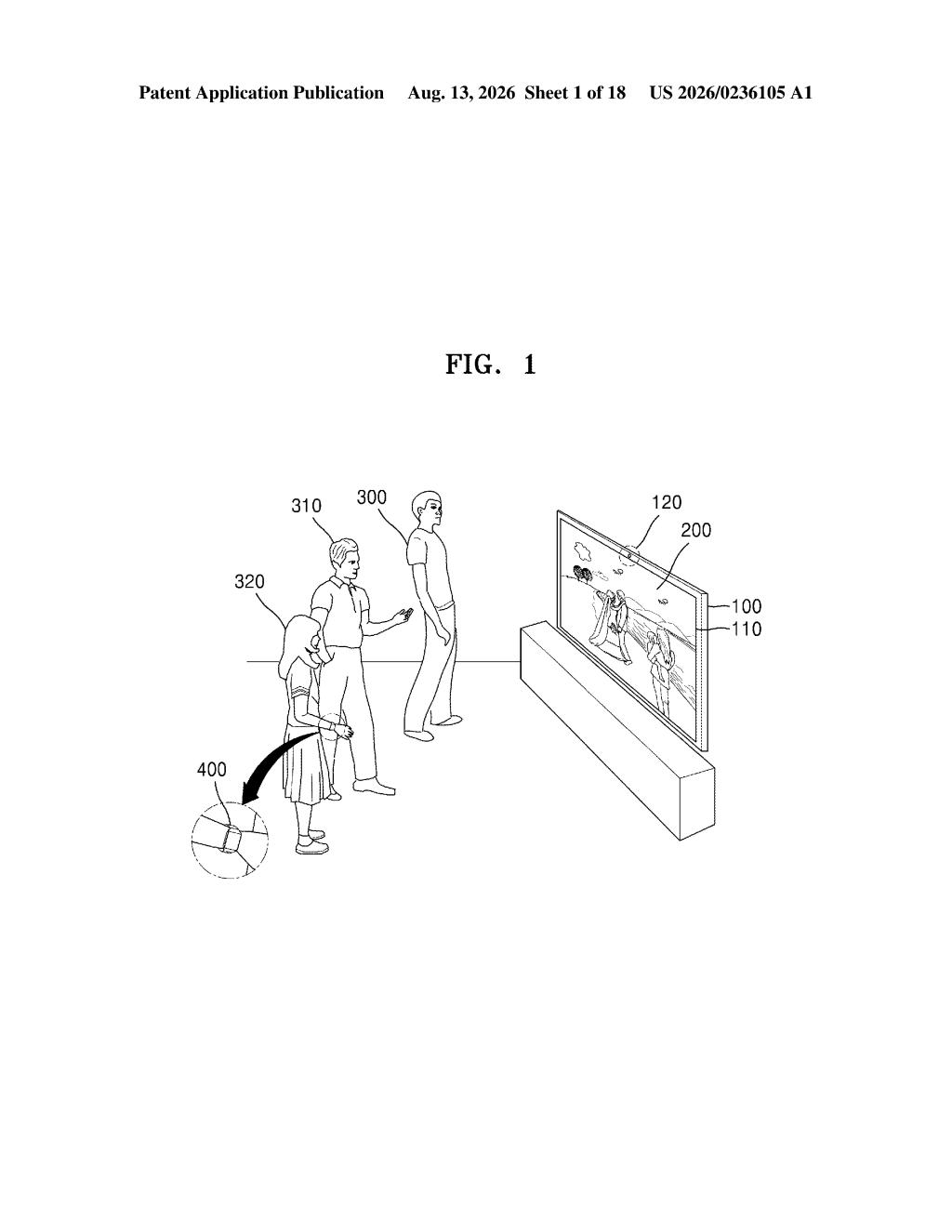
How Samsung figures out which person is actually in control
A Samsung TV stares at a couch full of people. Everyone shifts, waves, or reaches for their drink, and the camera picks up all of it. The problem is telling whose movement was actually meant as a command.
Samsung's approach is to cross-reference the camera footage with data from a physical device, like a remote control or a phone, that you're holding. That device tracks its own motion using built-in sensors. When the TV's camera sees multiple people moving, it finds the person whose body movement lines up with what the handheld device felt at the same moment. That person's gesture becomes the real command.
The result is that you don't have to point, speak, or press anything special to "claim" control. Just hold the device you already use, and the TV figures out the rest on its own.
… obtain at least one piece of gesture information corresponding to each of the at least one user by estimating a gesture from the user image, obtain inertial information from an external electronic device through the communication interface …
Translation: The device watches everyone in the room and checks their movement data against sensors in their wearable gadgets.
How inertial data pins a gesture to one specific user
The patent describes a system built around three separate data streams working together.
- Camera feed: The electronic device (a TV, display, or similar) continuously captures a wide view of the room and uses computer vision to estimate the gestures of every visible person simultaneously.
- Inertial information: A separate, external device (a remote, wearable, or phone) reports its own movement data via its built-in accelerometer and gyroscope. These sensors measure acceleration and rotation in three dimensions, producing a motion signature for whatever the holder is doing.
- Mapping step: The processor compares the gesture estimates from every person in the camera frame against the inertial motion signature from the handheld device. It finds the camera-detected gesture that most closely corresponds to what the held device physically felt, identifying that person as the active user.
Once the system has matched inertial data to one person in the frame, it extracts that person's final gesture and treats it as the controlling input. Everyone else's movements are ignored for that moment. The claim covers this as a single coordinated pipeline, from image capture through gesture estimation through inertial matching to final command output.
… obtain a final gesture for controlling the electronic device of a user corresponding to the mapping gesture information among the at least one user, based on the mapping gesture information and the inertial information.
Translation: The system identifies which specific person is trying to control the device by matching their motion to their gestures.
What this means for gesture-controlled Samsung TVs and displays
Multi-user gesture control has been a persistent friction point for living room devices. Previous approaches required users to stand in a specific spot, use a dedicated trigger gesture, or speak a wake phrase before a hand wave would register. Samsung's approach removes that ceremony by treating the physical remote as a passive identity token, something you already hold without thinking about it.
For Samsung's line of large-screen televisions and displays, this could make camera-based gesture input practical rather than gimmicky. The latest Big Tech patents in gesture and computer vision show a clear industry push toward hands-free interaction for living room and ambient display hardware, and this filing sits squarely in that current.
Claim 1 is written broadly enough to cover any electronic device with a camera, any external device with inertial sensors, and any method of matching the two. That scope is notable: it does not restrict the claim to televisions, remotes, or any specific hardware pairing, which means the patent, if granted as written, could touch a wide range of multi-user camera-control scenarios far beyond TV remotes. The practical blocking power depends entirely on how the patent office reads "mapping gesture information corresponding to the inertial information" and whether prior art in smartwatch-paired TV systems already covers the core idea. The claim is not narrow enough to be easily designed around, but it is also vague enough that its real-world reach will hinge on examination history.
There are more where this came from
We read every patent application Big Tech publishes and send you the ones worth knowing. Plain English, free, every week.
The drawings
18 drawing sheets from US 2026/0236105 A1 · click any drawing to enlarge


Want this weekly breakdown for a company we don't cover? Patentlyze Pro →
Be the first to weigh in