
Samsung Patents a Flexible Smartwatch Screen That Moves Notifications Based on Your Wrist Angle
Samsung is working on a smartwatch that knows which way your wrist is turned and shifts what appears on screen to match, so you're never craning your neck to read a notification.
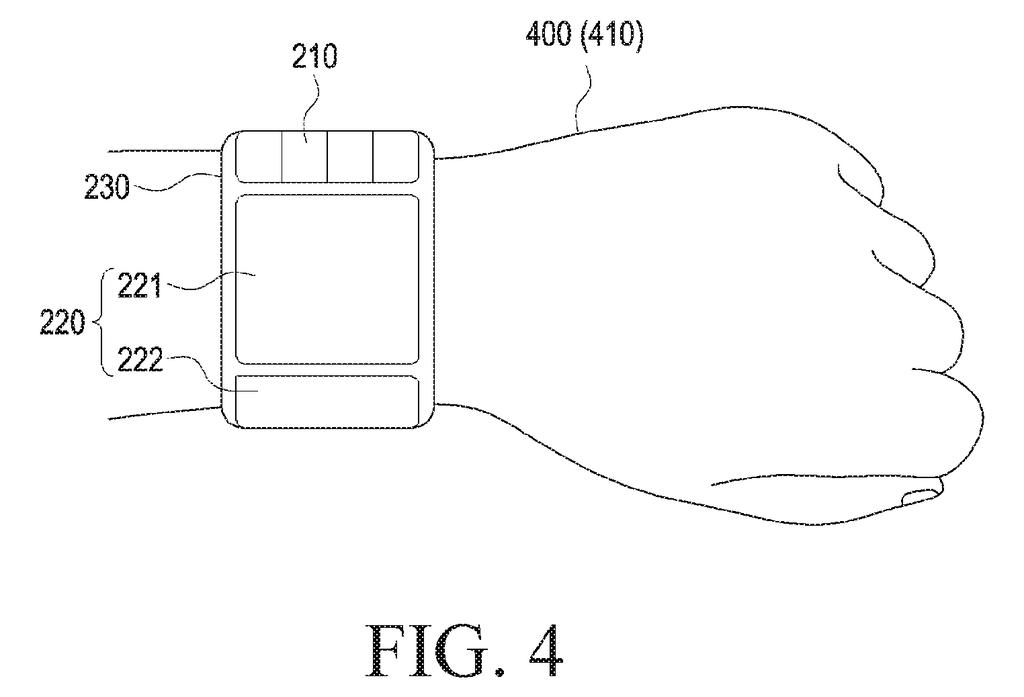
What Samsung's position-aware watch display actually does
Smartwatch screens are fixed rectangles, but your wrist is not a fixed rectangle. When you rotate your wrist to check the time, the screen is already pointed wherever it is, and you just have to deal with it.
Samsung's patent describes a watch with a flexible display that works in tandem with sensors tracking how your wrist rotates and how your arm moves. When a notification or alert comes in, the watch figures out which part of the screen is actually facing you at that moment and shows the content there, not in some default corner.
Think of it like a map that rotates so north always points up, except for your wrist. The display area that wins the lottery is the one your eyes can most comfortably reach. Whether that pays off in everyday use depends entirely on how well the sensors do their job.
… a first sensor configured to detect or identify a rotation of the electronic device, when the electronic device rotates based on a rotation of the wrist of the user; a second sensor configured to detect or identify a movement of the electronic device, when the electronic device moves based on a movement of a arm of the user; …
Translation: Sensors track how you turn your wrist and move your arm.
How the watch maps wrist angle to screen placement
The patent describes an electronic device, specifically a wrist-worn gadget with a flexible display, that uses two separate sensors to understand how the device is positioned at any given moment.
- A first sensor detects the rotation of the device caused by the wrist turning (think of the difference between your palm facing up versus facing down).
- A second sensor detects broader arm movements, capturing the bigger arc of how your whole arm is angled.
When an event occurs that requires showing something on screen, such as an incoming message or alarm, the device reads the combined sensing value from those two sensors. That value maps to a specific region of the flexible display. The processor then instructs the display to render the relevant screen content in that particular region rather than a fixed default area.
The flexible display is divided into a plurality of areas (meaning multiple distinct zones), and the content dynamically routes to whichever zone the sensor data identifies as the most accessible given your wrist's current orientation. The memory stores the instructions that tie the sensing values to the display zones, making this a software-plus-hardware solution rather than a purely mechanical one.
… control the display to display, based on the sensing value, a screen corresponding to the event in an area corresponding to the sensing value.
Translation: Notifications shift to different parts of the screen depending on your arm position.
What this means for flexible-display wearables
For anyone who has ever awkwardly tilted their wrist four times trying to see a smartwatch notification without stopping what they were doing, the underlying idea here is appealing. A display that adapts its active zone to where your wrist actually is could make quick glances faster and less contorted, especially during exercise or while carrying something.
The wider bet Samsung is making is that flexible displays on wearables are worth the engineering complexity they bring. A rigid screen has one usable area; a flexible one can theoretically have several, but only if the device is clever enough to know which one to use. That engineering challenge, and how Samsung and others are approaching it, shows up regularly in Big Tech patent news covering the wearables space.
Samsung's 86th filing we've tracked since May in our display technology watchlist, following work on syncing screens on one chip and a noise-blocking touch layer, adds another piece to the picture.
Routing notifications to different screen zones based on wrist rotation and arm movement sounds elegant until you consider what the system sacrifices: any ambiguous or transitional position becomes a failure point, and a misplaced notification is more disorienting than a static one would ever be. The patent says nothing about how the device resolves those in-between moments, which is precisely where users will lose confidence in the whole interaction. Samsung is betting that sensor fusion on a wrist-sized battery budget is reliable enough to make that cost disappear, and that bet is aggressive enough to matter.
There are more where this came from
We read every patent application Big Tech publishes and send you the ones worth knowing. Plain English, free, every week.
The drawings
25 drawing sheets from US 2026/0245488 A1 · click any drawing to enlarge


Want this weekly breakdown for a company we don't cover? Patentlyze Pro →
Be the first to weigh in