
Samsung Patents a Two-Device System for Cleaner Call Audio
Your earbuds already try to scrub out background noise, but Samsung thinks your phone should be doing half that job too. A newly published patent describes a system where the phone and the earbuds each clean the audio separately, then combine their work into a single, clearer signal.
How Samsung's phone-and-earbud noise cleanup works
Noise canceling on earbuds works by having tiny microphones pick up your voice and then try to separate it from everything happening around you. The problem is that the earbud alone only has so much processing power and so much information to work with, so it often leaves behind a noticeable amount of background noise.
Samsung's patent describes a two-step system where your earbuds handle the first round of noise removal, then send the result to your phone. Your phone takes a second audio stream from the earbuds and runs its own cleanup using a stored profile of what your voice sounds like in a quiet environment. That reference profile helps the phone identify and preserve your voice while discarding the rest.
The two cleaned signals are then blended together into one final output. The idea is that each device compensates for the other's blind spots, so the person on the other end of your call hears something much closer to just you speaking.
obtain a first enhanced audio signal generated by removing a noise from a first audio signal obtained through a first audio collection device comprising circuitry of the sound outputting device; …
Translation: The phone gets a cleaned up audio feed where background sounds have already been filtered out by the companion device.
How the phone layers two cleaned audio signals into one
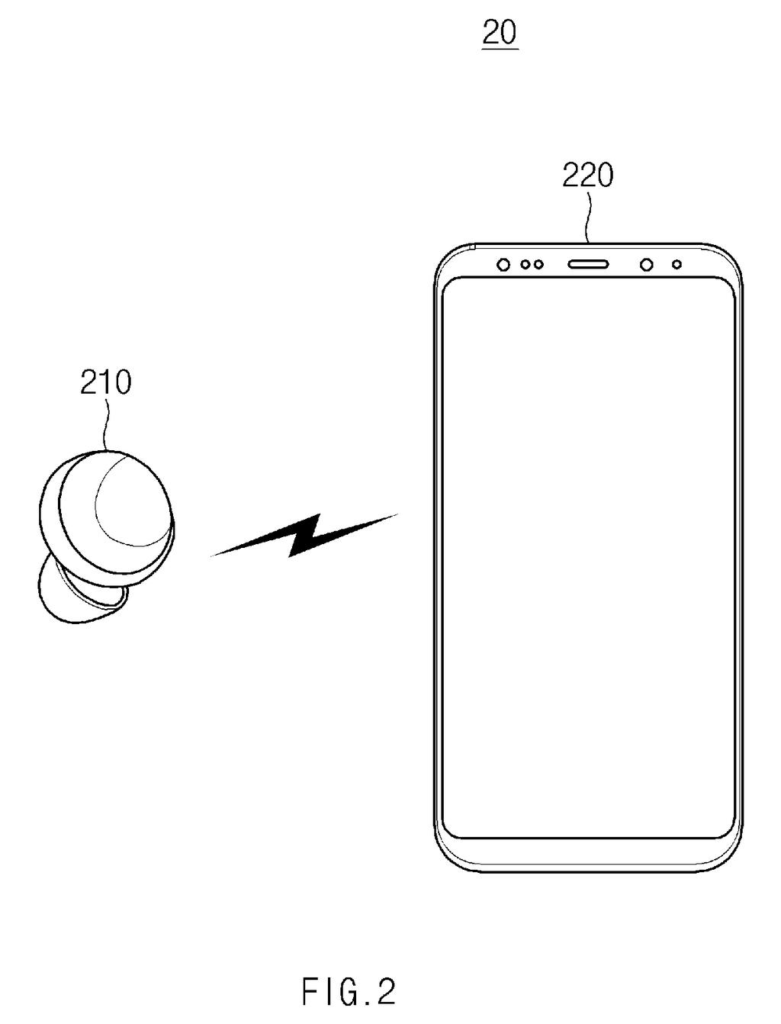
The patent centers on a mobile device that works in tandem with a paired sound outputting device (most likely earbuds or a headset). The system uses two separate microphone streams, processed in parallel.
- The earbuds capture a first audio signal and run their own noise-removal process, producing a "first enhanced audio signal" that gets sent to the phone.
- The earbuds simultaneously capture a second audio signal through a separate microphone channel and send that raw stream to the phone as well.
- The phone generates a second enhanced audio signal by comparing that raw stream against stored first feature information about the speaker's voice recorded in a quiet setting. Think of it as the phone having a reference copy of what your voice sounds like with no interference, which it uses to scrub the second stream more accurately.
- The phone then synthesizes (combines) both enhanced signals into a single output that benefits from two independent rounds of cleanup.
The dual-path approach matters because each cleaning step is imperfect on its own. The earbud's pass may miss some noise; the phone's pass uses speaker-specific knowledge that the earbud lacks. Blending both increases the odds that unwanted sounds are removed without damaging the voice signal.
The disclosure provides an audio signal processing system and method that improves noise component removal through collaboration between a sound outputting device and a mobile device, and an electronic device that supports the same..
Translation: This patent describes a method for cutting out background noise by having your phone and another gadget work together.
What this means for call quality on Galaxy devices
Background noise on phone calls is one of those persistent, everyday frustrations that people have largely accepted as unavoidable. Open offices, coffee shops, public transit, windy streets: these environments routinely make calls difficult, and the burden of fixing that has historically fallen entirely on the microphone closest to your mouth. A system that recruits the phone's processor and memory as a second opinion on the same audio stream is a real architectural shift, not a minor tweak.
For Samsung Galaxy users, this points toward tighter integration between Galaxy phones and Galaxy Buds as a coordinated audio processing unit rather than a phone and a peripheral. The speaker profile stored on the device also raises questions worth watching: how often does it update, who else can access it, and what happens when someone else borrows your earbuds? This patent sits in the broader audio-AI space that the latest Big Tech patents show several companies racing to improve, as AI-assisted voice clarity becomes a baseline expectation for wearables.
That makes this Samsung's 193rd filing in our cell phone patent coverage since May, a corpus that includes work like switching earbuds between phones and fixing rainbow folds in glass.
The problem this patent attacks is real and affects almost everyone who makes calls outside a quiet room. Noise on voice calls is not a niche complaint, and it has only gotten harder to solve as open-plan offices and hybrid work made loud environments the norm rather than the exception. The two-device approach is a credible answer to a structural limitation: earbuds are small, so they have limited compute and limited microphone placement options. Offloading a second processing pass to the phone, which has far more memory and processing power, makes practical sense.
The speaker-profile idea is particularly pointed: a stored voice reference in a quiet environment gives the system something most single-device noise cancelers lack, a ground truth for what the speaker actually sounds like. The main question is how well the voice profile holds up over time and across different speaking styles, whether someone is whispering on a bus or shouting at a concert. If the profile goes stale or works poorly in conditions far from the recording environment, the second pass may add complexity without proportional benefit.
That is an implementation challenge, not a flaw in the core idea.
Get our take in your Top Stories
Liked this breakdown? Add Patentlyze as a preferred source on Google, and our plain-English take shows up more often in your Top Stories the next time Samsung patent news breaks.
There are more where this came from
We read every patent application Big Tech publishes and send you the ones worth knowing. Plain English, free, every week.
The drawings
18 drawing sheets from US 2026/0255098 A1 · click any drawing to enlarge


Want this weekly breakdown for a company we don't cover? Patentlyze Pro →
Be the first to weigh in