
Samsung
Samsung · Cell phone · Filed Apr 20, 2026 · USPTO published Aug 27, 2026 · Aug 27 release
Samsung Patents Technology to Switch Earbuds Between Phones Without Resetting Them
Every time you try to pair a set of earbuds with a new phone, there's a decent chance you're about to spend five minutes resetting them and re-entering settings. Samsung's new patent targets exactly that problem.
- Publication number
- US 2026/0255416 A1(US20260255416A1)
- Applicant
- Samsung Electronics Co., Ltd.
- Filed · Published
- Apr 20, 2026 · Aug 27, 2026
- Inventors
- Jaehyeok LEE, Gwangseo AHN, Jaehoon LEE
- Status when we published
- Waiting for an examiner
- Document
- 28 claims
- US classification
- 455/41.2
- Examiner
- PHAM, TIMOTHY X (Art Unit 3648)
- Parent application
- Continuation of 19/453,867 (filed Jan 20, 2026)(19453867)
What Samsung's no-reset earbud handoff actually does
Ever grabbed a new phone and immediately struggled to get your earbuds talking to it without wiping everything? That moment of frustration, where your headphones forget all their settings because they think they're talking to a stranger, is what this patent is trying to fix.
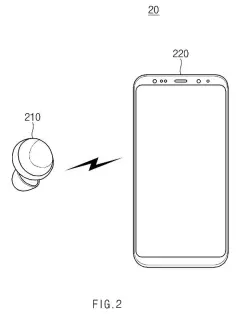
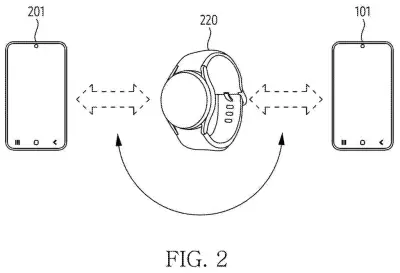
Samsung's approach works like a doorman checking a guest list. When your wearable (earbuds, a smartwatch, a fitness band) picks up a Bluetooth signal from a new phone, it checks whether that phone is logged into the same Samsung account as the old one. If the accounts match, the wearable skips the factory reset entirely and connects in what the patent calls a "transfer mode." Your settings stay intact.
If the accounts don't match, meaning a genuinely different person is trying to pair with your device, the wearable does the full reset it would do today. So you get a smooth handoff when it's your own phone, and proper security when it isn't.
… based on the first identification information corresponding to the second identification information, communicating with the second electronic device without performing the factory reset of the wearable device.
Translation: Earbuds connect to a new device without wiping data if the user accounts match.
How the user-account check skips the factory reset
The patent describes a two-device handshake built on Bluetooth Low Energy (BLE), the low-power wireless standard that most wireless earbuds and smartwatches already use to broadcast their presence.
Here's the sequence the patent lays out:
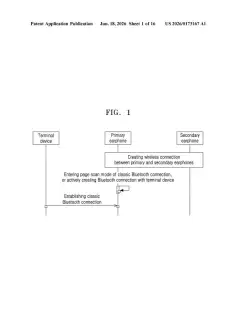
- The wearable broadcasts a BLE advertising signal after its old phone connection is dropped.
- A new phone picks up that signal and responds with user identification information tied to the account logged into that phone.
- The wearable compares that account ID against the account ID of the phone it was previously paired with.
- If the IDs match, the wearable enters a "transfer mode" and hands the new phone its own identification data so setup can continue without a wipe.
- If they don't match, a factory reset runs before pairing proceeds.
The key technical claim is that "transfer mode" bypasses the reset that normally happens when a wearable detects an unfamiliar host device. The wearable's stored settings, calibration data, and preferences stay in memory because the identity check gives the firmware enough confidence to skip the wipe step.
The system also specifies that the new phone sends a formal request message asking the wearable to enter transfer mode, and the wearable replies with a response message containing its own identification data. That back-and-forth is what drives the subsequent setup procedure on the phone side.
… transmit, to the wearable device through the wireless communication circuitry, a request message for changing a mode of the wearable device to a transfer mode for connecting the electronic device to the wearable device without a reset of the wearable device …
Translation: The phone asks the earbuds to enter a special transfer mode to avoid resetting.
What this means for Galaxy wearable owners
For everyday Galaxy users, this would mean getting a new phone and having your earbuds or smartwatch reconnect automatically, without losing EQ settings, touch controls, fit data, or any other personalization you've built up. That's a meaningful quality-of-life fix. The current experience of re-pairing wearables is one of those friction points that makes upgrading a phone feel like more work than it should be.
The deeper engineering point is that this patent draws a clean line between "same owner, new device" and "completely new owner," using account-level identity rather than just hardware addresses. That distinction matters for privacy too: a wearable that resets only when necessary is also a wearable that's harder to accidentally pair with someone else's account. Samsung's wireless connectivity patents sit alongside a steady stream of new Big Tech patents covering account-aware device pairing, a category that's growing as people own more devices that need to move between phones.
This is the 192nd Samsung filing in our cell phone patent coverage we've tracked since May, joining applications like one on killing rainbow patterns on folding screens and one on a spring-loaded gear hinge.
Source: US 2026/0255416 A1 at the USPTO (PDF). Full patent text and figures are in the official publication.
Get our take in your Top Stories
Liked this breakdown? Add Patentlyze as a preferred source on Google, and our plain-English take shows up more often in your Top Stories the next time Samsung patent news breaks.
Add Patentlyze on Google
One click.
There are more where this came from
We read the new patents from Big Tech, carmakers and more and send you the ones worth knowing. Plain English, free, every week.
The drawings · 16 sheets
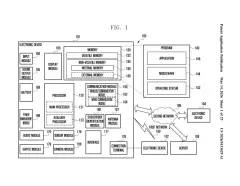
16 drawing sheets from US 2026/0255416 A1 · click any drawing to enlarge


Show the other 8 sheets


More from Samsung
All 1,662 Samsung patents →
More in Cell phone
All 496 Cell phone patents →
Google
Google Patents a Way to Keep Both Earbuds in Sync on a Single Audio Stream
Samsung
Samsung Patents Earbuds That Can Record Two Different Users Separately
Samsung
Samsung Patents a No-Reset Method for Switching Wearables Between Phones
Samsung