
Samsung Files Patent for Paying at the Register With Your Phone, No Tap Needed
Samsung has filed a patent for a checkout where the register announces itself to your phone as you approach, using the same radio signals that measure distance. The store's identity and payment details ride inside that first message.
What Samsung's UWB checkout handshake does
You're walking up to a checkout counter with your phone still in your pocket. The register sends out a short radio signal, and your phone picks it up, learns which store this is, and sees which payment methods the terminal accepts.
Samsung's patent is about the language those two devices speak. It uses ultra-wide band (UWB), a radio technology that can tell how far apart two devices are. The terminal's opening message carries a store identifier and payment information. Your phone answers, gets a closing message back, and then sends a report.
The filing also describes a moment where the clerk picks your device on their screen, and your phone can accept or reject that connection. Nothing gets paid until you agree.
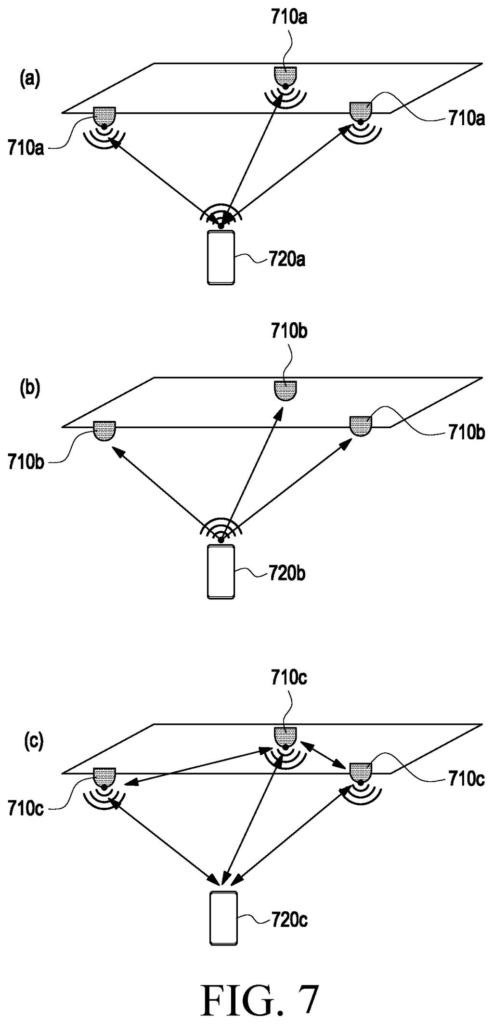
… performing DL-TDoA-based localization on the basis of the first UWB message, the second UWB messages, and the third UWB message.
Translation: The system calculates your exact physical location inside the store using radio wave arrival times.
How the terminal and phone swap messages
The claims cover a simple four-step exchange between a customer's device and a merchant's device, both using UWB (a short-range radio that measures distance by timing signals). The merchant device sends an initiation message to start a ranging procedure (the distance-measuring routine). The customer device sends back response messages. The merchant then sends a final message, and the customer device sends a report message in return.
The key detail is what the first message carries. It is formatted as a tag length value (TLV) message, a labeled-box format where each piece of data says what it is and how long it is. Inside are an identifier for the merchant, defined by a payment service provider, and payment-related information.
That payment information can include:
- A list of supported payment protocols (the rulebooks for completing a payment)
- A request to connect, sent when a clerk selects your device
- Space for proprietary or future uses
Your device's replies can include your own identifier, an accept or reject answer to the connection request, the payment protocols it supports, and shipping information used to fill out a bill or receipt. The description adds that the abstract's positioning method (working out where your phone is from signals sent between fixed terminals) can run in the same round. The claims are written for both the phone side and the terminal side.
Why Samsung's UWB payments filing matters
If this works as described, paying could start before you reach the counter. Your phone would already know which store it is dealing with and which payment methods both sides support, so the final step is a confirmation rather than a hunt for the right app.
The patent application has been approved by the patent office, and once Samsung pays the final fee it should be issued as a granted patent. It is not issued yet. Samsung has not announced a product built on this, and the filing describes a general approach that any UWB-capable phone and payment terminal could follow.
One more thing to know: the patent office has already approved this application. Once Samsung pays the final fee, it should be issued as a granted patent, and the final claims may read a little differently from the version described here.
Samsung's 1433rd filing in our Samsung coverage since May adds to a location-tracking thread that includes 3D cell network positioning and self-checking indoor location.
The first message your phone sends is readable by anyone nearby with the right receiver, exposing which store you are in and what payment methods you carry. That is a deliberate tradeoff: keep the opening handshake light and fast, protect the card number in a later encrypted step. The cost is low enough that the trade reads as sensible.
The harder cost is the clerk choosing your phone from a list before anything charges. That human step prevents your phone from accidentally paying the wrong register in a crowded store, which is a real problem worth solving, but it also punctures the promise of checkout that simply happens as you walk past.
None of it matters at scale without stores buying and installing new hardware first, and that is where designs like this have historically stalled.
Get our take in your Top Stories
Liked this breakdown? Add Patentlyze as a preferred source on Google, and our plain-English take shows up more often in your Top Stories the next time Samsung patent news breaks.
There are more where this came from
We read every patent application Big Tech publishes and send you the ones worth knowing. Plain English, free, every week.
The drawings
31 drawing sheets from US 2026/0323565 A1 · click any drawing to enlarge


Show the other 23 sheets


Want this weekly breakdown for a company we don't cover? Patentlyze Pro →
Be the first to weigh in