
Samsung Files Patent for Indoor Location Finding That Checks Its Own Work
Your phone can estimate which radio signals were probably blocked on the way to it, yet picking only the clearest ones can still lead it astray. Samsung's patent adds a sanity check: does the answer land inside the zone the beacons surround?
What Samsung's indoor location check does
Finding yourself indoors with radio beacons has a catch: when a signal bounces around or gets blocked on its way to your phone, the timing looks off, and a few bad timings add up to a wrong spot. A hand or a pocket in the way can be enough to cause it. Samsung's filing describes a way for your phone to catch that before it settles on an answer.
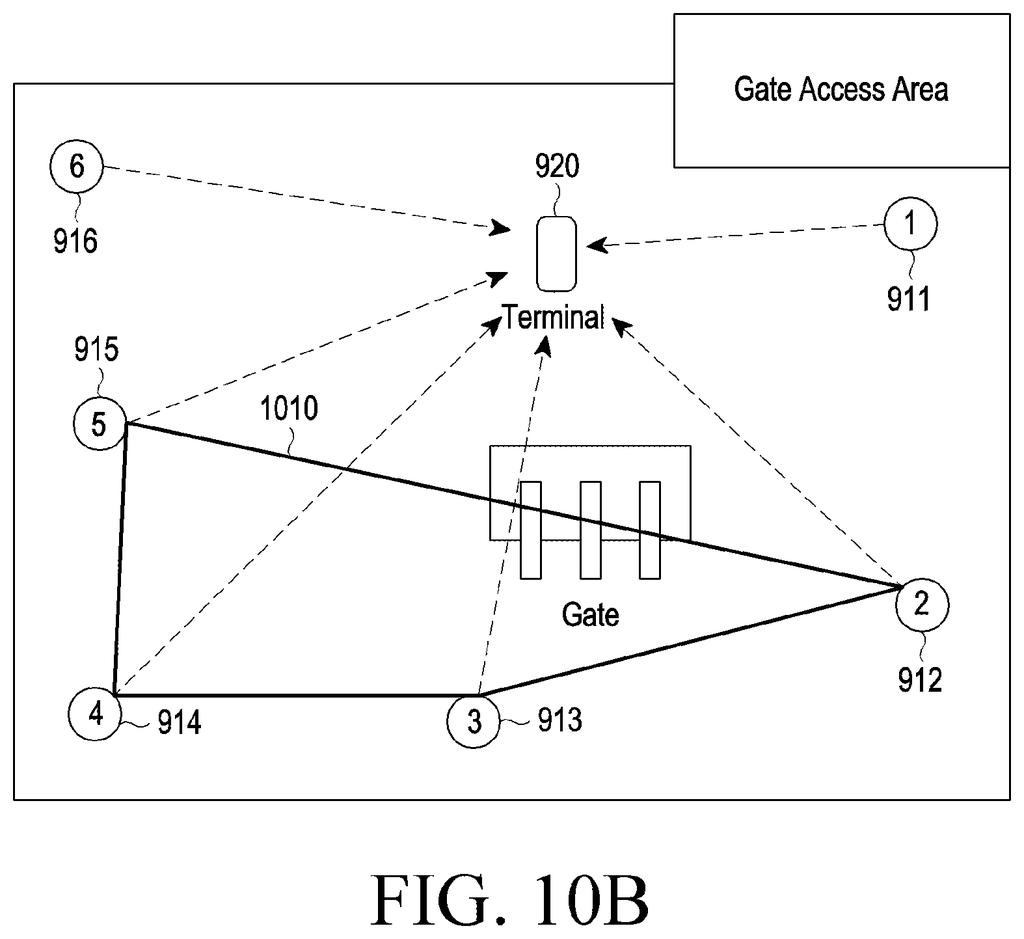
First, the phone rates each beacon signal on how likely it is to have traveled a clear, direct path. It works out your position from the four best-rated ones. Then comes the sanity check: does that position fall inside the area those four beacons surround? If so, that's your answer.
If not, the phone adjusts, adding the next-best signal or swapping out the weakest, and tries again. The reasoning is that the clearest signals often come from beacons in front of you, which can skew the result. The area check is there to catch exactly that.
… determining whether the obtained location is within an area of a cluster configured with UWB anchors which transmit the identified UWB signals; and in case that the obtained location is within the area of the cluster, determining the obtained location as a final location of the electronic device …
Translation: The device checks if its calculated position actually makes sense inside the network area before accepting it.
How the phone picks which signals to trust
The method starts with ultra-wideband (UWB), a short-range radio technology good at measuring distance and timing. Fixed beacons called anchors, mounted on walls or ceilings, send timed messages to one another. Your phone listens in and compares when each message arrives, a technique called downlink time difference of arrival (DL-TDoA), to work out where it is.
Before doing that math, the phone rates every signal with a trained convolutional neural network (an AI model that is good at spotting patterns). The model reads the shape of the signal's echo pattern, called the channel impulse response, and outputs a line-of-sight probability: how likely the signal took a clear path. The claims then run these steps:
- Pick a preset number of the best-rated signals (four, in the claimed example).
- Calculate the phone's position from them.
- Check whether that position sits inside the cluster, the area covered by the anchors that sent those signals.
- If it does, keep it as the final location.
If the position lands outside the cluster, the filing describes fallbacks. The phone can add the next-best signal, or add it and drop the weakest of the original four. It can also score every four-anchor combination by its average rating and try the best one, then the next best. In the filing's example, six anchors near a gate score from 0.21 to 0.94. Which fallback to use can depend on how many anchors the phone can hear.
identifying, on the basis of a line of sight (LOS) probability for multiple received UWB signals, a preconfigured number of UWB signals from the multiple received UWB signals; obtaining the location of the electronic device by using the identified UWB signals …
Translation: It filters out blocked signals and picks the clearest ones to calculate where you are indoors.
Why gates, car keys and checkouts care
Indoor positioning only helps if it is right at the moment it matters. The filing names a tagless gate, a digital car key and a point-of-service app as places the approach could be used, all cases where a phone that misjudges where you stand causes real annoyance. Samsung says the method may raise location accuracy, though the text gives no final-location error figures.
The description also reports test numbers for the signal-rating step alone. Smoothing the model's guesses over several readings raised its accuracy in hand and pocket tests, for example from 78.8% to 92.0% with the phone in a front pocket. That smoothing is described as an add-on rather than the core of the claims.
Samsung's 1431st filing we've tracked since May in our Samsung coverage adds to a run that includes a rollable screen lubricant seal and a dual-spring foldable hinge.
The design buys reliability by spending extra computation. Rating every signal with a neural network, then redoing the position math when the first answer looks off, costs time and battery. The try-every-combination option gets heavier as more anchors come into range, and the filing itself says so, suggesting the faster fallback when many anchors are in range.
The check itself is blunt. It only asks whether your estimated position sits inside the zone the anchors surround, so a wrong answer that happens to land inside the zone passes without a second look. Everything also hangs on the AI model's ratings: if it mistakes a blocked signal for a clear one, the safety net is built on bad input.
A few extra calculations are cheap next to a gate or checkout that misreads where you stand. For those uses the trade reads as a sensible one, though the filing offers no final-location accuracy numbers to prove it.
Get our take in your Top Stories
Liked this breakdown? Add Patentlyze as a preferred source on Google, and our plain-English take shows up more often in your Top Stories the next time Samsung patent news breaks.
There are more where this came from
We read every patent application Big Tech publishes and send you the ones worth knowing. Plain English, free, every week.
The drawings
25 drawing sheets from US 2026/0323572 A1 · click any drawing to enlarge


Show the other 17 sheets


Want this weekly breakdown for a company we don't cover? Patentlyze Pro →
Be the first to weigh in