
Samsung Patents a Robot Hand That Adjusts Its Grip Based on What It's Holding
A robot that knows how to pick something up is useful. A robot that also knows how to set it down correctly is far more useful, and that's the gap Samsung's new patent is trying to close.
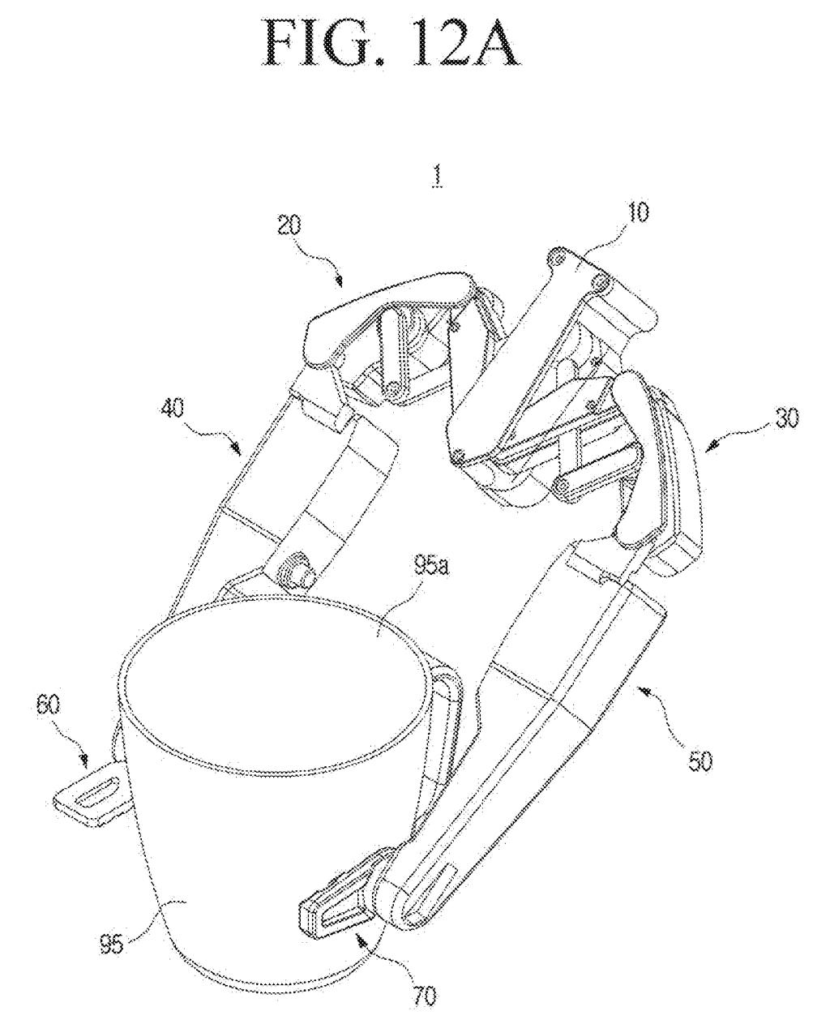
How Samsung's robot hand figures out what it's holding
Most robot arms today are programmed to grab things in one fixed way, which works fine on an assembly line where every part arrives in the same position. The moment something shows up at an angle or in an unexpected orientation, the robot gets confused or drops it.
Samsung's patent describes a robot hand with two grippers that first looks at an object through a camera, figures out its shape and which way it's facing, and then physically adjusts how it will grab it. Once it has the object, it can rotate its own grip so that the object ends up in exactly the right orientation when it's set down at its destination.
The result is a robot that doesn't just pick things up; it delivers them correctly. That matters a lot in warehouses, factories, or any setting where precise placement is as important as the grab itself.
recognizing a type, a shape or an orientation of an object; changing, based on the recognized type of the object, the recognized shape of the object or the recognized orientation of the object, a grasping orientation of the first gripper and the second gripper; …
Translation: The robot figures out what the object is like and adjusts how its fingers will grab it.
How the gripper reads shape, then re-orients for placement
The system centers on two coordinated grippers attached to a robot hand. A camera scans the target object and identifies its type, shape, and orientation (basically: what is it, what does it look like, and which way is it facing right now).
Based on that scan, the grippers adjust their angle before making contact. This is called changing the grasping orientation, which means the hand approaches from a direction that gives it the most secure hold for that specific object shape. A cylindrical bottle and a flat circuit board, for example, would each trigger a different grip angle.
After the object is picked up, the system identifies the target position where the object needs to land. It then compares the object's current orientation to what that destination requires, and rotates the grippers to correct the difference before setting it down.
The key claim is that both the approach angle and the release angle are calculated from live camera data, not pre-programmed positions. That makes the system adaptive rather than brittle, though how well it handles ambiguous or irregular shapes depends heavily on the underlying computer-vision quality.
… rotating the first gripper and the second gripper to change an orientation of the object according to a target position for the object to be seated.
Translation: The hand twists the item into the correct position before setting it down.
What this means for factory robots and home automation
For factory and warehouse automation, the ability to handle objects that weren't perfectly staged is one of the biggest unsolved problems. Most industrial robots require parts to arrive in a known position, which means humans or other machines spend time doing that staging work. A gripper that reads and compensates for orientation on the fly could cut that overhead significantly, and it's why companies from logistics giants to appliance makers are racing toward more adaptive robotic hands.
Samsung is a major manufacturer of consumer electronics, home appliances, and semiconductor equipment, all of which involve precision assembly. This patent fits that context, suggesting the company is building toward robots that could handle its own production lines or, eventually, domestic tasks, and it joins a growing stream of new Big Tech patents in robotics manipulation that treat object recognition and physical control as a single integrated problem rather than two separate steps.
The core design trade here is between flexibility and reliability. Relying on real-time camera recognition to determine grip angle means the system is only as good as its vision model. A poorly lit object, an unusual material finish that confuses the camera, or an object type the model hasn't seen before could all produce a bad grip decision, and a bad grip decision downstream of a camera failure is harder to debug than a bad grip from a fixed program. That cost is real. The trade reads as worth it for environments with moderate object variety, but the patent makes no claims about how the recognition layer handles edge cases, which is where this kind of system tends to break in practice.
There are more where this came from
We read every patent application Big Tech publishes and send you the ones worth knowing. Plain English, free, every week.
The drawings
26 drawing sheets from US 2026/0233411 A1 · click any drawing to enlarge


Want this weekly breakdown for a company we don't cover? Patentlyze Pro →
Be the first to weigh in