
Sony
Sony · Display · Filed Sep 8, 2025 · USPTO published Aug 27, 2026 · Aug 27 release
Sony Patents a Guide That Pinpoints Exactly What Is Draining Your Battery
Sony is patenting a step-by-step on-screen guide that tells you exactly which app or habit is hurting your phone battery, why it's harmful, and what to change to fix it.
- Publication number
- US 2026/0253272 A1(US20260253272A1)
- Applicant
- Sony Group Corporation
- Filed · Published
- Sep 8, 2025 · Aug 27, 2026
- Inventors
- Kimitaka BENISE, Kuniharu SUZUKI, Go TANAKA, Hikaru FURUKAWA, Hidetoshi AKASAWA, Tatsuya FURUYA, Pohsiang CHEN, Yuki FUJIMOTO
- Status when we published
- Waiting for an examiner
- Document
- 10 claims
- US classification
- 345/440
- Parent application
- National Stage Entry of PCT/JP2024/009484 (filed Mar 12, 2024)(PCTJP2024009484)
What Sony's battery-damage explainer actually shows you
Imagine your phone pops up a screen saying "streaming video for six hours yesterday damaged your battery." You tap it, and a second screen explains the specific reason why that activity causes wear. Tap again, and a third screen offers a concrete settings change to reduce the damage going forward.
That's the system Sony has filed a patent for. Instead of burying battery health information in a settings menu most people never find, the phone surfaces the problem, explains it in plain terms, and then hands you a fix, all in three taps.
Battery degradation is one of those things that happens slowly and invisibly until your phone suddenly won't make it through the day. Sony's idea here is to make the process transparent, so you understand what's wearing out your battery before it's too late to change your habits.
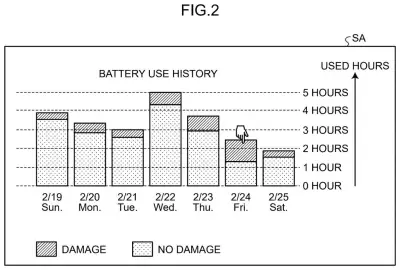
… the processor causes the display unit to display a first display indicating a use having caused damage to the battery, causes the display unit to display a second display indicating a cause of the damage given to the battery, when the first display is selected …
Translation: The device identifies specific activities that are harming your battery and explains why they are causing that damage.
How Sony's three-screen battery coaching flow works
The patent describes a mobile device with a processor that drives three sequential screens, each triggered by the previous one being tapped.
- First display: Shows a specific use or behavior that has caused measurable damage to the battery. Think of this as the "what happened" screen.
- Second display: Appears when the first screen is selected, and explains the cause of that damage. For example, it might explain that charging to 100 percent regularly degrades battery chemistry over time.
- Third display: Appears when the second screen is selected, and presents a concrete setting change the user can make to reduce future damage, such as enabling a charge limit or lowering screen brightness.
The chain is intentionally sequential: you can't jump to the fix without first seeing the problem and the explanation. This structured flow is designed to make sure users understand why a change matters, not just that they should make it.
The patent is broad enough to cover any type of battery-harming behavior the device can track, so the system could theoretically flag charging habits, app usage patterns, temperature exposure, or other factors depending on what the phone monitors.
… causes the display unit to display a third display indicating a proposal of a setting for reducing the damage given to the battery, when the second display is selected.
Translation: Once you see the cause of the problem, the phone suggests specific settings changes to help your battery last longer.
What this means for phone battery life frustration
Battery degradation is the single most common reason people feel their phone has "gotten worse" over time. Most people have no idea which habits are responsible or that small changes, like not charging overnight, can meaningfully extend a battery's life. A system that proactively names the problem and hands you a fix at the moment it's relevant could genuinely shift user behavior in a way that burying the same advice in a settings menu never has.
Sony is not the only company thinking about this space, but this filing takes a more structured, tutorial-style approach than the basic battery health percentage screens most phones show today. For anyone following how phone makers are trying to extend device longevity through software rather than hardware, this sits alongside other battery and device-care patents covered in plain-English patent summaries that track where companies like Sony are placing their bets.
This is the 73rd Sony filing we've tracked in our Display coverage since May, adding to work like one fixing screen errors mid-shoot and one streaming select pixel data.
Source: US 2026/0253272 A1 at the USPTO (PDF). Full patent text and figures are in the official publication.
Get our take in your Top Stories
Liked this breakdown? Add Patentlyze as a preferred source on Google, and our plain-English take shows up more often in your Top Stories the next time Sony patent news breaks.
Add Patentlyze on Google
One click.
There are more where this came from
We read the new patents from Big Tech, carmakers and more and send you the ones worth knowing. Plain English, free, every week.
The drawings · 6 sheets
6 drawing sheets from US 2026/0253272 A1 · click any drawing to enlarge


More from Sony
All 722 Sony patents →
More in Cell phone
All 496 Cell phone patents →
Samsung
Samsung Patents a Flexible Screen Support That Prevents Cracking Along the Fold
Qualcomm
Qualcomm Patents a Screen That Moves Buttons Out of the Way When You Fold It
Samsung
Samsung Patents a Folded Zoom Camera Design That Captures Sharper Distant Shots
Samsung