
Samsung
Samsung · Energy · Filed Dec 12, 2025 · USPTO published Oct 1, 2026 · Oct 1 release
Samsung Patents a System That Picks Which Battery Powers Your Device
Most devices treat all their batteries as one. Samsung is filing patents for hardware that reads each battery's condition individually and routes power through whichever one is best suited for the moment.
- Publication number
- US 2026/0296261 A1(US20260296261A1)
- Applicant
- SAMSUNG ELECTRONICS CO., LTD.
- Filed · Published
- Dec 12, 2025 · Oct 1, 2026
- Inventors
- JINYONG JEON
- Status when we published
- Waiting for an examiner
- Document
- 20 claims
- US classification
- 307/9.1
What Samsung's multi-battery routing actually does
Today, when a device has more than one battery, it typically treats them as a single pool of energy, drawing from them in a fixed or simple alternating pattern with no real awareness of which cell is healthiest or most efficient right now. Samsung wants to change that.
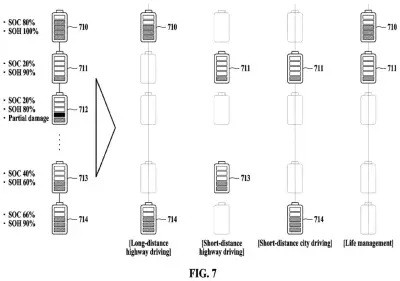
This patent describes a device that monitors each battery separately, checking things like charge level and condition, then decides which battery or combination of batteries should be active based on what the device needs at that moment. The selection isn't random: the system uses that real-time status data alongside information about the current power demand to make a deliberate choice.
The result is that your device wouldn't just drain batteries in order. It would route power intelligently, potentially keeping you going longer between charges or reducing wear on any single cell.
determining state information of each of a plurality of batteries based on sensing data associated with each of the plurality of batteries …
Translation: The device checks the health and charge levels of all its internal batteries using sensors.
How the device reads each battery and picks a target
The patent covers a method with four main steps:
- Sense each battery individually: The device collects sensing data from every battery in the system, reading things like voltage, temperature, and charge level for each one separately.
- Determine state information: It processes that raw data into a meaningful status for each battery, essentially answering 'how healthy and available is this cell right now?'
- Obtain power demand information: The system also reads what the device currently needs: how much power, for what kind of load, and under what conditions.
- Select and configure: Using both the battery states and the demand information together, it picks one or more 'target batteries' and physically configures the power source around that selection.
The phrase 'configuring the power source' is key. This isn't just software telling the device which battery to prefer; it implies the hardware can actually reconfigure which cells are connected and how, which is why the patent title mentions 'reconfiguration of battery connection.'
The abstract is intentionally broad, which is standard for a claim meant to cover the method at a high level. The specific sensing hardware, decision logic, and switching circuitry would live in the dependent claims and figures.
… selects at least one target battery from among the batteries based on each of the determined state information and the obtained information …
Translation: It chooses the best battery to use right now by looking at sensor data and power needs.
What this means for multi-battery phones and gadgets
For consumers, the promise is straightforward: a device that actively manages multiple batteries could last longer and age more gracefully. If one cell is warmer or more depleted, the system skips it rather than stressing it further, which can extend the overall lifespan of the battery pack.
This is especially relevant as foldable phones, tablets with dual-cell packs, and wearables with auxiliary batteries become more common. Samsung makes all of those categories. A patent like this, if it reaches production hardware, would give their power management a more active role than the passive cell-balancing circuits most devices use today.
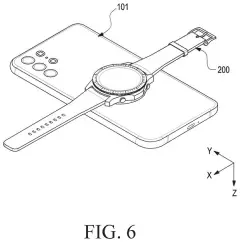
Samsung's 41st filing in the battery and power work we've tracked since May adds to a run that includes a wireless charge-and-share system and robots guided to their charger.
Source: US 2026/0296261 A1 at the USPTO (PDF). Full patent text and figures are in the official publication.
Get our take in your Top Stories
Liked this breakdown? Add Patentlyze as a preferred source on Google, and our plain-English take shows up more often in your Top Stories the next time Samsung patent news breaks.
Add Patentlyze on Google
One click.
There are more where this came from
We read the new patents from Big Tech, carmakers and more and send you the ones worth knowing. Plain English, free, every week.
The drawings · 9 sheets
9 drawing sheets from US 2026/0296261 A1 · click any drawing to enlarge


Show sheet 9

More from Samsung
All 1,662 Samsung patents →
More in Energy
All 147 Energy patents →
IBM
IBM's New Patent Covers Keeping Human-Shaped Work Robots Charged Through the Floor
Intel
Intel Patents a Physical Key System That Stops You Installing the Wrong Laptop Battery
Apple
Apple Patents a Fix for the Garbled Data Hidden Inside Wireless Charging
Apple
No comments yet