
Intel Patents a Physical Key System That Stops You Installing the Wrong Laptop Battery
Intel has filed a patent for a battery pack with a shaped exterior that physically prevents the wrong battery from sliding in, the same way a house key can't fit the wrong lock. The goal is to make laptop batteries user-replaceable without the risk of installing an incompatible cell chemistry.
What Intel's battery 'key' actually does for you
Every time a laptop battery dies for good, the owner faces the same dilemma: pay a repair shop, ship it back to the manufacturer, or risk buying an aftermarket battery that might not match the device. That mismatch isn't just inconvenient; the wrong battery chemistry can cause overheating or damage.
Intel's patent describes a simple mechanical solution. The outside of the battery pack has raised ridges or grooves in a specific pattern. The slot inside the laptop has the matching inverse pattern. If the shapes don't fit together, the battery won't slide in at all. The pattern itself encodes what kind of battery chemistry is inside, so a lithium-iron-phosphate pack can't accidentally be dropped into a slot designed for a different chemistry.
Think of it like the notch on a SIM card tray: a small physical detail that makes it impossible to install something the wrong way. The idea applies to the flat, pouch-style batteries common in thin laptops as well as the cylindrical cells found in older designs.
… at least one key structure, including at least one of a recess or a protrusion, wherein the at least one key structure is attached to the outer surface and has a dimension which is coded to a characteristic of the battery package.
Translation: The battery features physical bumps or grooves sized specifically to match its power rating.
How the protrusions and recesses lock in the right chemistry
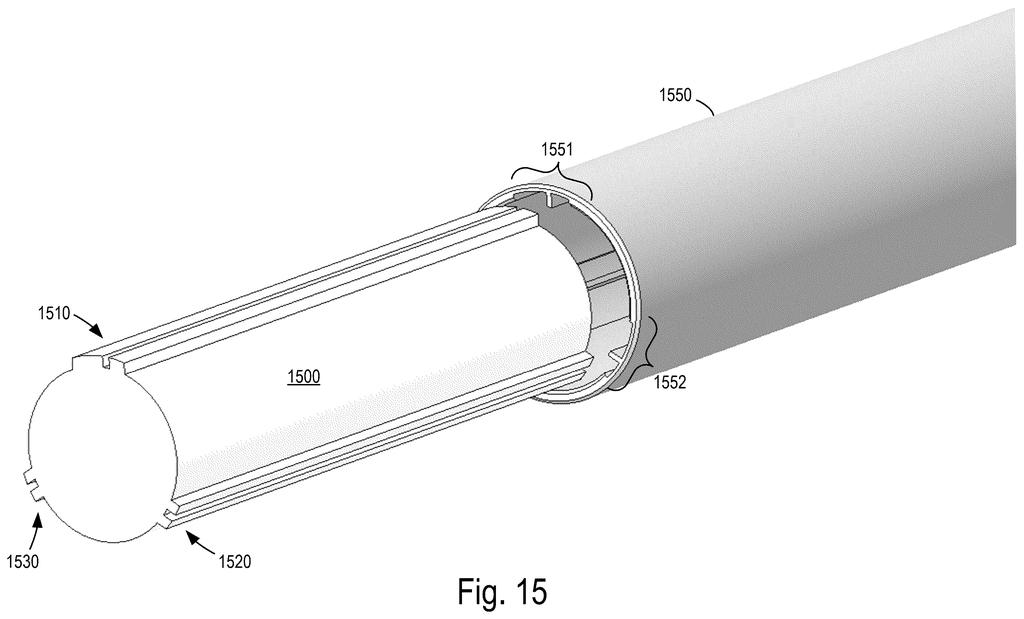
The patent describes a battery package with an outer surface that carries at least one key structure, which is a raised protrusion, a recessed groove, or a combination of both. These shapes run along the length of the battery pack and are made from a rigid material (like plastic) attached to what is otherwise a soft, flexible outer shell (often an aluminum-plastic laminate or Mylar film).
The battery container inside the laptop has inverse key structures that mirror the battery's shapes. Only a battery whose key pattern matches the container's inverse pattern can physically seat itself. The shape of the key encodes specific characteristics of the battery, primarily its cell chemistry (for example, lithium-ion versus lithium-iron-phosphate), but potentially other parameters like capacity or voltage range.
The system is designed to work with two main battery form factors:
- Pouch or prismatic cells: flat, flexible batteries common in slim laptops, where the key structures are added to a rigid rectangular frame around the pack
- Cylindrical cells: round cells where the key structures are added to the exterior surface of the cylinder
No electronics, no firmware, no authentication chip. The compatibility check is purely mechanical, which keeps the system simple and low-cost.
The key structures match corresponding inverse key structures in a battery container so that only a compatible battery can be installed in the container.
Translation: The physical shapes lock into place only when the correct battery is inserted into the laptop.
What this means for laptop repairability
For everyday users, this patent is about right-to-repair in a very tangible sense. If a laptop's battery slot physically accepts only the correct chemistry, manufacturers could allow end users to swap batteries themselves without lengthy warnings about compatibility. You wouldn't need a technician to verify you have the right part.
For device makers, it removes one of the standard arguments against user-replaceable batteries: that untrained users might install dangerous substitutes. A keyed slot makes that physically impossible. Intel keeps filing on laptop hardware modularity, and this patent fits a broader moment when repairability legislation in the US and Europe is putting pressure on the whole PC industry to open up access to components.
Intel's second filing in battery and power we've tracked since August follows one on EVs and grid charging.
Claim 1 covers any battery pack with a physical shape on its outer surface that signals what kind of battery is inside. That is a wide net: any bump, groove, or ridge whose size or form is tied to battery chemistry or specs would fall under it.
If granted, that scope gives Intel a stake in how any laptop battery and its matching slot are designed to fit together. A maker who wants to build a compatible replacement pack would need to work around this claim or seek a license.
The claim's real weight is in the phrase "coded to a characteristic." That language ties the physical key to the battery's identity, which is the core of the invention. How the patent office reads that phrase will determine whether this claim stands wide or gets narrowed down to Intel's specific design.
There are more where this came from
We read every patent application Big Tech publishes and send you the ones worth knowing. Plain English, free, every week.
The drawings
13 drawing sheets from US 2026/0291039 A1 · click any drawing to enlarge


Want this weekly breakdown for a company we don't cover? Patentlyze Pro →
Be the first to weigh in