
Samsung Patents a System That Carries What You Did in VR Over to Your Real Devices
Spend time in a virtual meeting or digital storefront, get interested in something there, and then step back into the real world with no way to pick up where you left off. Samsung is patenting a fix for exactly that handoff.
What Samsung's virtual-to-real context transfer actually does
Imagine you're inside a virtual meeting room and a colleague pulls up a 3D model of a product you want to explore further. The session ends, you pull off the headset, and that moment of interest just evaporates.
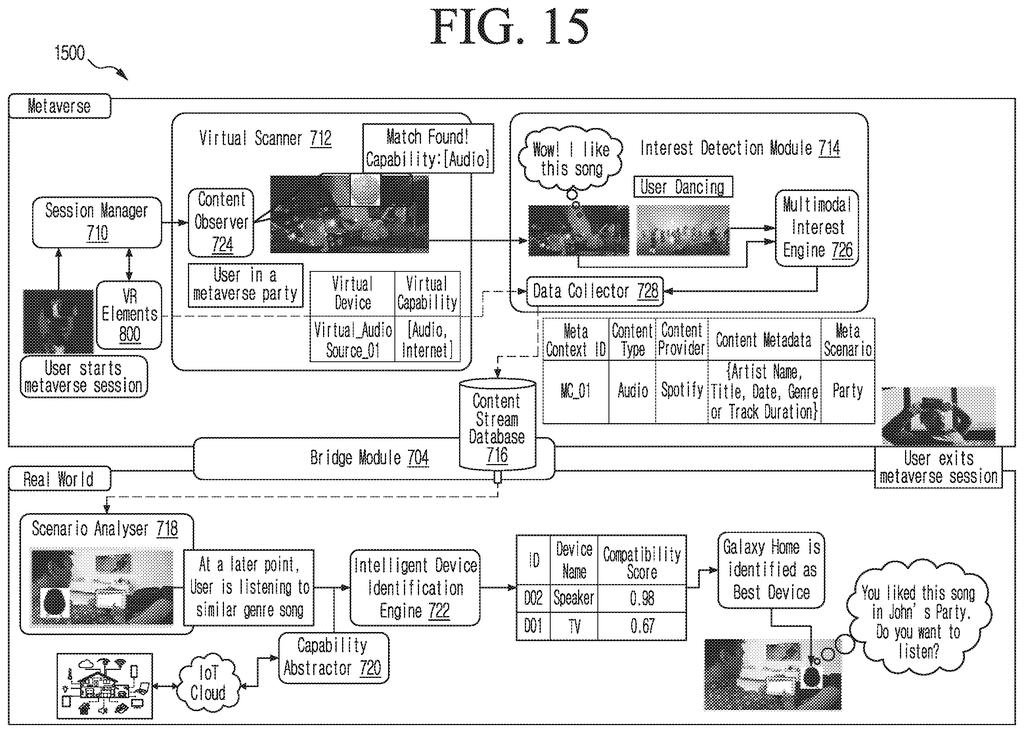
Samsung's patent describes a system that watches for what catches your attention inside a virtual space and then figures out which of your real devices is best suited to continue with it. If you lingered on a video, maybe your phone gets the clip. If you were studying a document, maybe your laptop receives it. The system reads your behavior as a signal, cross-references it against what your actual devices can do, and hands the content off automatically.
The key word is context. It isn't just moving a file; it's moving the relevant state of what you were doing, matched to the right screen or speaker or surface. Think of it as a smart relay between a virtual room and your real one.
obtaining a context of a virtual content present in the virtual environment; obtaining user interest information related with the virtual content based on a user input of a user in the virtual environment; …
Translation: The system figures out what you are looking at and what you care about inside the virtual world.
How the system matches virtual content to a real device
The patent describes a four-step process that runs each time a user is detected inside a virtual environment:
- Context capture: The system identifies what virtual content is present and what the user is paying attention to. That content could be a document, a 3D object, a video stream, or any other virtual asset.
- Interest detection: Based on user inputs inside the virtual environment (gestures, gaze, selections, or explicit actions), the system infers what the user is actually interested in, not just what is visible.
- Capability correlation: The system holds a profile of the user's real-world devices and what each one can do. It then generates correlation information, essentially a compatibility score between the inferred interest and each device's capabilities.
- Target device selection: The device that scores best for the given context is identified as the handoff destination, and the context of the virtual content is transferred there.
The claim is written broadly enough to cover any virtual environment, whether that is an augmented reality overlay, a fully immersive headset session, or a virtual desktop. The phrase "meta-context transfer" in the title signals that the system is moving more than raw data; it is carrying the interpretive layer (what the content means in relation to what the user was doing) alongside the content itself.
… obtaining correlation information between the at least one user interest and at least one content capability of a plurality of real world user devices of the at least one user; …
Translation: It matches your virtual interests with the capabilities of your actual physical devices.
What this means for Samsung's mixed-reality ambitions
For anyone who uses Samsung's Galaxy ecosystem across a phone, tablet, laptop, and potentially a future headset, this describes an automatic layer of continuity that doesn't require you to manually AirDrop, email yourself, or remember a URL. The system would handle the handoff for you, choosing the device without you having to think about it.
The broader bet here is that virtual environments are becoming a real part of work and shopping, not just gaming, and the moment you leave them is currently a hard break. A system that softens that break could make extended-reality sessions feel less like side trips and more like a natural extension of your existing device setup. Samsung's interest in cross-device continuity shows up repeatedly across its ecosystem software, and this patent pushes that idea one step further into immersive spaces.
Samsung's 22nd filing we've tracked since June in the AI assistants that remember you watchlist builds on one on detecting new topics and one on call summaries by relationship.
The design trade in this patent is clear: the system is making a judgment call about which device you want, based on behavior signals inside a virtual space. That inference step is where things could go wrong. Gaze and gesture data are noisy proxies for intent, and a system that confidently sends your half-formed browsing to the wrong screen is worse than one that does nothing at all.
The patent doesn't specify how the system handles ambiguity or lets you correct a bad guess, which is a real gap. If the confidence threshold is too low, the handoff fires constantly and becomes noise. If it's too high, the feature rarely triggers and users stop trusting it.
Still, the underlying problem being solved is real and underserved. The cost of getting the inference wrong is low (a file shows up on the wrong device), and the benefit of getting it right repeatedly is that XR sessions start to feel genuinely connected to the rest of your digital life. That trade reads as worth attempting, even if the execution will need careful calibration.
There are more where this came from
We read every patent application Big Tech publishes and send you the ones worth knowing. Plain English, free, every week.
The drawings
22 drawing sheets from US 2026/0277309 A1 · click any drawing to enlarge


Want this weekly breakdown for a company we don't cover? Patentlyze Pro →